The cyclical cascade of HIV care: Temporal care engagement trends within a population-wide cohort
- PMID: 38728361
- PMCID: PMC11125544
- DOI: 10.1371/journal.pmed.1004407
The cyclical cascade of HIV care: Temporal care engagement trends within a population-wide cohort
Abstract
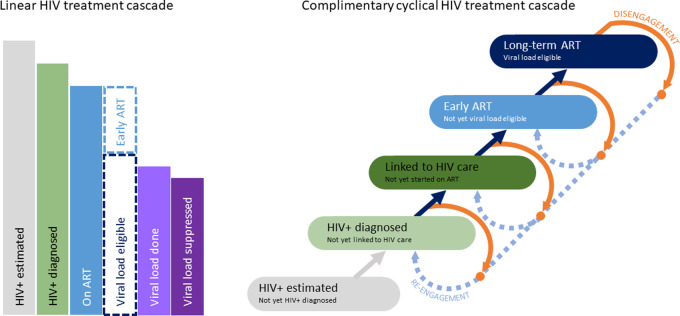
Background: The traditional HIV treatment cascade aims to visualise the journey of each person living with HIV from diagnosis, through initiation on antiretroviral therapy (ART) to treatment success, represented by virological suppression. This representation has been a pivotal tool in highlighting and quantifying sequential gaps along the care continuum. There is longstanding recognition, however, that this may oversimplify the complexity of real-world engagement with HIV services in settings with mature high-burden HIV epidemics. A complementary "cyclical" cascade has been proposed to represent the processes of disengagement at different points on the care continuum, with multiple pathways to re-engagement, although the feasibility of implementing this at scale has been uncertain. This study aimed to populate, refine, and explore the utility of a cyclical representation of the HIV cascade, using routine data from a high-burden HIV setting.
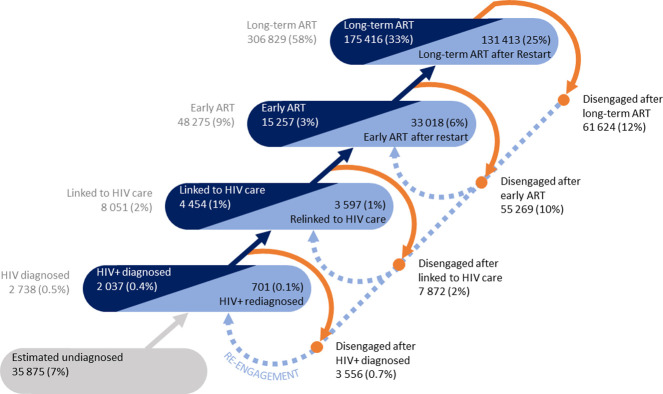
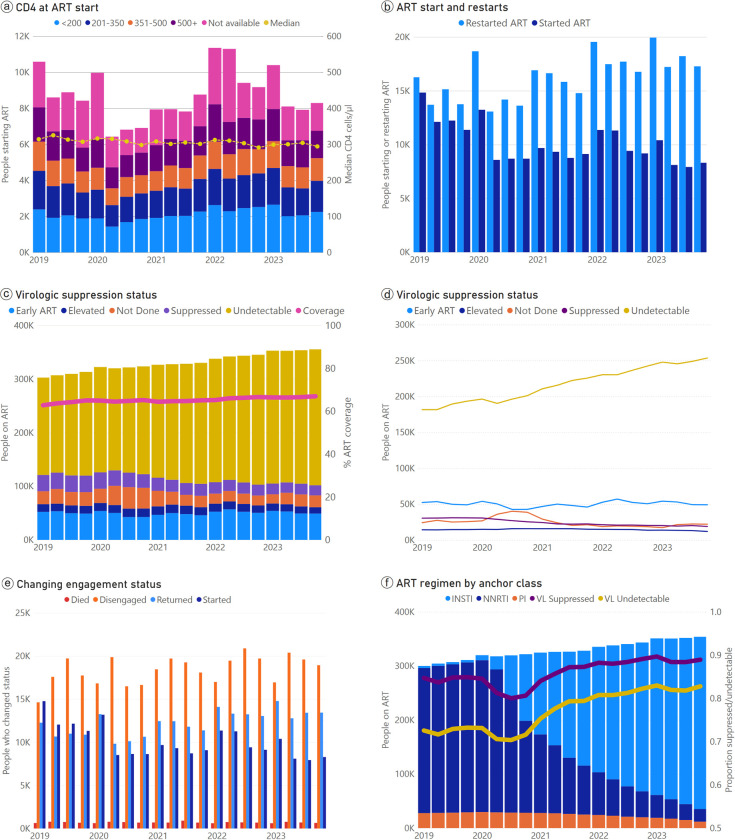
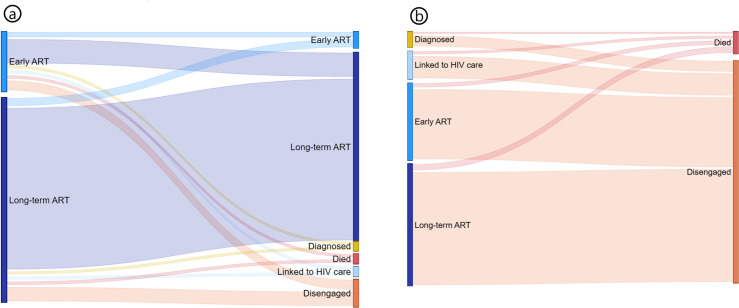
Methods and findings: This observational cohort study leveraged person-level data on all people living with HIV in the Western Cape (WC), South Africa, who accessed public health services in the 2 years prior to 31 December 2023. Programme data from disease registers were complemented by data from pharmacy and laboratory systems. At study closure, 494 370 people were included, constituting 93% of those of those estimated to be living with HIV in the province, of whom 355 104 were on ART. Substantial disengagement from HIV care was evident at every point on the cascade. Early treatment emerged as a period of higher risk of disengagement, but it did not account for the majority of disengagement. Almost all those currently disengaged had prior experience of treatment. While re-engagement was also common, overall treatment coverage had increased slowly over 5 years. The transition to dolutegravir-based regimens was dramatic with good virological outcomes for those in care, notwithstanding a clearly discernible impact of the Coronavirus Disease 2019 (COVID-19) pandemic on viral load (VL) testing. People currently engaged and disengaged in care are similar with respect to age and gender. Those who died or disengaged recently were previously distributed across a range of cascade statuses, and a substantial proportion of those newly initiating and re-initiating treatment were no longer on treatment 6 months later. The main limitation of this study was incomplete evidence of HIV testing, linkage to HIV-specific services, and out-of-facility mortality.
Conclusions: Using routine data, it was possible to populate and automate a cyclical cascade of HIV care that continuously captured the nonlinear care journeys of individuals living with HIV. In this generalised mature HIV epidemic, most people are treatment experienced. Disengagement is common and occurs at various points along the cascade, making it challenging to identify high-impact intervention opportunities. While historical HIV cascades remain valuable for target setting and service monitoring, they can be complemented with insights from more detailed cyclical cascades.
Copyright: © 2024 Euvrard et al. This is an open access article distributed under the terms of the Creative Commons Attribution License, which permits unrestricted use, distribution, and reproduction in any medium, provided the original author and source are credited.
Conflict of interest statement
The authors have declared that no competing interests exist.
Figures
References
-
- World Health Organisation. SCALING UP ANTIRETROVIRAL THERAPY IN RESOURCE-LIMITED SETTINGS: TREATMENT GUIDELINES FOR 2003 REVISION 2003.
Publication types
MeSH terms
Substances
Grants and funding
LinkOut - more resources
Full Text Sources
Medical