Review
. 2025 Apr:70:103-124.
doi: 10.1016/j.jare.2024.05.004. Epub 2024 May 9.

Mesenchymal stem cell secretome for regenerative medicine: Where do we stand?

Affiliations
Review

Mesenchymal stem cell secretome for regenerative medicine: Where do we stand?

Catarina M Trigo et al. J Adv Res. 2025 Apr.

Abstract

Background: Mesenchymal stem cell (MSC)-based therapies have yielded beneficial effects in a broad range of preclinical models and clinical trials for human diseases. In the context of MSC transplantation, it is widely recognized that the main mechanism for the regenerative potential of MSCs is not their differentiation, with in vivo data revealing transient and low engraftment rates. Instead, MSCs therapeutic effects are mainly attributed to its secretome, i.e., paracrine factors secreted by these cells, further offering a more attractive and innovative approach due to the effectiveness and safety of a cell-free product.

Aim of review: In this review, we will discuss the potential benefits of MSC-derived secretome in regenerative medicine with particular focus on respiratory, hepatic, and neurological diseases. Both free and vesicular factors of MSC secretome will be detailed. We will also address novel potential strategies capable of improving their healing potential, namely by delivering important regenerative molecules according to specific diseases and tissue needs, as well as non-clinical and clinical studies that allow us to dissect their mechanisms of action.

Key scientific concepts of review: MSC-derived secretome includes both soluble and non-soluble factors, organized in extracellular vesicles (EVs). Importantly, besides depending on the cell origin, the characteristics and therapeutic potential of MSC secretome is deeply influenced by external stimuli, highlighting the possibility of optimizing their characteristics through preconditioning approaches. Nevertheless, the clarity around their mechanisms of action remains ambiguous, whereas the need for standardized procedures for the successful translation of those products to the clinics urges.

Keywords: Extracellular vesicles; Mesenchymal stem cells; Preconditioning strategies; Regenerative medicine; Secretome.


Conflict of interest statement

Declaration of competing interest The authors declare that they have no known competing financial interests or personal relationships that could have appeared to influence the work reported in this paper.

Figures

None
Graphical abstract
Fig. 1
Fig. 1
MSCs exert several immunomodulatory effects by regulating both innate and adaptive immune cell populations. Abreviations: Arg-1: arginase-1; CTLs; cytotoxic T lymphocytes; CDKN1B: cyclin dependent kinase inhibitor 1B; CDK2: cyclin-dependent kinase 2; COX-2: cyclooxygenase 2; HLA-G: major histocompatibiliy complex, class I, G; HGF: hepatocyte growth factor; IDO: indoleamine 2,3-dioxygenase; IFN-γ: interferon-gamma; IL: interleukin; IL-1RA: interleukin 1 receptor antagonist; LPS: lipopolysaccharide; miR: miRNA; GM-CSF: granulocyte-macrophage colony-stimulating growth factor; NK: natural killer; NO: nitric oxide; PGE2: prostaglandin E2; SOD3: extracellular superoxide dismutase; TGF-β: transforming growth factor beta; Th1: T helper cells 1; Th2: T helper cells 2; Th17: T helper cells 17; TNF-α: tumor necrosis factor alpha; TSG-6: anti-inflammatory TNF-α-stimulated gene 6 protein.
Fig. 2
Fig. 2
Benefits of hypoxia-preconditioned MSCs compared to normoxia MSCs. Hypoxia-preconditioned MSC-derived secretome has shown to induce keratinocytes and fibroblast proliferation as well as angiogenesis by releasing high levels of angiogenic factors, therefore enhancing the process of wound healing. MSC-derived secretome obtained in hypoxia conditions can reduce the concentration of ROS due to low levels of O2, thus reducing the cellular oxidative stress. Regarding neuroprotection, MSCs obtained under these conditions have shown to release high levels of proteins with a neuroprotective role and, in the context of acute lung injury, have revealed to reduce neutrophil activation by reducing the levels of IL-8. Abbreviations: ALI: acute lung injury; EF-2: eukaryotic elongation factor 2; IL-8: interleukin 8; MSCs: mesenchymal stem cells; Prx1: peroxiredoxin 1; ROS: reactive oxygen species; UCHL1: ubiquitin C-terminal hydrolase L1.
Fig. 3
Fig. 3
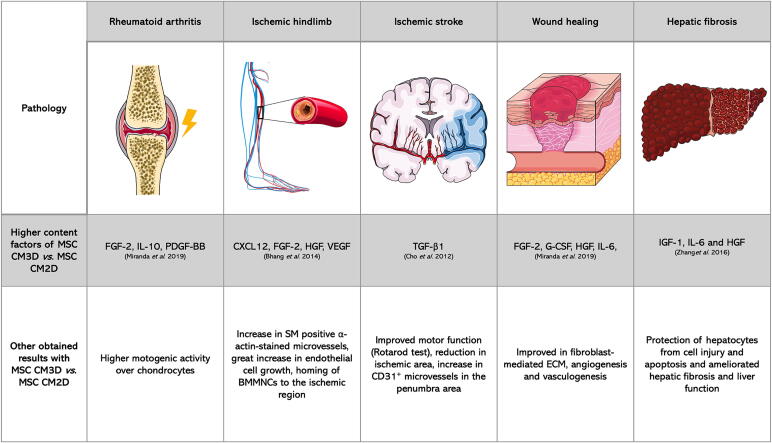
The main factors involved in the greater effects of MSC-CM3D in different pathologies (This figure was partly generated using Servier Medical Art, provided by Servier, licensed under a Creative Commons Attribution 3.0 unported license). Abbreviations: BMMNCs: bone marrow mononuclear cells; CXCL12: C-X-C motif chemokine ligand 12; ECM: extracellular matrix; FGF-2: fibroblast growth factor 2; G-CSF: granulocyte colony-stimulating factor; HGF: hepatocyte growth factor; IGF-1: insulin-like growth factor; IL-6: interleukin 6; IL-10: interleukin 10; MSCs: mesenchymal stem cells; MSC-CM2D: MSC-derived two-dimensional conditioned media; MSC-CM3D: MSC-derived three-dimensional conditioned media; PDGF-BB: platelet-derived growth factor BB; SM: smooth muscle; TGF-β1: transforming growth factor 1; VEGF: vascular endothelial growth factor.
Fig. 4
Fig. 4
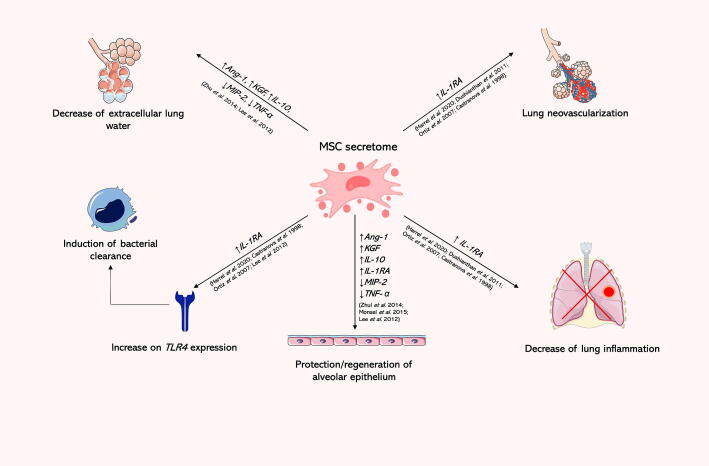
The role of main players of MSC-derived secretome on the several features that can be present on respiratory diseases. (This figure was partly generated using Servier Medical Art, provided by Servier, licensed under a Creative Commons Attribution 3.0 unported license). Abbreviations; Ang-1: angiopoietin 1; KGF: keratinocyte growth factor; IL-10: interleukin 10; IL-1RA: interleukin 1 receptor antagonist; MIP-2: macrophage inflamamtory protein 2; MSCs: mesenchymal stem cells; TNF-α: tumor necrosis factor alpha; TLR4; toll-like receptor 4.
Fig. 5
Fig. 5
The main mechanisms and factors involved in the liver regenerative potential of MSC-derived secretome. (The figure was partly generated using Servier Medical Art, provided by Servier, licensed under a Creative Commons Attribution 3.0 unported license). Abbreviations: ANXA1: annexin A1; ANGPTs: angiopoietins; EGF: epidermal growth factor; FGF-2: fibroblast growth factor 2; HGF: hepatocyte growth factor; IDO: indoleamine-pyrrole 2,3-dioxygnease; IGF-1: insulin-like groth factor; IL-1β: interleukin 1 beta; IL-6: interleukin 6; IL-10: interleukin 10; IL-22: interleukin 22; IL-1RA: interleukin 1 receptor antagonist; MCP-1: monocyte chemoattractant protein 1; MIP-2: macrophage inflammatory protein 2; MGFE8: milk fat globule epidermal growth factor 8; MMPs: matrix metalloproteinases; MSC: mesenchymal stem cells; Smad: mothers against decapentaplegic; TGF-β: transforming growth factor beta; TNF-α: tumor necrosis factor alpha; VEGF-A: vascular endothelial growth factor A; VEGF-R1/R2: vascular endothelial growth factor receptor 1/2.
Fig. 6
Fig. 6
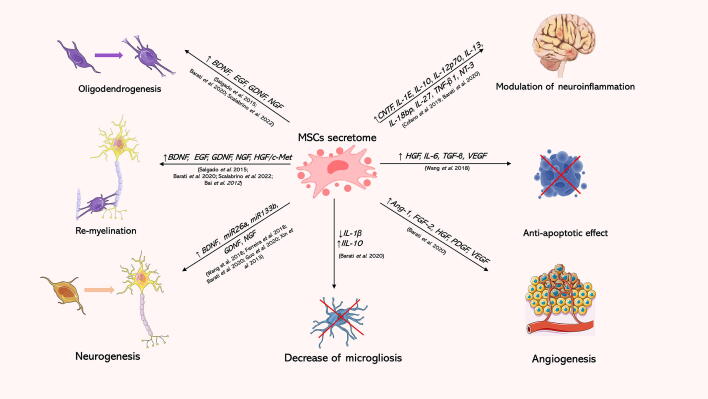
The role of MSC-derived secretome in neuroregeneration. MSC release a plethora of growth factors and neurotrophins that can regulate neurogenesis, oligodendrogenesis, angiogenesis and modulates neuroinflammation, therefore contributing to neuroregeneration. Abbreviations: Ang-1: angiopoietin 1; BDNF: brain derived growth factor; EGF: epidermal growth factor; FGF-2: fibroblast growth factor 2; CNTF: ciliary neurotrophic factor; GDNF: glial cell derived growth factor; HGF: hepatocyte growth factor; IL: interleukin; MSCs: mesenchymal stem cells; NAP-2: neutrophil activating protein 2; NGF: nerve growth factor; NT-3: neurotrophin 3; PDGF: platelet derived growth factor; TGF-β: transforming growth factor beta; TNF-β1: tumor necrosis factor beta 1; VEGF: vascular endothelial growth factor.

References

    1. Friedenstein A.J., Chailakhjan R.K., Lalykina K.S. The development of fibroblast colonies in monolayer cultures of guinea-pig bone marrow and spleen cells. Cell Prolif. 1970;3:393–403. doi: 10.1111/j.1365-2184.1970.tb00347.x. - DOI - PubMed
    1. Tullis G.E., Spears K., Kirk M.D. Immunological barriers to stem cell therapy in the central nervous system. Stem Cells Int. 2014;2014 doi: 10.1155/2014/507905. - DOI - PMC - PubMed
    1. Farfán N., Carril J., Redel M., Zamorano M., Araya M., Monzón E., et al. Intranasal administration of mesenchymal stem cell secretome reduces hippocampal oxidative stress, neuroinflammation and cell death, improving the behavioral outcome following perinatal asphyxia. Int J Mol Sci. 2020;21 doi: 10.3390/ijms21207800. - DOI - PMC - PubMed
    1. Pittenger MF, Discher DE, Péault BM, Phinney DG, Hare JM, Caplan AI. Mesenchymal stem cell perspective: cell biology to clinical progress. Npj Regene Med 2019;4(1):1–15. doi: 10.1038/s41536-019-0083-6. - PMC - PubMed
    1. Dexter T.M., Spooncer E. Growth and differentiation in the hemopoietic system. Annu Rev Cell Biol. 1987;3:423–441. doi: 10.1146/annurev.cb.03.110187.002231. - DOI - PubMed

MeSH terms

LinkOut - more resources