Review
. 2024 Apr;133(2):93-115.
doi: 10.1007/s00412-024-00822-0.

Meiosis through three centuries

Affiliations
Review

Meiosis through three centuries

Gareth Jones et al. Chromosoma. 2024 Apr.

Abstract

Meiosis is the specialized cellular program that underlies gamete formation for sexual reproduction. It is therefore not only interesting but also a fundamentally important subject for investigation. An especially attractive feature of this program is that many of the processes of special interest involve organized chromosomes, thus providing the possibility to see chromosomes "in action". Analysis of meiosis has also proven to be useful in discovering and understanding processes that are universal to all chromosomal programs. Here we provide an overview of the different historical moments when the gap between observation and understanding of mechanisms and/or roles for the new discovered molecules was bridged. This review reflects also the synergy of thinking and discussion among our three laboratories during the past several decades.

Keywords: Crossing over; Evolution; Meiosis; Pairing; Synaptonemal complex.


Conflict of interest statement

There are no financial or non-financial interests that are directly or indirectly related to the work submitted for publication for any of the authors.

The authors declare no competing interests.

The three authors agree to their participation and to the publication of the review presented here.

Figures
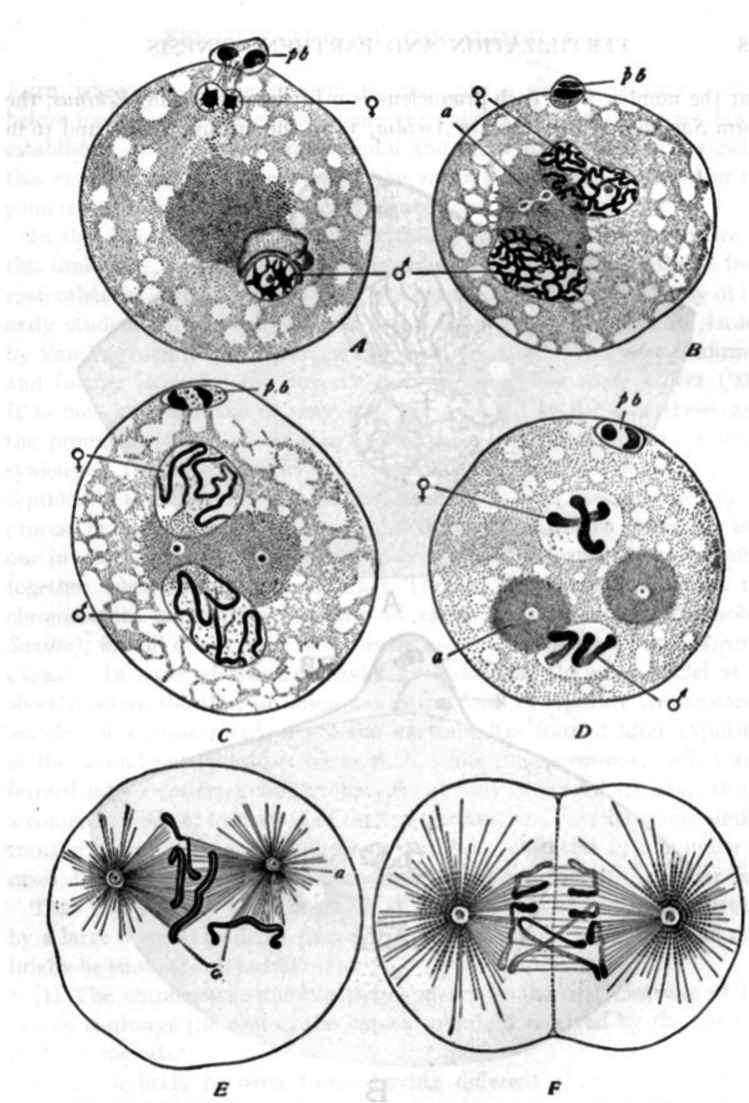
Fig. 1
Fig. 1
Demonstration by Boveri (; Fig. 197) that egg and sperm contribute equal numbers of chromosomes to the zygote during the fertilization of the egg of Ascaris megalocephala. Using the fact that this Ascaris has large clear cells and only two pairs of chromosomes, Boveri was able to trace the fate of egg and sperm chromosomes in cell lineages with great precision. This is illustrated here for the second meiotic division. A The sperm nucleus (shown by its symbol) has entered the oocyte (shown by its symbol); above is indicated the extrusion of the first polar body (pb), which occurs when meiosis I is achieved. B The oocyte enters meiosis II as indicated by the early prophase stage in the two (female and male) pronuclei. The grey sphere (a) indicates the central body. C Chromosomes are more compact in the pronuclei and the central body is divided. The second polar body (pb) has divided as indicated by the two polar dark masses. D The two sister chromatids are now visible and the central body is divided into two spheres (a). E and F correspond, respectively, to metaphase and anaphase of meiosis II. F Cleavage is in progress while daughter-chromosomes move towards the spindle-poles. The drawings illustrate, for the first time, that chromosome numbers are reduced in half when they enter meiosis II and that male and female nuclei provide the same number of chromosomes
Fig. 2
Fig. 2
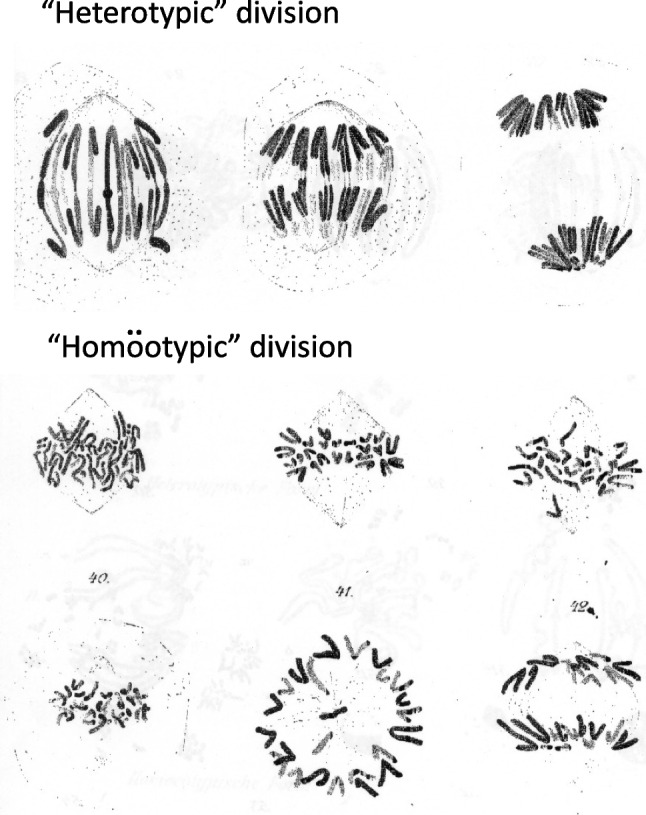
Discovery and demonstration by Flemming (1887) that the two spermatogenic divisions in the amphibian Salamandra maculate were fundamentally different, referring to them as “heterotypic” and “homöotypic” – now known as meiosis I and meiosis II
Fig. 3
Fig. 3
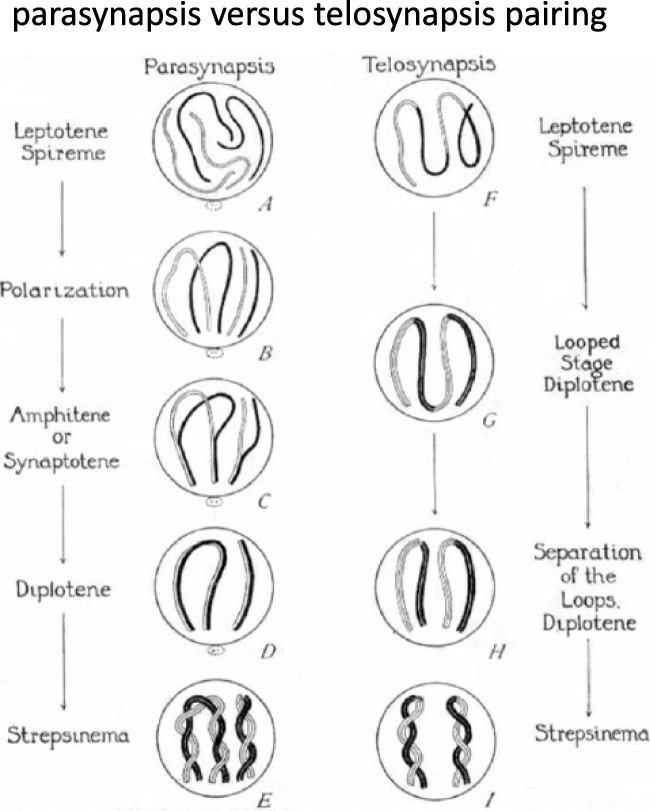
Long standing question: how do homologous chromosome associate during pairing? Early dispute (illustrated by Wilson ; Fig. 274) as to whether homologous chromosomes associated side by side (parasynapsis, left) or end to end (telosynapsis, right). His legend says: "Diagram showing the relation between “parasynapsis” and "telosynapsis" by loop-formation. In the parasynaptic series, one pair of loops and one pair of rods are shown. The final stages are much alike in effect (parasynaptic association of the synaptic mates), but the early stages are widely different"
Fig. 4
Fig. 4
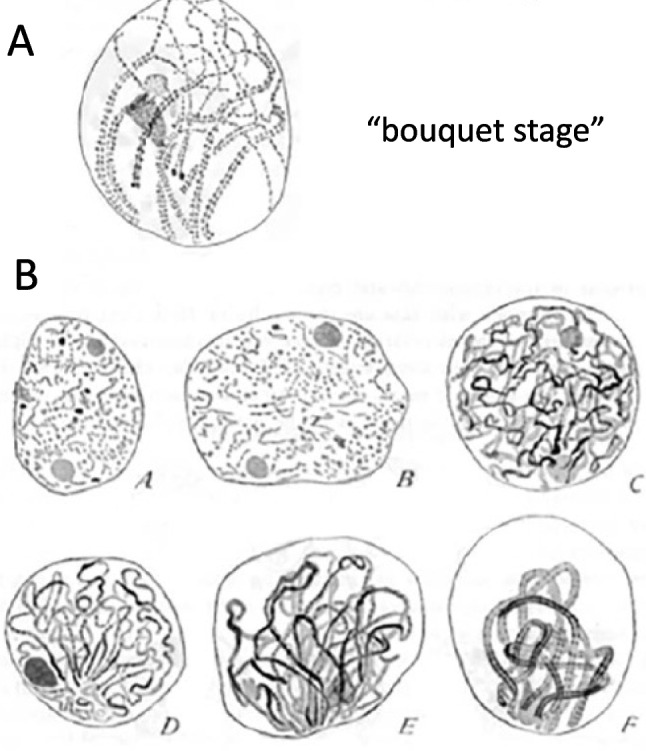
Detailed cytological observations on meiotic prophase I demonstrated side-by-side synapsis of homologs. A Grasshopper (from Wenrich 1916). Note that the clear drawing shows a zygotene stage where homolog ends are paired/synapsed (bottom) in a bouquet configuration while the middle part of the homologs are not yet coaligned (top). B Drawing of Triclade Dendrocoelum meiotic prophase I by Gelei (1921). (A-C) progression of axis formation and (D-F) of tight bouquet formation from late leptotene (left) to pachytene (right)
Fig. 5
Fig. 5
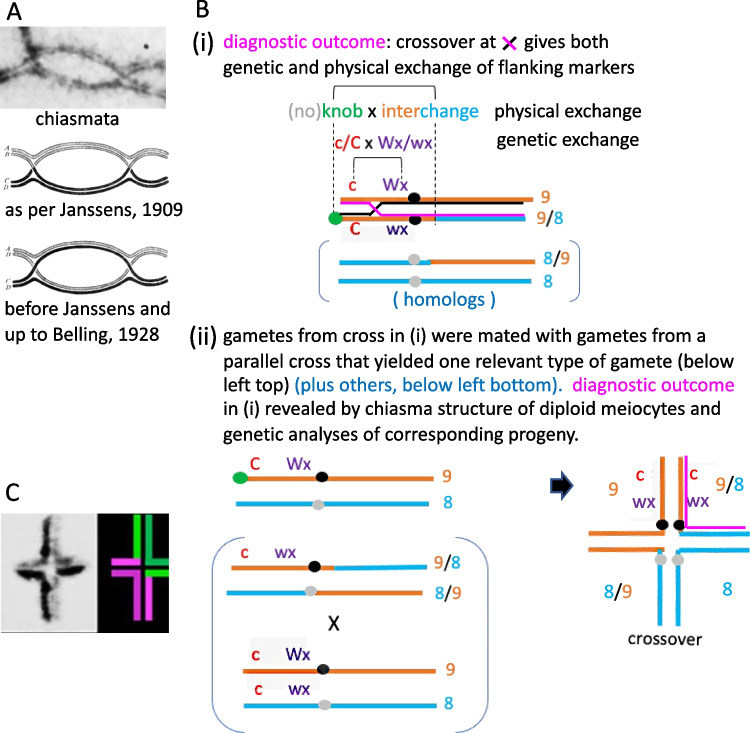
Chiasmata and physical exchange of non-sister chromatids at crossover sites. A top: Two chiasmata at diplotene from Locusta migratoria (G. Jones): arrows point to the two chiasmata sites. Middle: chiasma structure as points of physical exchange between the (non-sister) chromatids of homologous (black and white) chromosomes as interpreted by Janssens (1909). Bottom: alternatively, before Janssens and up to Belling (1928), chiasmata were represented as points when homologous chromosomes came together at diplotene but without physical exchange. B Creighton and McClintock (1931) showed that genetical crossovers coincide with physical exchange of chromosome segments by examining the output of meiosis in a maize line heterozygous for two genetic markers (C/c and Wx/wx) and flanking physical markers (a knob and a reciprocal translocation breakpoint). Panel (i) shows the heterozygous configuration at pachytene with a single crossover between the genetic markers which should be accompanied by physical exchange of the flanking physical markers. To reveal this outcome, gametes from the cross in (i) were mated with gametes from the line in (ii). Panel (iii, right) shows the resulting diagnostic chromosome configuration, defined by combined genetic and cytological analysis (these drawings and further explication in Coe and Kass 2005). C Proof that chiasmata coincide precisely with points of physical crossover exchanges, and that chiasmata do not migrate from their initial sites to more distal locations, was provided by differential BrdU labelling of sister chromatids in Locusta migratoria (adapted from Jones and Tease 1981)
Fig. 6
Fig. 6
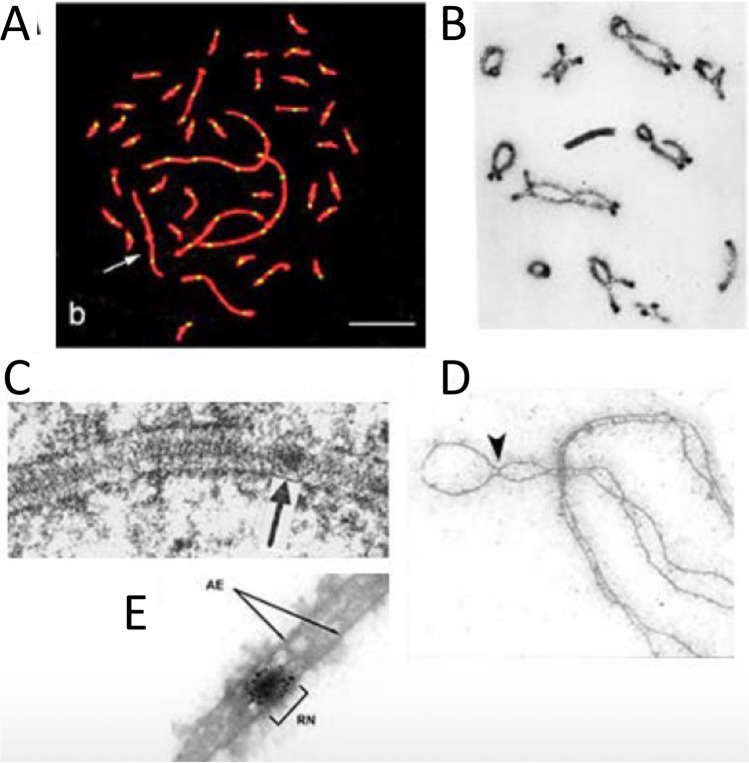
Synaptonemal complex and recombination nodules. A MLH1 foci ( white) along pachytene chromosomes (red) in zebra finch (Taeniopygia guttata), 2n = 80 comprising 14 macro-chromosomes and 64 micro-chromosomes (Calderon and Pigozzi, 2006). B Diplotene chiasmata in desert locust Schistocerca gregaria with different sizes of chromosomes (Jones and Franklin 2006). C EM image of SC and EM-defined SC-associated nodule (arrow) that correspond to crossover recombination complexes, in D. melanogaster female. Note that the nodule does not penetrate the SC central region (Carpenter 2003). D EM spread of coaligned homolog axes linked by bridges (arrowhead) in spread preparations of Allium fistulosum (Albini and Jones 1987). E EM-defined SC-associated nodule (RN) is confirmed as a crossover site by immunogold colocalization of crossover factor Mlh1 (Lhuissier et al. 2007)

References

    1. Acquaviva L, Boekhout M, Karasu ME, Brick K, et al. Ensuring meiotic DNA break formation in the mouse pseudoautosomal region. Nature. 2020;582(7812):426–431. doi: 10.1038/s41586-020-2327-4. - DOI - PMC - PubMed
    1. Adams EE, He Q, McKee BD. How noncrossover homologs are conjoined and segregated in Drosophila male meiosis I: Stable but reversible homolog linkers require a novel Separase target protein. PLoS Genet. 2020;16(10):e1008997. doi: 10.1371/journal.pgen.1008997. - DOI - PMC - PubMed
    1. Ahmad SF, Jehangir M, Cardoso AL, Wolf IR, et al. B chromosomes of multiple species have intense evolutionary dynamics and accumulated genes related to important biological processes. BMC Genomics. 2020;21(1):656. doi: 10.1186/s12864-020-07072-1. - DOI - PMC - PubMed
    1. Alani E, Padmore R, Kleckner N. Analysis of wild-type and rad50 mutants of yeast suggests an intimate relationship between meiotic chromosome synapsis and recombination. Cell. 1990;61(3):419–436. doi: 10.1016/0092-8674(90)90524-I. - DOI - PubMed
    1. Albini SM, Jones GH. Synaptonemal complex spreading in Allium cepa and A. fistulosum. I The initiation and sequence of pairing. Chromosoma. 1987;95:324–338. doi: 10.1007/BF00293179. - DOI

Publication types

LinkOut - more resources