


In Vivo, In Vitro and In Silico Anticancer Activity of Ilama Leaves: An Edible and Medicinal Plant in Mexico
- PMID: 38731446
- PMCID: PMC11085222
- DOI: 10.3390/molecules29091956
In Vivo, In Vitro and In Silico Anticancer Activity of Ilama Leaves: An Edible and Medicinal Plant in Mexico
Abstract
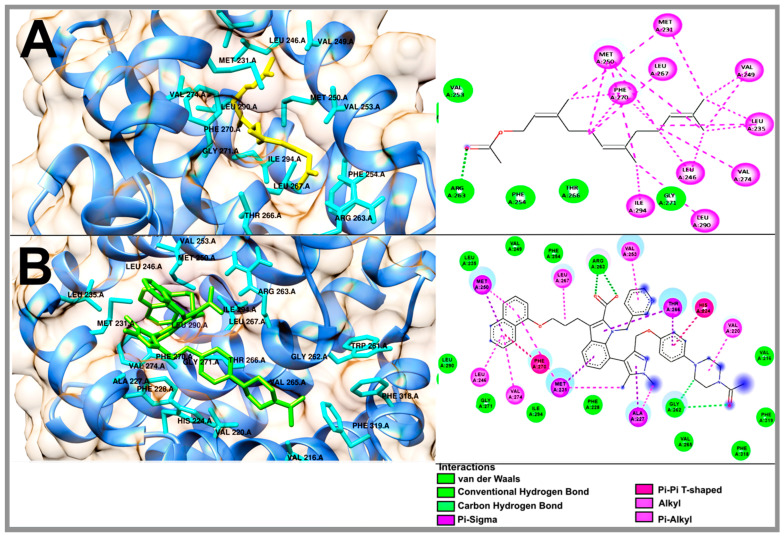
Ilama leaves are an important source of secondary metabolites with promising anticancer properties. Cancer is a disease that affects a great number of people worldwide. This work aimed to investigate the in vivo, in vitro and in silico anticancer properties of three acyclic terpenoids (geranylgeraniol, phytol and farnesyl acetate) isolated from petroleum ether extract of ilama leaves. Their cytotoxic activity against U-937 cells was assessed using flow cytometry to determine the type of cell death and production of reactive oxygen species (ROS). Also, a morphological analysis of the lymph nodes and a molecular docking study using three proteins related with cancer as targets, namely, Bcl-2, Mcl-1 and VEGFR-2, were performed. The flow cytometry and histomorphological analysis revealed that geranylgeraniol, phytol and farnesyl acetate induced the death of U-937 cells by late apoptosis and necrosis. Geranylgeraniol and phytol induced a significant increase in ROS production. The molecular docking studies showed that geranylgeraniol had more affinity for Bcl-2 and VEGFR-2. In the case of farnesyl acetate, it showed the best affinity for Mcl-1. This study provides information that supports the anticancer potential of geranylgeraniol, phytol and farnesyl acetate as compounds for the treatment of cancer, particularly with the potential to treat non-Hodgkin's lymphoma.
Keywords: Annona macroprophyllata; acyclic terpenoids; agri-food waste; cancer; docking; flow cytometry; ilama leaves; morphological analysis.
Conflict of interest statement
The authors declare no conflicts of interest.
Figures




References
-
- Julián-Loaeza A.P., Santos-Sánchez N.F., Valadez-Blanco R., Sánchez-Guzman B.S., Salas-Coronado R. Chemical composition, color, and antioxidant activity of three varieties of Annona diversifolia Safford fruits. Ind. Crops Prod. 2011;34:1262–1268. doi: 10.1016/j.indcrop.2010.06.012. - DOI
-
- Otero-Sánchez M.A., Becerril-Román A.E., Castillo-Morales A., Michel-Aceves A.C., Ariza-Flores R., Barrios-Ayala A., Rebolledo-Martínez A. Producción de ilama (Annona diversifolia Saff.) en el trópico seco de Guerrero, México. Rev. Chapingo Ser. Hortic. 2006;12:137–146. doi: 10.5154/r.rchsh.2005.09.035. - DOI
-
- Lefebvre C., Segura S., Carmona A., Mathuriau C., Barrios S., Andrés J., Medellín-Azuara J. Linking local Appreciation with conservation of an edible fruit species: The case study of Ilama (Annona diversifolia Saff.) in Tierra Caliente, Mexico. Nat. Resour. 2018;9:337–353. doi: 10.4236/nr.2018.910021. - DOI
MeSH terms
Substances
LinkOut - more resources
Full Text Sources
