. 2024 Apr 24;25(9):4630.
doi: 10.3390/ijms25094630.

A Pilot Immunohistochemical Study Identifies Hedgehog Pathway Expression in Sinonasal Adenocarcinoma

Affiliations

A Pilot Immunohistochemical Study Identifies Hedgehog Pathway Expression in Sinonasal Adenocarcinoma

Matko Leović et al. Int J Mol Sci. .

Abstract

Tumors of the head and neck, more specifically the squamous cell carcinoma, often show upregulation of the Hedgehog signaling pathway. However, almost nothing is known about its role in the sinonasal adenocarcinoma, either in intestinal or non-intestinal subtypes. In this work, we have analyzed immunohistochemical staining of six Hedgehog pathway proteins, sonic Hedgehog (SHH), Indian Hedgehog (IHH), Patched1 (PTCH1), Gli family zinc finger 1 (GLI1), Gli family zinc finger 2 (GLI2), and Gli family zinc finger 3 (GLI3), on 21 samples of sinonasal adenocarcinoma and compared them with six colon adenocarcinoma and three salivary gland tumors, as well as with matching healthy tissue, where available. We have detected GLI2 and PTCH1 in the majority of samples and also GLI1 in a subset of samples, while GLI3 and the ligands SHH and IHH were generally not detected. PTCH1 pattern of staining shows an interesting pattern, where healthy samples are mostly positive in the stromal compartment, while the signal shifts to the tumor compartment in tumors. This, taken together with a stronger signal of GLI2 in tumors compared to non-tumor tissues, suggests that the Hedgehog pathway is indeed activated in sinonasal adenocarcinoma. As Hedgehog pathway inhibitors are being tested in combination with other therapies for head and neck squamous cell carcinoma, this could provide a therapeutic option for patients with sinonasal adenocarcinoma as well.

Keywords: hedgehog; sinonasal adenocarcinoma; tumor–stroma interaction.


Conflict of interest statement

The authors declare no conflicts of interest. The funders had no role in the design of the study; in the collection, analyses, or interpretation of data; in the writing of the manuscript; or in the decision to publish the results.

Figures
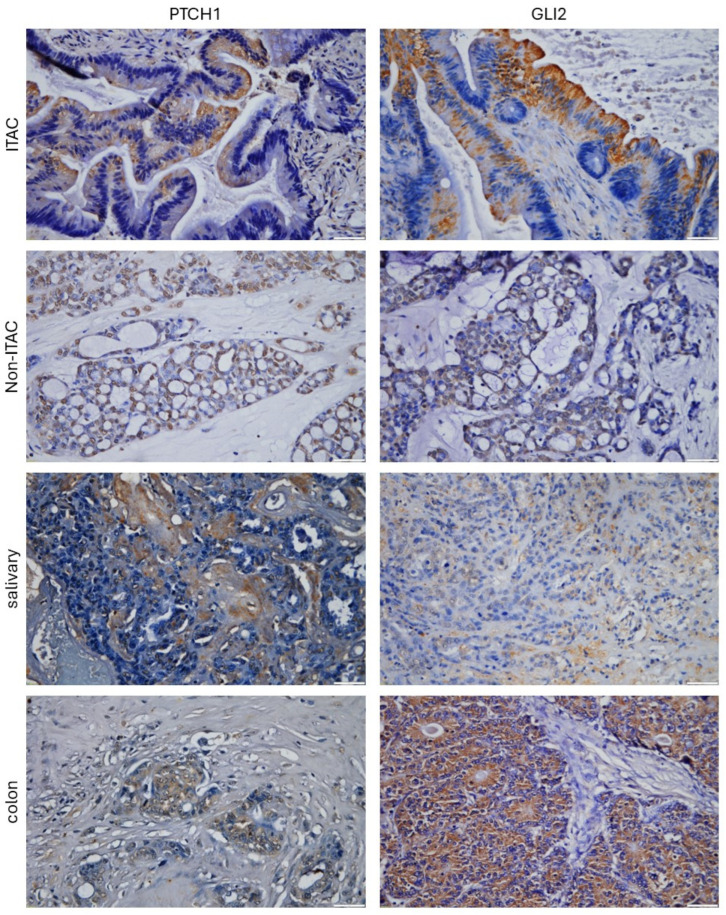
Figure 1
Figure 1
Examples of IHC staining for GLI2 and PTCH1 proteins in ITAC (cytoplasmatic staining in tumor cells), non-ITAC (cytoplasmatic and nuclear staining in tumor cells), salivary (cytoplasmatic staining in stromal cells), and colon (cytoplasmatic staining in tumor cells) adenocarcinomas. Scale bar = 50 µm.
Figure 2
Figure 2
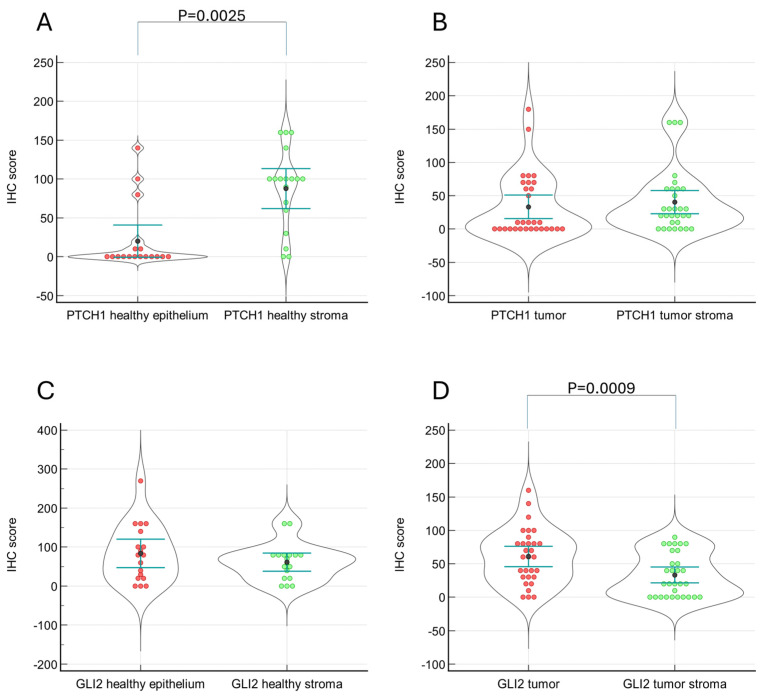
Staining scores of PTCH1 and GLI2 in healthy tissues and tumor tissues for all analyzed samples. PTCH1 staining differs in the healthy tissues, where the stromal compartment shows stronger staining compared to the epithelial compartment (p = 0.0001). GLI2 staining differs in the tumor samples, where the tumor tissues show stronger staining compared to the tumor stromal compartment (p = 0.0052). (A): PTCH1 staining in healthy tissues, (B): PTCH1 staining in tumor tissues, (C): GLI2 staining in healthy tissues, (D): GLI2 staining in tumor tissues.
Figure 3
Figure 3
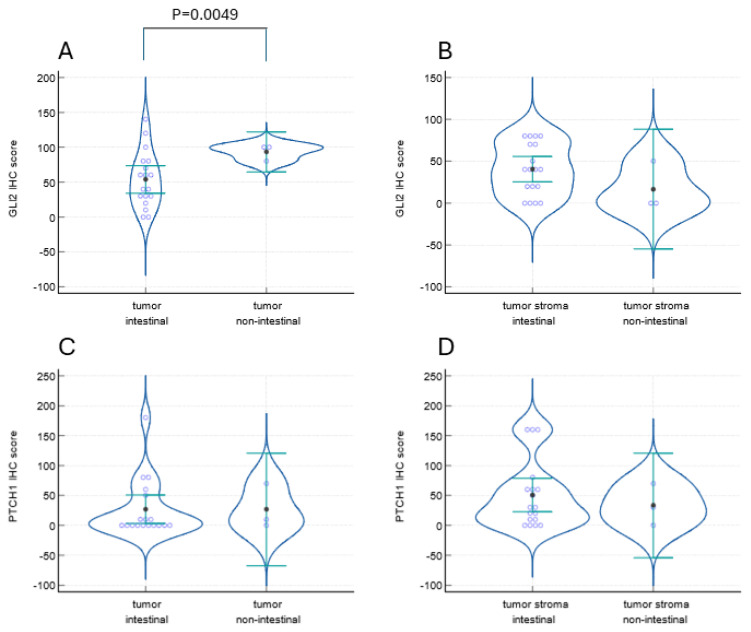
Comparison of the GLI2 and PTCH1 staining scores for the intestinal and non-intestinal subtypes of sinonasal adenocarcinoma. GLI2 score is slightly higher in the non-intestinal tumors compared to the intestinal ones (p = 0.0049), while for PTCH1, there are no differences in staining between the two subtypes. (A): GLI2 staining in the tumor tissue for ITAC and non-ITAC, (B): GLI2 staining in the stroma for ITAC and non-ITAC, (C): PTCH1 staining in the tumor tissue for ITAC and non-ITAC, (D): PTCH1 staining in the stroma for ITAC and non-ITAC.
Figure 4
Figure 4
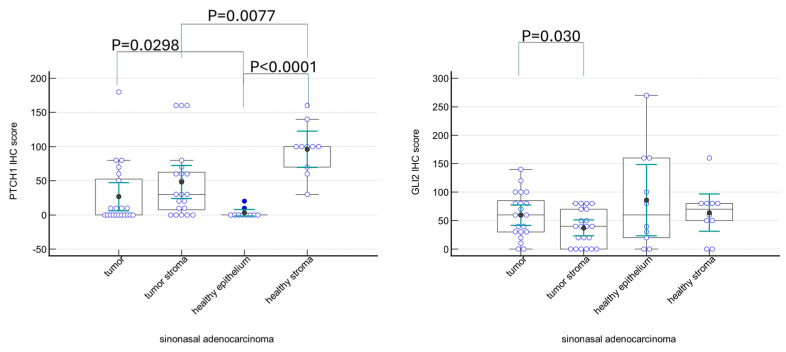
IHC scores for PTCH1 and GLI2 proteins in sinonasal adenocarcinoma. PTCH1 expression is the highest in the healthy stromal cells, and it is downregulated in the tumor stroma (p = 0.0077). On the other hand, healthy epithelium shows very weak or no expression of PTCH1, which is increased in tumor tissue (p = 0.0298). GLI2 expression is mostly uniform throughout the groups, with stronger staining of tumor tissue compared to its stromal compartment.

References

    1. Gritli-Linde A., Lewis P., McMahon A.P., Linde A. The Whereabouts of a Morphogen: Direct Evidence for Short- and Graded Long-Range Activity of Hedgehog Signaling Peptides. Dev. Biol. 2001;236:364–386. doi: 10.1006/dbio.2001.0336. - DOI - PubMed
    1. Cobourne M.T., Green J.B.A. Hedgehog Signalling in Development of the Secondary Palate. Front. Oral Biol. 2012;16:52–59. doi: 10.1159/000337543. - DOI - PubMed
    1. Jaskoll T., Leo T., Witcher D., Ormestad M., Astorga J., Bringas P., Carlsson P., Melnick M. Sonic Hedgehog Signaling Plays an Essential Role during Embryonic Salivary Gland Epithelial Branching Morphogenesis. Dev. Dyn. 2004;229:722–732. doi: 10.1002/dvdy.10472. - DOI - PubMed
    1. Sagai T., Amano T., Maeno A., Kiyonari H., Seo H., Cho S.-W., Shiroishi T. SHH Signaling Directed by Two Oral Epithelium-Specific Enhancers Controls Tooth and Oral Development. Sci. Rep. 2017;7:13004. doi: 10.1038/s41598-017-12532-y. - DOI - PMC - PubMed
    1. Abramyan J. Hedgehog Signaling and Embryonic Craniofacial Disorders. J. Dev. Biol. 2019;7:9. doi: 10.3390/jdb7020009. - DOI - PMC - PubMed

MeSH terms