


Pulmonary Hypertension in Sickle Cell Disease: Novel Findings of Gene Polymorphisms Related to Pathophysiology
- PMID: 38732015
- PMCID: PMC11084253
- DOI: 10.3390/ijms25094792
Pulmonary Hypertension in Sickle Cell Disease: Novel Findings of Gene Polymorphisms Related to Pathophysiology
Abstract
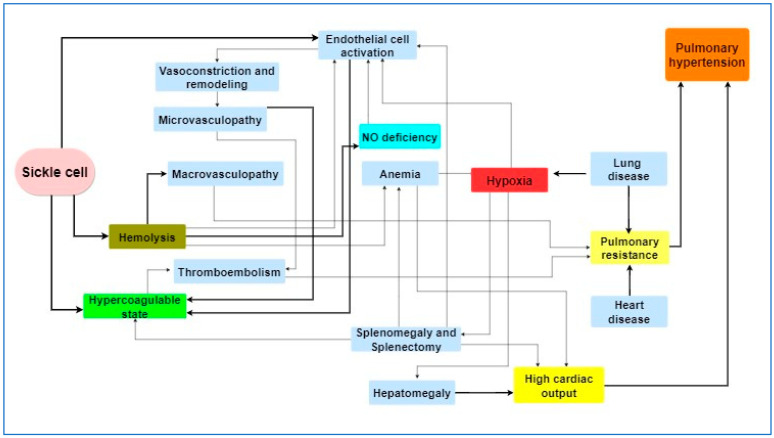
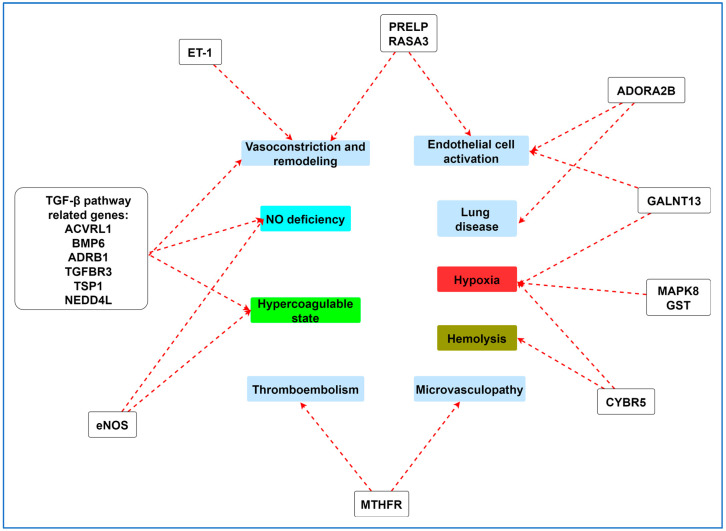
Pulmonary hypertension (PH) is a progressive and potentially fatal complication of sickle cell disease (SCD), affecting 6-10% of adult SCD patients. Various mechanisms and theories have been evaluated to explain the pathophysiology of this disease. However, questions remain, particularly regarding the clinical heterogeneity of the disease in terms of symptoms, complications, and survival. Beyond the classical mechanisms that have been thoroughly investigated and include hemolysis, nitric oxide availability, endothelial disorders, thrombosis, and left heart failure, attention is currently focused on the potential role of genes involved in such processes. Potential candidate genes are investigated through next-generation sequencing, with the transforming growth factor-beta (TGF-β) pathway being the initial target. This field of research may also provide novel targets for pharmacologic agents in the future, as is already the case with idiopathic PH. The collection and processing of data and samples from multiple centers can yield reliable results that will allow a better understanding of SCD-related PH as a part of the disease's clinical spectrum. This review attempts to capture the most recent findings of studies on gene polymorphisms that have been associated with PH in SCD patients.
Keywords: gene polymorphisms; gene sequencing; pulmonary hypertension; sickle cell disease.
Conflict of interest statement
The authors declare no conflict of interest.
Figures
References
-
- Savale L., Habibi A., Lionnet F., Maitre B., Cottin V., Jais X., Chaouat A., Artaud-Macari E., Canuet M., Prevot G., et al. Clinical phenotypes and outcomes of precapillary pulmonary hypertension of sickle cell disease. Eur. Respir. J. 2019;54:1900585. doi: 10.1183/13993003.00585-2019. - DOI - PubMed
-
- Humbert M., Kovacs G., Hoeper M.M., Badagliacca R., Berger R.M., Brida M., Carlsen J., Coats A.J., Escribano-Subias P., Ferrari P., et al. 2022 ESC/ERS Guidelines for the diagnosis and treatment of pulmonary hypertension. Eur. Respir. J. 2022;61:2200879. doi: 10.1183/13993003.00879-2022. - DOI - PubMed
Publication types
MeSH terms
LinkOut - more resources
Full Text Sources
Medical
