


End-to-End Ultrasonic Hand Gesture Recognition
- PMID: 38732843
- PMCID: PMC11086334
- DOI: 10.3390/s24092740
End-to-End Ultrasonic Hand Gesture Recognition
Abstract
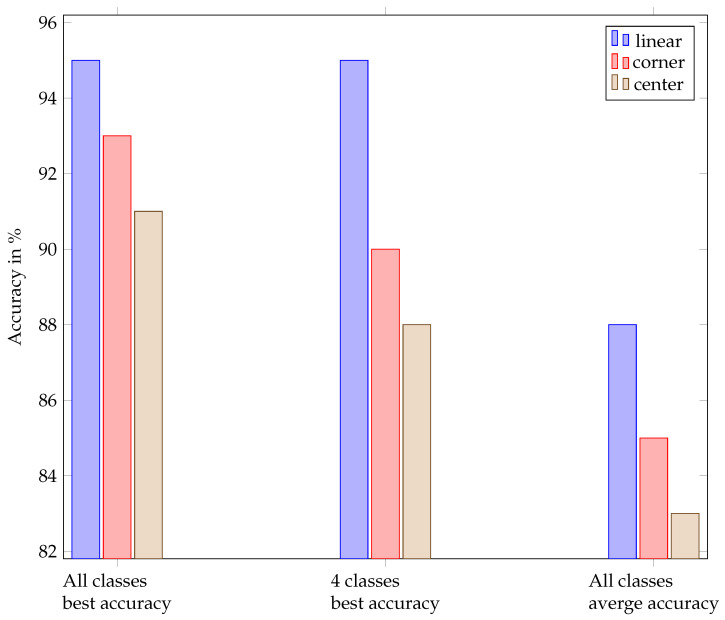
As the number of electronic gadgets in our daily lives is increasing and most of them require some kind of human interaction, this demands innovative, convenient input methods. There are limitations to state-of-the-art (SotA) ultrasound-based hand gesture recognition (HGR) systems in terms of robustness and accuracy. This research presents a novel machine learning (ML)-based end-to-end solution for hand gesture recognition with low-cost micro-electromechanical (MEMS) system ultrasonic transducers. In contrast to prior methods, our ML model processes the raw echo samples directly instead of using pre-processed data. Consequently, the processing flow presented in this work leaves it to the ML model to extract the important information from the echo data. The success of this approach is demonstrated as follows. Four MEMS ultrasonic transducers are placed in three different geometrical arrangements. For each arrangement, different types of ML models are optimized and benchmarked on datasets acquired with the presented custom hardware (HW): convolutional neural networks (CNNs), gated recurrent units (GRUs), long short-term memory (LSTM), vision transformer (ViT), and cross-attention multi-scale vision transformer (CrossViT). The three last-mentioned ML models reached more than 88% accuracy. The most important innovation described in this research paper is that we were able to demonstrate that little pre-processing is necessary to obtain high accuracy in ultrasonic HGR for several arrangements of cost-effective and low-power MEMS ultrasonic transducer arrays. Even the computationally intensive Fourier transform can be omitted. The presented approach is further compared to HGR systems using other sensor types such as vision, WiFi, radar, and state-of-the-art ultrasound-based HGR systems. Direct processing of the sensor signals by a compact model makes ultrasonic hand gesture recognition a true low-cost and power-efficient input method.
Keywords: Fourier transform; HMI; MEMS ultrasonic transducer; machine learning; pre-processing.
Conflict of interest statement
Authors Elfi Fertl, Do Dinh Tan Nguyen, Martin Krueger, and Georg Stettinger were employed by the company Infineon Technologies AG. The remaining authors declare that the research was conducted in the absence of any commercial or financial relationships that could be construed as a potential conflict of interest.
Figures



References
-
- Kirimtat A., Krejcar O., Kertesz A., Tasgetiren M.F. Future Trends and Current State of Smart City Concepts: A Survey. IEEE Access. 2020;8:86448–86467. doi: 10.1109/ACCESS.2020.2992441. - DOI
-
- Fu J., Rota A., Li S., Zhao J., Liu Q., Iovene E., Ferrigno G., De Momi E. Recent Advancements in Augmented Reality for Robotic Applications: A Survey. Actuators. 2023;12:323. doi: 10.3390/act12080323. - DOI
-
- Guo L., Lu Z., Yao L. Human-Machine Interaction Sensing Technology Based on Hand Gesture Recognition: A Review. IEEE Trans. Human-Mach. Syst. 2021;51:300–309. doi: 10.1109/THMS.2021.3086003. - DOI
MeSH terms
LinkOut - more resources
Full Text Sources
Research Materials
