


Enhancing cervical cancer detection and robust classification through a fusion of deep learning models
- PMID: 38734714
- PMCID: PMC11088661
- DOI: 10.1038/s41598-024-61063-w
Enhancing cervical cancer detection and robust classification through a fusion of deep learning models
Abstract
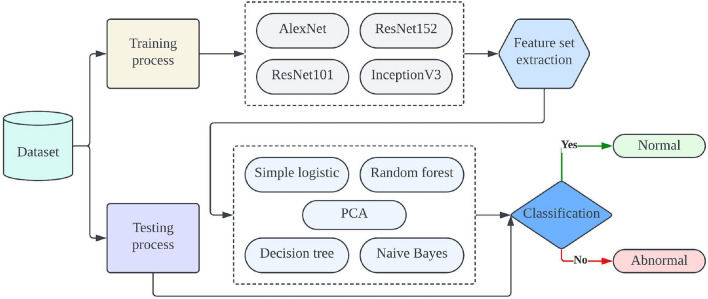
Cervical cancer, the second most prevalent cancer affecting women, arises from abnormal cell growth in the cervix, a crucial anatomical structure within the uterus. The significance of early detection cannot be overstated, prompting the use of various screening methods such as Pap smears, colposcopy, and Human Papillomavirus (HPV) testing to identify potential risks and initiate timely intervention. These screening procedures encompass visual inspections, Pap smears, colposcopies, biopsies, and HPV-DNA testing, each demanding the specialized knowledge and skills of experienced physicians and pathologists due to the inherently subjective nature of cancer diagnosis. In response to the imperative for efficient and intelligent screening, this article introduces a groundbreaking methodology that leverages pre-trained deep neural network models, including Alexnet, Resnet-101, Resnet-152, and InceptionV3, for feature extraction. The fine-tuning of these models is accompanied by the integration of diverse machine learning algorithms, with ResNet152 showcasing exceptional performance, achieving an impressive accuracy rate of 98.08%. It is noteworthy that the SIPaKMeD dataset, publicly accessible and utilized in this study, contributes to the transparency and reproducibility of our findings. The proposed hybrid methodology combines aspects of DL and ML for cervical cancer classification. Most intricate and complicated features from images can be extracted through DL. Further various ML algorithms can be implemented on extracted features. This innovative approach not only holds promise for significantly improving cervical cancer detection but also underscores the transformative potential of intelligent automation within the realm of medical diagnostics, paving the way for more accurate and timely interventions.
Keywords: Cervical cancer; Classification; Deep neural network; Machine learning; Pap smear.
© 2024. The Author(s).
Conflict of interest statement
The authors declare no competing interests.
Figures



References
-
- Basak H, Kundu R, Chakraborty S, Das N. Cervical cytology classification using PCA and GWO enhanced deep features selection. SN Comput. Sci. 2021;2:369. doi: 10.1007/s42979-021-00741-2. - DOI
-
- Dong N, Zhao L, Wu CH, Chang JF. Inception v3 based cervical cell classification combined with artificially extracted features. Appl. Soft Comput. 2020;93:106311. doi: 10.1016/j.asoc.2020.106311. - DOI
-
- Akpudo UE, Hur JWJ. D-dCNN: A novel hybrid deep learning-based tool for vibration-based diagnostics. Energies. 2021;14(17):5286. doi: 10.3390/en14175286. - DOI
-
- Zhang T, Luo YM, Li P. Cervical precancerous lesions classification using pre-trained densely connected convolutional networks with colposcopy images. Biomed. Signal Process. Control. 2020;55:101566. doi: 10.1016/j.bspc.2019.101566. - DOI
