


Association between receiving Covid-19 vaccine and menstrual cycle patterns among childbearing women: A cross-sectional study
- PMID: 38736480
- PMCID: PMC11082084
- DOI: 10.1002/hsr2.1934
Association between receiving Covid-19 vaccine and menstrual cycle patterns among childbearing women: A cross-sectional study
Abstract
Background and aims: Many women reported experiencing abnormalities in their cycle after being vaccinated with Covid-19 vaccination. To understand this issue further, our study aimed to evaluate the menstrual cycle patterns among women of childbearing age after receiving COVID-19 vaccinations.
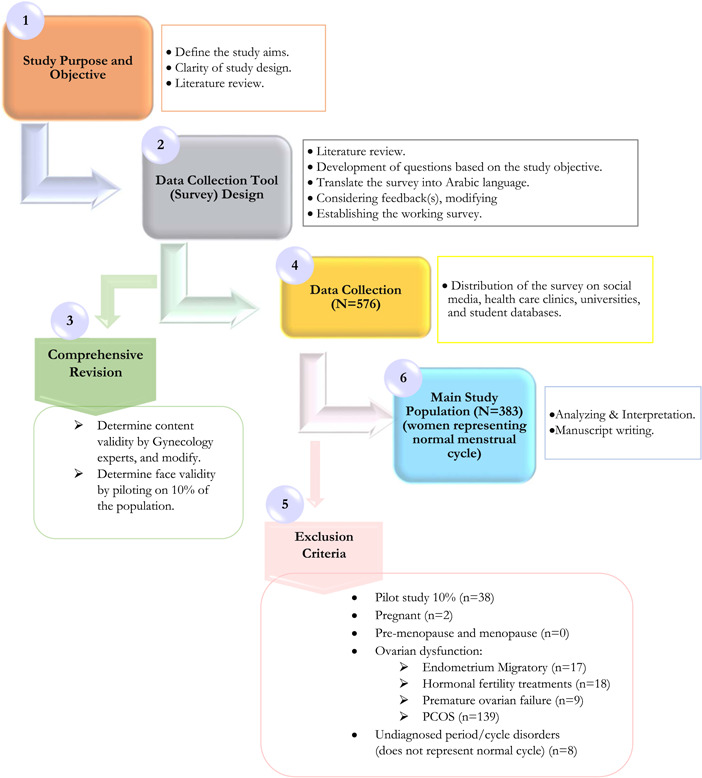
Methods: A cross-sectional study was conducted to investigate the impact of COVID-19 vaccine on women aged 18 years and above in Saudi Arabia. A self-administered online questionnaire was distributed among participants who had received at least one dose of COVID-19 vaccine. The questionnaire included questions about the participants' demographic characteristics, medical history, and vaccine-related adverse events.
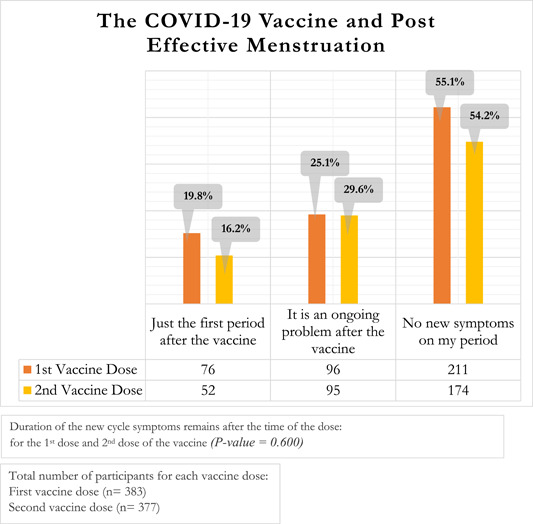
Results: The study included 383 female participants with an average age of 30.8 ± 8.1 years. The majority of participants, 92.7%, were Saudi, and more than half, 51.4%, were single. Of the participants, 78.9% were disease-free, and a majority of 67.9% had no history of Coronavirus Disease 2019 infection. A significant proportion of participants reported postvaccination changes in the menstrual cycle. Specifically, 43.1% reported changes after the first dose, and 38.4% reported changes after the second dose (p = 0.044). The severity of premenstrual symptoms increased from 44 (11.5%) to 113 (29.5%) after the first dose. Reported pain on the (WONG-BAKER) scale was also significantly elevated from 34 (8.9%) to 87 (22.7%) (p < 0.001) after the first dose.
Conclusion: A relatively high prevalence of menstrual cycle irregularities was reported by Saudi vaccinated women, particularly young adults. These findings suggest the need to further research and explore the underlying causes of these irregularities and develop interventions that may help mitigate their impact on women's health. It is also recommended that women who observe long-term changes in their menstrual cycles seek follow-up and consultation with healthcare providers to ensure that any potential health concerns are addressed promptly.
Keywords: COVID‐19; COVID‐19 vaccine; Saudi Arabia; menstrual cycle; vaccine side effects; women's health.
© 2024 The Authors. Health Science Reports published by Wiley Periodicals LLC.
Conflict of interest statement
The authors declare no conflict of interest.
Figures
References
-
- Covid‐19 dashboard: Saudi Arabia [Internet] . Moh.Gov.SA. 2023. https://covid19.moh.gov.sa/
-
- WHO (COVID‐19) WHED . Saudi Arabia: Who coronavirus disease (COVID‐19) dashboard with vaccination data [Internet]. World Health Organization; 2023. https://covid19.who.int/region/emro/country/sa
LinkOut - more resources
Full Text Sources
