


Attending Perceptions on the Use of Preference Signaling in the Ophthalmology Residency Application Process
- PMID: 38736610
- PMCID: PMC10804734
- DOI: 10.1055/s-0043-1775576
Attending Perceptions on the Use of Preference Signaling in the Ophthalmology Residency Application Process
Abstract
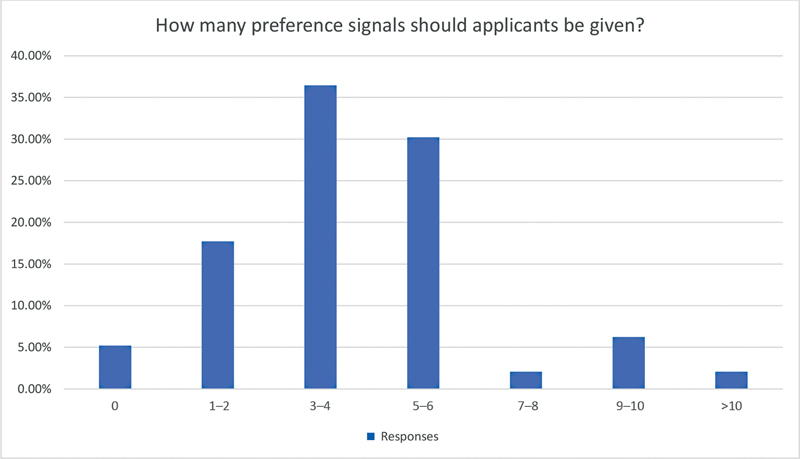
Objective This article characterizes perspectives of ophthalmologists involved in the residency selection process regarding the potential impact of preference signaling on the ophthalmology residency match. Methods An anonymous online questionnaire generated from SurveyMonkey was approved by the Association of University Professors of Ophthalmology (AUPO) Data Resource Committee for distribution to 391 individuals from the AUPO Departmental Chairs, Program Directors, and Directors of Medical Student Education email listservs in August 2022. Results A total of 96 (24.6%) ophthalmology faculty completed the questionnaire. The majority ( n = 76, 79.2%) agreed or strongly agreed that preference signaling should be implemented in the ophthalmology residency application system. Most respondents agreed or strongly agreed that preference signaling will allow for more holistic reviews of applications ( n = 55, 57.3%), agreed or strongly agreed that it will benefit applicants who do not have connections to home programs or faculty that can reach out to desired programs ( n = 81, 84.4%), and agreed or strongly agreed that it will improve the distribution of interviews to applicants ( n = 76, 79.2%). Participants agreed or strongly agreed that applicants who have signaled interest in their program will receive preference when offering interviews ( n = 59, 61.5%), and those signals will be used as a tiebreaker for similar applications ( n = 75, 78.1%). The majority of participants believed that the ideal number of preference signals' applicants should be given three to four signals ( n = 35, 36.0%) or five to six signals ( n = 29, 30.2%). Conclusion A majority of ophthalmology faculty surveyed support the integration of preference signaling into the ophthalmology residency match.
Keywords: holistic review; interview selection; medical education; ophthalmology match; preference signaling; program directors; residency selection.
The Author(s). This is an open access article published by Thieme under the terms of the Creative Commons Attribution-NonDerivative-NonCommercial License, permitting copying and reproduction so long as the original work is given appropriate credit. Contents may not be used for commercial purposes, or adapted, remixed, transformed or built upon. ( https://creativecommons.org/licenses/by-nc-nd/4.0/ ).
Conflict of interest statement
Conflict of Interest J.S. is a consultant for Alcon, Allergan, Apellis, D.O.R.C., Genentech, OcuTerra, and Regeneron.
Figures
References
-
- Association of American Medical Colleges ERAS Statistics. 2021. Accessed March 5, 2022 at:https://www.aamc.org/eras-statistics-2019
-
- SF Match Ophthalmology Residency Match Summary Report. Accessed May 5, 2022 at:https://www.sfmatch.org/specialty/ophthalmology-residency/Statistics
-
- Venincasa M J, Steren B, Young B K et al.Ophthalmology Residency Match in the Covid-19 Era: Applicant and Program Director Perceptions of the 2020-2021 Application Cycle. Semin Ophthalmol. 2022;37(01):36–41. - PubMed
-
- Nallasamy S, Uhler T, Nallasamy N, Tapino P J, Volpe N J. Ophthalmology resident selection: current trends in selection criteria and improving the process. Ophthalmology. 2010;117(05):1041–1047. - PubMed
Grants and funding
LinkOut - more resources
Full Text Sources
