


Evaluating symptom severity and urinary cytokine levels in interstitial cystitis/bladder pain syndrome patients, with and without Hunner's lesions
- PMID: 38736620
- PMCID: PMC11087211
- DOI: 10.62347/BLED2401
Evaluating symptom severity and urinary cytokine levels in interstitial cystitis/bladder pain syndrome patients, with and without Hunner's lesions
Abstract
Purpose: Interstitial cystitis/bladder pain syndrome (IC/BPS) is a condition characterized in part by urinary urgency, frequency, and pain. There is a strong interest in gathering more data to compare and assess the differences in characteristics based on the presence of Hunner's lesions in patients with IC/BPS.
Materials and methods: Using a nationwide crowdsource effort, we collected surveys and urine samples from patients with a history of IC/BPS. Participants completed the Interstitial Cystitis Symptom Index (ICSI) and Problem Index (ICPI), Overactive Bladder questionnaire (OABq SF), and pain scores. In addition, participants reported any co-morbidities and lifestyle modifications. Urinary cytokine levels were measured and compared to symptom severity.
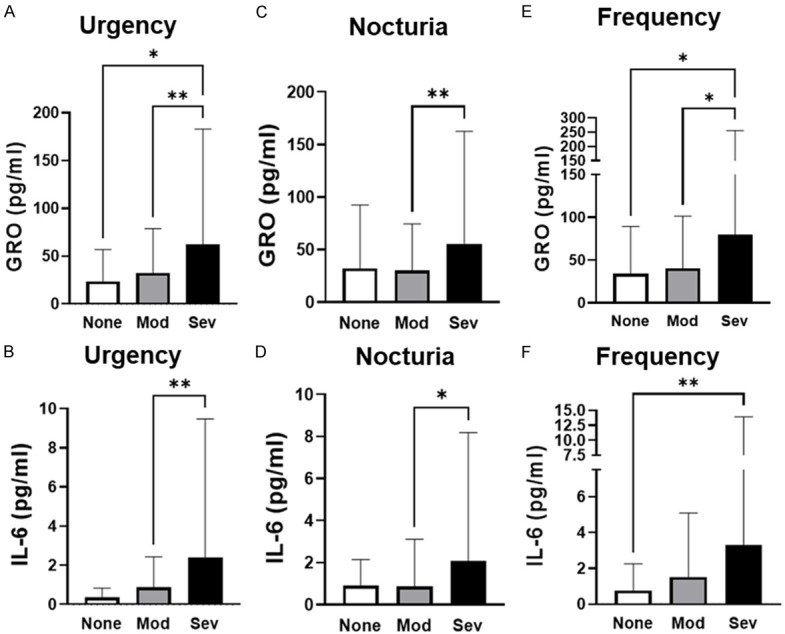
Results: 491 participants enrolled: 119 with history of ulcerative Hunner's lesions (UIC), 372 reported no lesions (NHIC), and 2 unknowns. 96.3% were female, and prevalence of UIC was equal for both genders. Average age was higher for UIC vs. NHIC group (P = 0.011), as was the duration since diagnosis (P < 0.001). Symptom scores were elevated in UIC patients (P < 0.001). Both groups widely implemented lifestyle modifications, with dietary changes being most prevalent (70.1%), followed by prescription medication usage (63.1%). More UIC compared to NHIC participants experienced co-morbidities (P = 0.010). Urine samples were analyzed for GRO, IL-6, IL-8, and MCP-1. MCP-1 levels were significantly higher in UIC patients (P = 0.044). Weak positive correlation was found between cytokines and symptom scores.
Conclusions: Patients with UIC and NHIC from across the United States displayed distinct phenotypic and urine biological characteristics. These findings contribute to increased understanding of IC/BPS and may aid in improving our knowledge of the condition.
Keywords: Urine; biomarker; bladder; inflammation; interstitial cystitis.
AJCEU Copyright © 2024.
Conflict of interest statement
MBC has intellectual property associated with methods for diagnosing interstitial cystitis.
Figures
References
-
- Suskind AM, Berry SH, Ewing BA, Elliott MN, Suttorp MJ, Clemens JQ. The prevalence and overlap of interstitial cystitis/bladder pain syndrome and chronic prostatitis/chronic pelvic pain syndrome in men: results of the RAND Interstitial Cystitis Epidemiology male study. J Urol. 2013;189:141–145. - PMC - PubMed
-
- Hanno PM, Erickson D, Moldwin R, Faraday MM American Urological Association. Diagnosis and treatment of interstitial cystitis/bladder pain syndrome: AUA guideline amendment. J Urol. 2015;193:1545–1553. - PubMed
-
- Chancellor MB, Bartolone SN, Veerecke A, Lamb LE. Crowdsourcing disease biomarker discovery research: the IP4IC study. J Urol. 2018;199:1344–1350. - PubMed
-
- Clemens JQ, Mullins C, Kusek JW, Kirkali Z, Mayer EA, Rodriguez LV, Klumpp DJ, Schaeffer AJ, Kreder KJ, Buchwald D, Andriole GL, Lucia MS, Landis JR, Clauw DJ MAPP Research Network Study Group. The MAPP research network: a novel study of urologic chronic pelvic pain syndromes. BMC Urol. 2014;14:57. - PMC - PubMed
Grants and funding
LinkOut - more resources
Full Text Sources
Miscellaneous