Development and validation of a novel criterion of histologic healing in ulcerative colitis defined by inflammatory cell enumeration in lamina propria mucosa: A multicenter retrospective cohort in China
- PMID: 38738696
- PMCID: PMC11191007
- DOI: 10.1097/CM9.0000000000003154
Development and validation of a novel criterion of histologic healing in ulcerative colitis defined by inflammatory cell enumeration in lamina propria mucosa: A multicenter retrospective cohort in China
Abstract
Background: Histological healing is closely associated with improved long-term clinical outcomes and lowered relapses in patients with ulcerative colitis (UC). Here, we developed a novel diagnostic criterion for assessing histological healing in UC patients.
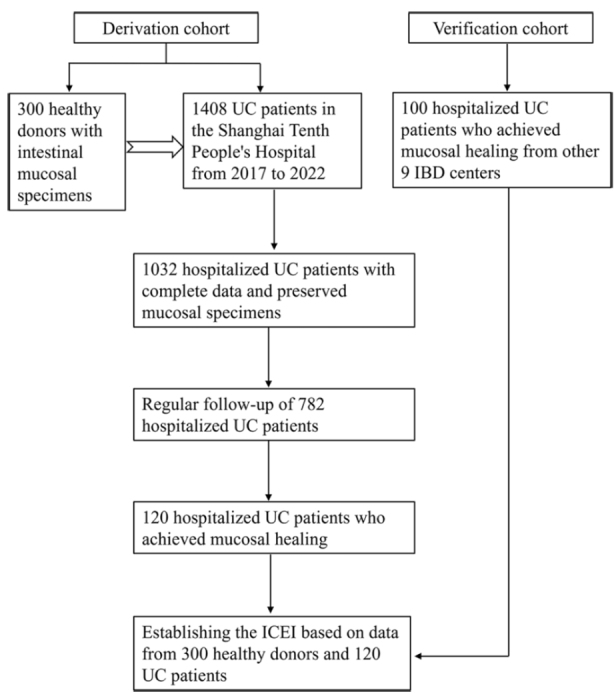
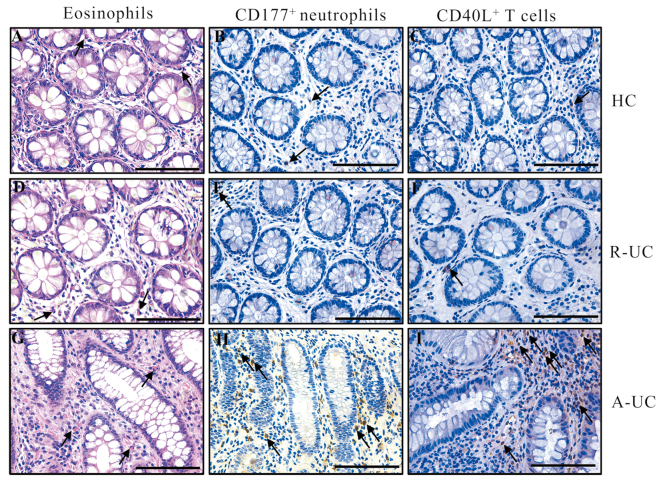
Methods: We conducted a retrospective cohort study in UC patients, whose treatment was iteratively optimized to achieve mucosal healing at Shanghai Tenth People's Hospital of Tongji University from January 2017 to May 2022. We identified an inflammatory cell enumeration index (ICEI) for assessing histological healing based on the proportions of eosinophils, CD177 + neutrophils, and CD40L + T cells in the colonic lamina propria under high power field (HPF), and the outcomes (risks of symptomatic relapses) of achieving histological remission vs . persistent histological inflammation using Kaplan-Meier curves. Intrareader reliability and inter-reader reliability were evaluated by each reader. The relationships to the changes in the Nancy index and the Geboes score were also assessed for responsiveness. The ICEI was further validated in a new cohort of UC patients from other nine university hospitals.
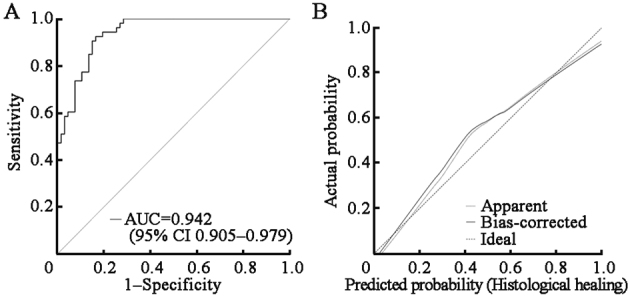
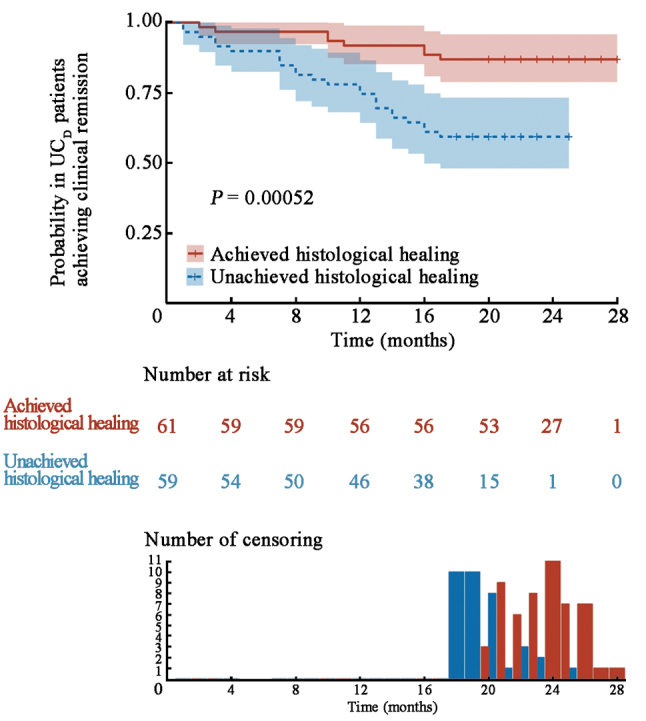
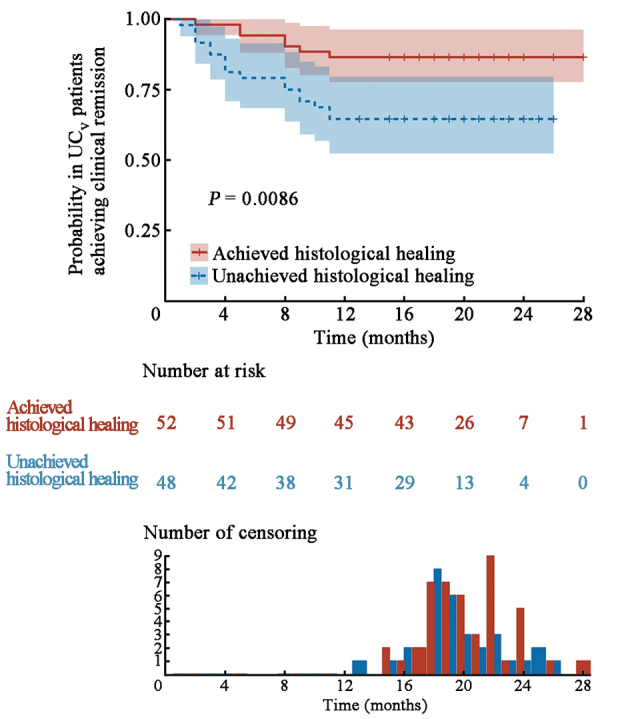
Results: We developed an ICEI for clinical diagnosis of histological healing, i.e., Y = 1.701X 1 + 0.758X 2 + 1.347X 3 - 7.745 (X 1 , X 2 , and X 3 represent the proportions of CD177 + neutrophils, eosinophils, and CD40L + T cells, respectively, in the colonic lamina propria under HPF). The receiver operating characteristics curve (ROC) analysis revealed that Y <-0.391 was the cutoff value for the diagnosis of histological healing and that an area under the curve (AUC) was 0.942 (95% confidence interval [CI]: 0.905-0.979) with a sensitivity of 92.5% and a specificity of 83.6% ( P <0.001). The intraclass correlation coefficient (ICC) for the intrareader reliability was 0.855 (95% CI: 0.781-0.909), and ICEI had good inter-reader reliability of 0.832 (95% CI: 0.748-0.894). During an 18-month follow-up, patients with histological healing had a substantially better outcome compared with those with unachieved histological healing ( P <0.001) using ICEI. During a 12-month follow-up from other nine hospitals, patients with histological healing also had a lower risk of relapse than patients with unachieved histological healing.
Conclusions: ICEI can be used to predict histological healing and identify patients with a risk of relapse 12 months and 18 months after clinical therapy. Therefore, ICEI provides a promising, simplified approach to monitor histological healing and to predict the prognosis of UC.
Registration: Chinese Clinical Trial Registry, No. ChiCTR2300077792.
Copyright © 2024 The Chinese Medical Association, produced by Wolters Kluwer, Inc. under the CC-BY-NC-ND license.
Conflict of interest statement
None.
Figures
References
Publication types
MeSH terms
LinkOut - more resources
Full Text Sources
Medical