. 2024 May 13;22(1):6.
doi: 10.1186/s13053-024-00279-3.

Incidences of colorectal adenomas and cancers under colonoscopy surveillance suggest an accelerated "Big Bang" pathway to CRC in three of the four Lynch syndromes

Affiliations

Incidences of colorectal adenomas and cancers under colonoscopy surveillance suggest an accelerated "Big Bang" pathway to CRC in three of the four Lynch syndromes

Pål Møller et al. Hered Cancer Clin Pract. .

Abstract

Background: Colorectal cancers (CRCs) in the Lynch syndromes have been assumed to emerge through an accelerated adenoma-carcinoma pathway. In this model adenomas with deficient mismatch repair have an increased probability of acquiring additional cancer driver mutation(s) resulting in more rapid progression to malignancy. If this model was accurate, the success of colonoscopy in preventing CRC would be a function of the intervals between colonoscopies and mean sojourn time of detectable adenomas. Contrary to expectations, colonoscopy did not decrease incidence of CRC in the Lynch syndromes and shorter colonoscopy intervals have not been effective in reducing CRC incidence. The prospective Lynch Syndrome Database (PLSD) was designed to examine these issues in carriers of pathogenic variants of the mis-match repair (path_MMR) genes.

Materials and methods: We examined the CRC and colorectal adenoma incidences in 3,574 path_MLH1, path_MSH2, path_MSH6 and path_PMS2 carriers subjected to regular colonoscopy with polypectomy, and considered the results based on sojourn times and stochastic probability paradigms.

Results: Most of the path_MMR carriers in each genetic group had no adenomas. There was no association between incidences of CRC and the presence of adenomas. There was no CRC observed in path_PMS2 carriers.

Conclusions: Colonoscopy prevented CRC in path_PMS2 carriers but not in the others. Our findings are consistent with colonoscopy surveillance blocking the adenoma-carcinoma pathway by removing identified adenomas which might otherwise become CRCs. However, in the other carriers most CRCs likely arised from dMMR cells in the crypts that have an increased mutation rate with increased stochastic chaotic probabilities for mutations. Therefore, this mechanism, that may be associated with no or only a short sojourn time of MSI tumours as adenomas, could explain the findings in our previous and current reports.

Keywords: MLH1; MSH2; MSH6; PMS2; Adenoma; Colonoscopy; Colorectal; Lynch syndromes; MSI; Sojourn time; cancer; dMMR.


Conflict of interest statement

The authors declare no competing interests.

Figures

Fig. 1
Fig. 1
Pie-charts showing total number of colorectal adenomas by genetic variant
Fig. 2
Fig. 2
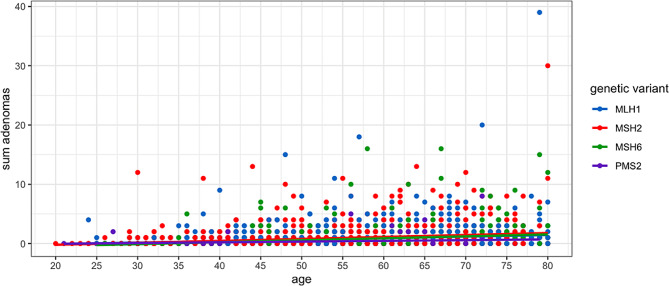
Standard linear regression on the total number of colorectal adenomas by genetic variant and age for age up to 80 years at last examination. Path_PMS2 carriers had less than the others (p < 0.01). Only a few at any age and with any genetic variant had multiple colorectal adenomas. Regression line for MLH1 is hidden under MSH6.
Fig. 3
Fig. 3
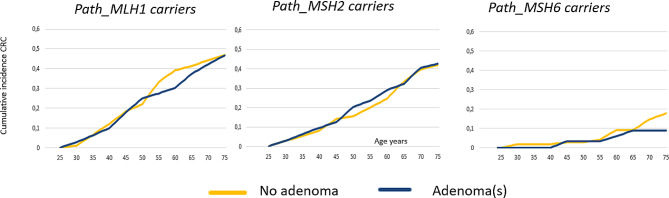
Cumulative incidences of CRC in path_MLH1, path MSH2 and path_MSH6 carriers with and without colorectal adenoma(s)
Fig. 4
Fig. 4
Possible pathways to CRC in LS modified from [6]. Carcinogenesis in LS follows a stochastic process where two major selection pressures apply: selection through conferred growth advantage and counter-selection through the immune system. MMR-deficient crypts may undergo immune elimination (arrows at the bottom central part of the graphic pointing to an empty space left by the eliminated crypt and now filled with immune cells), and MMR-deficient adenomas and cancers might be eliminated by the immune system, too (not shown by arrows). However, cancer may still arise via at least three pathways depicted here. Cancers arising through Pathway 1 may have a longer sojourn time as adenomas, as they spend part of their progression as MMR-proficient adenomas and only later acquire MMR deficiency. At this stage, Pathway 1-cancers can be prevented by colonoscopy. If not prevented, further mutations could accumulate eventually leading to cancer. Cancers arising through Pathway 2 may have shorter sojourn time as adenomas compared to Pathway 1, as they develop from initially MMR-deficient crypts acquiring further mutations to develop into MMR-deficient adenomas, thus not spending time as MMR-proficient lesions. However, the sojourn time as adenoma in Pathway 2 is longer compared to cancers arising through Pathway 3. The latter cancers likely have no sojourn time as adenomas and arise upon a single somatic hit (cnLOH) activating beta-catenin and inactivating MLH1. According to the current knowledge, this pathway is therefore specific for MLH1 carriers. Red arrows indicate regression due to counterselection by the immune system, black arrows indicate progression due to gained growth advantage, dotted black arrows indicate hypothetical progression if removal by colonoscopy did not take place Attribution: Hourglass element is an image by freepik
Fig. 5
Fig. 5
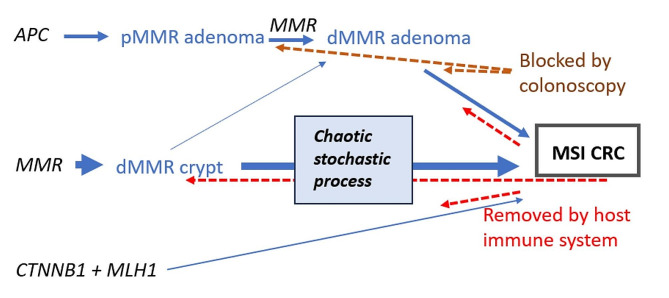
Simplified diagram of possible pathways to MSI CRC in path_MMR carriers, modified from [6, 20], compliant with Fig. 4 and specifying the accelerated chaotic stochastic process Big Bang theory [37] as discussed in the text APC inactivation occurs prior to loss of the wild-type MMR allele resulting in adenoma initiation. Subsequent loss of the second MMR allele in the adenoma generates a dMMR clone with increased risk of progression to cancer The initial event is loss of the second MMR allele resulting in a dMMR crypt causing an accelerated stochastic chaotic probability of mutations (that is greater for path_MLH1 and path_MSH2 compared to path_MSH6 and only marginally raised in Path_PMS2). Many different driver genes may be mutated and in different orders [38], causing no or only a short sojourn time of tumours as adenomas. A dMMR cell may also become a dMMR adenoma In path_MLH1 carriers, a single LOH event at chromosome 3p22 may inactivate the wild-type alleles of the co-located CTNNB1 and MLH1 genes (in a cell that has already sustained a single CTNNB1 mutation, usually at codon 41 or 45 in Exon3). This specific initiating event may occur in up to 40% of CRC in Path_MLH1 carriers [32] Regular colonoscopy may block the adenoma-carcinoma pathway. dMMR/MSI crypts, adenomas and cancer might be removed by the host immune system. Mutated genes in black. pMMR adenoma: MMR proficient adenoma. dMMR adenoma: MMR deficient adenoma

References

    1. Møller P, Seppälä TT, Ahadova A, et al. Dominantly inherited micro-satellite instable cancer - the four Lynch syndromes - an EHTG, PLSD position statement. Hered Cancer Clin Pract. 2023;21(1):19. doi: 10.1186/s13053-023-00263-3. - DOI - PMC - PubMed
    1. https://www.omim.org/ Accessed April 2nd 2024.
    1. Chan TA, Wang Z, Dang LH, Vogelstein B, Kinzler KW. Targeted inactivation of CTNNB1 reveals unexpected effects of beta-catenin mutation. Proc Natl Acad Sci U S A. 2002;99(12):8265–70. doi: 10.1073/pnas.082240999. - DOI - PMC - PubMed
    1. Segditsas S, Tomlinson I. Colorectal cancer and genetic alterations in the wnt pathway. Oncogene. 2006;25:7531–7. doi: 10.1038/sj.onc.1210059. - DOI - PubMed
    1. Jass JR, Stewart SM. Evolution of hereditary non-polyposis colorectal cancer. Gut. 1992;33(6):783–6. doi: 10.1136/gut.33.6.783. - DOI - PMC - PubMed

LinkOut - more resources