Review
. 2024 May 21;5(5):101555.
doi: 10.1016/j.xcrm.2024.101555. Epub 2024 May 13.

Advancements in clinical RNA therapeutics: Present developments and prospective outlooks

Affiliations
Review

Advancements in clinical RNA therapeutics: Present developments and prospective outlooks

Phei Er Saw et al. Cell Rep Med. .

Abstract

RNA molecules have emerged as promising clinical therapeutics due to their ability to target "undruggable" proteins or molecules with high precision and minimal side effects. Nevertheless, the primary challenge in RNA therapeutics lies in rapid degradation and clearance from systemic circulation, the inability to traverse cell membranes, and the efficient intracellular delivery of bioactive RNA molecules. In this review, we explore the implications of RNAs in diseases and provide a chronological overview of the development of RNA therapeutics. Additionally, we summarize the technological advances in RNA-screening design, encompassing various RNA databases and design platforms. The paper then presents an update on FDA-approved RNA therapeutics and those currently undergoing clinical trials for various diseases, with a specific emphasis on RNA medicine and RNA vaccines.

Keywords: RNA medicine; RNA screening; RNA therapeutics; RNA vaccine; clinical translation of RNA.


Conflict of interest statement

Declaration of interests All authors declare no competing interests.

Figures

None
Graphical abstract
Figure 1
Figure 1
A concise historical timeline outlining the discoveries in RNA biology and their subsequent contributions to RNA therapy development
Figure 2
Figure 2
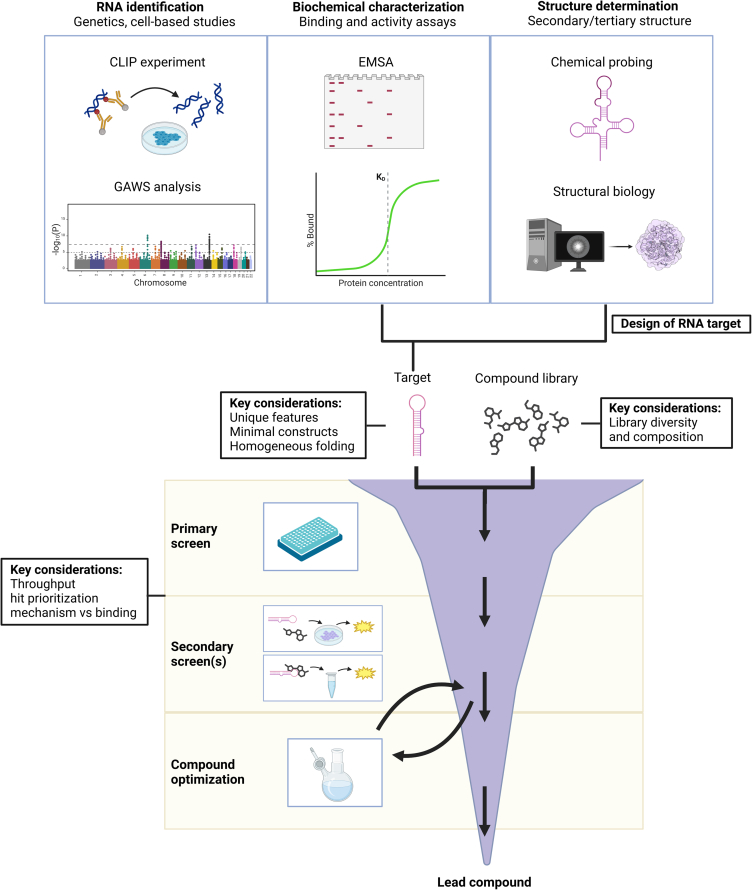
Schematic representation of the RNA screens development workflow (1) Identification of RNAs of interest: Genetic methods, encompassing genome-wide association studies and knockout models, alongside cell-based strategies like immunoprecipitation (CLIP)-based methods and crosslinking, are employed to identify RNAs of interest. (2) Characterization of RNA functions: RNA functions are elucidated through biochemical assays, such as electrophoretic mobility shift assays (EMSA). (3) Design of RNA target construct: Insights derived from functional and structural analyses guide the development of the RNA target construct for the initial high-throughput screening (HTS). (4) HTS: Entails affinity or mechanism-based screens to identify potential hits. (5) Hit validation: Selected hits from HTS are validated using orthogonal secondary assays. (6) Lead compound optimization: Hits undergo iterative modifications to yield a lead compound, optimizing for both efficacy and specificity.
Figure 3
Figure 3
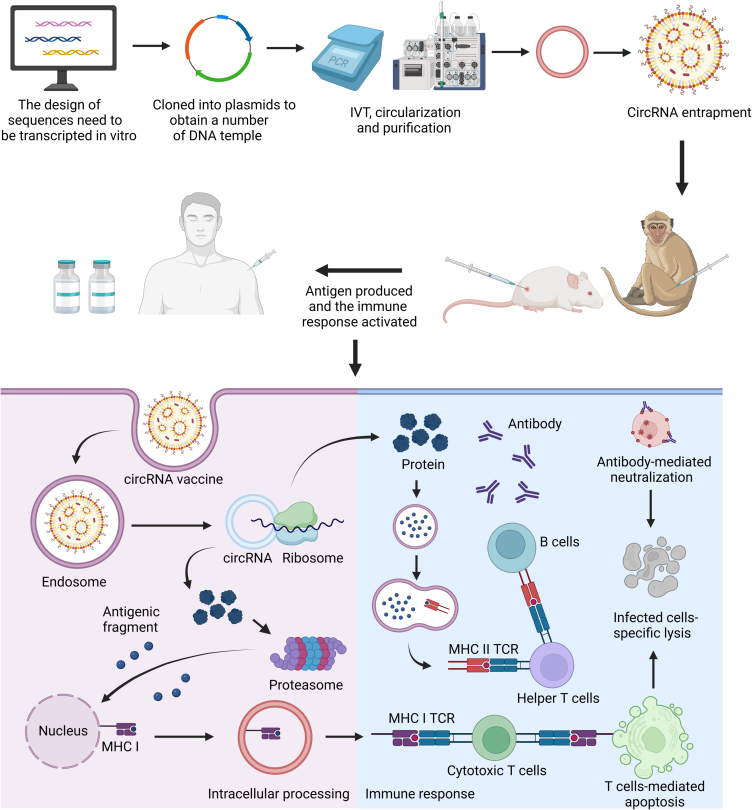
Development of a circRNA vaccine production pipeline and induction of immune response through disease-specific targeted antigen strategies The circRNA vaccine production pipeline entails the design of encoding sequences for peptides/proteins, subsequently cloned into a plasmid DNA construct. Plasmid DNA is transcribed into a linear RNA precursor (pre-circRNA) using in vitro transcribed (IVT) technology. The pre-circRNA is then cyclized in vitro to form circRNA, followed by purification using high-performance liquid chromatography (HPLC). The purified circRNA is encapsulated in various vehicles (i.e., viral-like particles, liposomes). Prior to clinical trials, comprehensive biosafety and pharmacodynamic evaluations are imperative. The scale-up manufacturing of circRNA vaccine precedes clinical trials. Upon initiation of antigen-specific immune responses, intracellular processes of circRNA vaccines focus on immune initiation, antigen encoding, and endosome escape within antigen-presenting cells (APCs): (1) Endosomes are formed by circRNA vaccines-containing LNPs in the cytoplasm. (2) Subsequently, the circRNA vaccine is released from the endosomes. (3) The encoding sequences in circRNA then undergo translation, yielding proteins or peptides with antigenic properties. (4) Endogenous antigens undergo degradation by proteasomes, resulting in the formation of polypeptides subsequently presented by MHC I, (5) ultimately activating cytotoxic CD8+ T cells. Humoral immunity initiated by circRNA is as crucial, (6) due to the secretion of endogenous antigens eventually presented to helper T cells by MHC class II proteins. In turn, these helper T cells (CD4+ T cells) stimulate the production of neutralizing antibodies by B cells.

References

    1. Wei C., Xu Y., Shen Q., Li R., Xiao X., Saw P.E., Xu X. Role of long non-coding RNAs in cancer: From subcellular localization to nanoparticle-mediated targeted regulation. Mol. Ther. Nucleic Acids. 2023;33:774–793. doi: 10.1016/j.omtn.2023.07.009. - DOI - PMC - PubMed
    1. Hahne J.C., Lampis A., Valeri N. Vault RNAs: hidden gems in RNA and protein regulation. Cell. Mol. Life Sci. 2021;78:1487–1499. doi: 10.1007/s00018-020-03675-9. - DOI - PMC - PubMed
    1. Gulìa C., Signore F., Gaffi M., Gigli S., Votino R., Nucciotti R., Bertacca L., Zaami S., Baffa A., Santini E., et al. Y RNA: An Overview of Their Role as Potential Biomarkers and Molecular Targets in Human Cancers. Cancers. 2020;12 doi: 10.3390/cancers12051238. - DOI - PMC - PubMed
    1. Iwasaki Y.W., Siomi M.C., Siomi H. PIWI-Interacting RNA: Its Biogenesis and Functions. Annu. Rev. Biochem. 2015;84:405–433. doi: 10.1146/annurev-biochem-060614-034258. - DOI - PubMed
    1. Li X., Loh T.J., Lim J.J., Er Saw P., Liao Y. Glycan-RNA: a new class of non-coding RNA. BIO Integration. 2022;3:124–131. doi: 10.15212/bioi-2021-0032. - DOI