


Global projections of heat exposure of older adults
- PMID: 38744815
- PMCID: PMC11094092
- DOI: 10.1038/s41467-024-47197-5
Global projections of heat exposure of older adults
Abstract
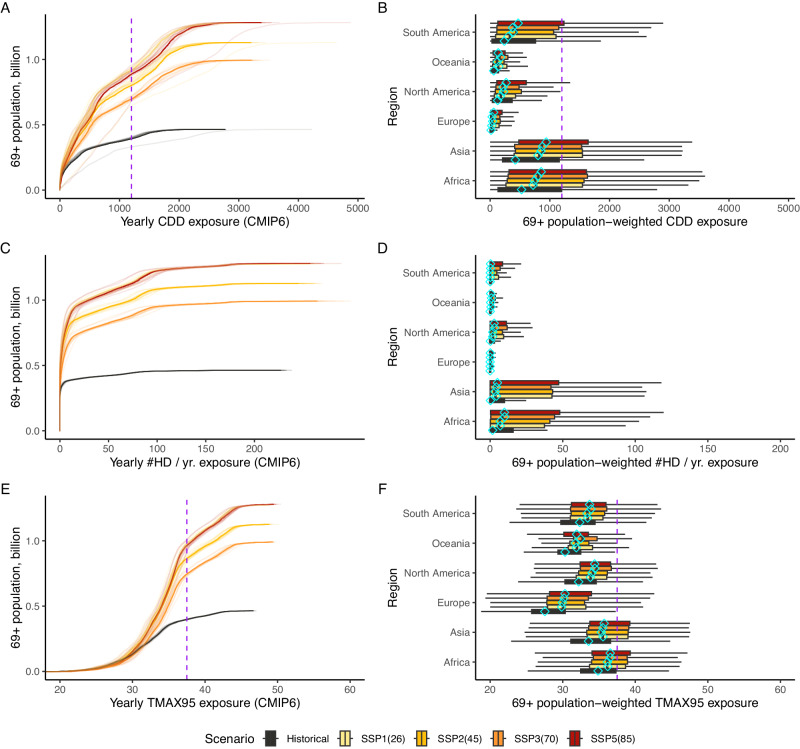
The global population is aging at the same time as heat exposures are increasing due to climate change. Age structure, and its biological and socio-economic drivers, determine populations' vulnerability to high temperatures. Here we combine age-stratified demographic projections with downscaled temperature projections to mid-century and find that chronic exposure to heat doubles across all warming scenarios. Moreover, >23% of the global population aged 69+ will inhabit climates whose 95th percentile of daily maximum temperature exceeds the critical threshold of 37.5 °C, compared with 14% today, exposing an additional 177-246 million older adults to dangerous acute heat. Effects are most severe in Asia and Africa, which also have the lowest adaptive capacity. Our results facilitate regional heat risk assessments and inform public health decision-making.
© 2024. The Author(s).
Conflict of interest statement
The authors declare no competing interests.
Figures



References
-
- IPCC. Climate Change 2022: Impacts, Adaptation, and Vulnerability. Contribution of Working Group II to the Sixth Assessment Report of the Intergovernmental Panel on Climate Change (Cambridge University Press, New York, 2022).
MeSH terms
Grants and funding
- 756194/EC | EU Framework Programme for Research and Innovation H2020 | H2020 Priority Excellent Science | H2020 European Research Council (H2020 Excellent Science - European Research Council)
- 756194/EC | EU Framework Programme for Research and Innovation H2020 | H2020 Priority Excellent Science | H2020 European Research Council (H2020 Excellent Science - European Research Council)
- DE-SC0022141/DOE | Office of Science (SC)
LinkOut - more resources
Full Text Sources
Medical
