. 2024 May 14;14(1):10985.
doi: 10.1038/s41598-024-61925-3.

Prognostic relevance of radiological findings on early postoperative MRI for 187 consecutive glioblastoma patients receiving standard therapy

Affiliations

Prognostic relevance of radiological findings on early postoperative MRI for 187 consecutive glioblastoma patients receiving standard therapy

Alexander Malcolm Rykkje et al. Sci Rep. .

Abstract

Several prognostic factors are known to influence survival for patients treated with IDH-wildtype glioblastoma, but unknown factors may remain. We aimed to investigate the prognostic implications of early postoperative MRI findings. A total of 187 glioblastoma patients treated with standard therapy were consecutively included. Patients either underwent a biopsy or surgery followed by an early postoperative MRI. Progression-free survival (PFS) and overall survival (OS) were analysed for known prognostic factors and MRI-derived candidate factors: resection status as defined by the response assessment in neuro-oncology (RANO)-working group (no contrast-enhancing residual tumour, non-measurable contrast-enhancing residual tumour, or measurable contrast-enhancing residual tumour) with biopsy as reference, contrast enhancement patterns (no enhancement, thin linear, thick linear, diffuse, nodular), and the presence of distant tumours. In the multivariate analysis, patients with no contrast-enhancing residual tumour or non-measurable contrast-enhancing residual tumour on the early postoperative MRI displayed a significantly improved progression-free survival compared with patients receiving only a biopsy. Only patients with non-measurable contrast-enhancing residual tumour showed improved overall survival in the multivariate analysis. Contrast enhancement patterns were not associated with survival. The presence of distant tumours was significantly associated with both poor progression-free survival and overall survival and should be considered incorporated into prognostic models.


Conflict of interest statement

The authors declare no competing interests.

Figures
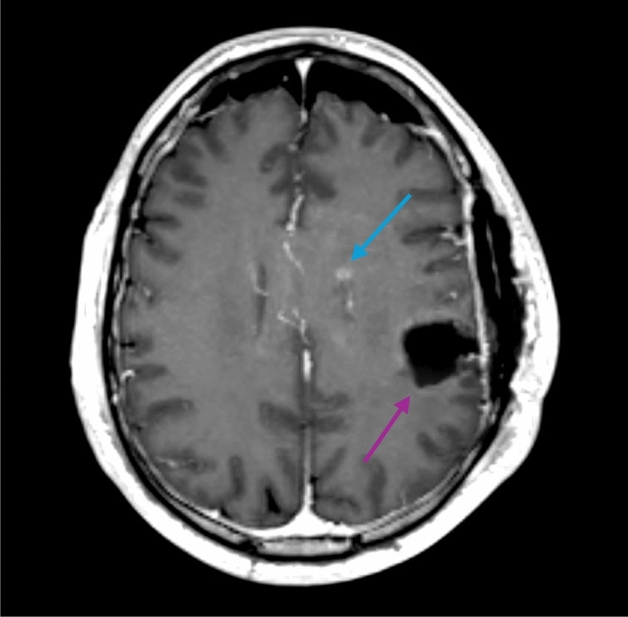
Figure 1
Figure 1
Axial gadolinium-enhanced T1-weighted image of a patient with a distant tumour (yellow arrow). The distant tumour is seen anteromesial to the resection cavity (blue arrow).
Figure 2
Figure 2
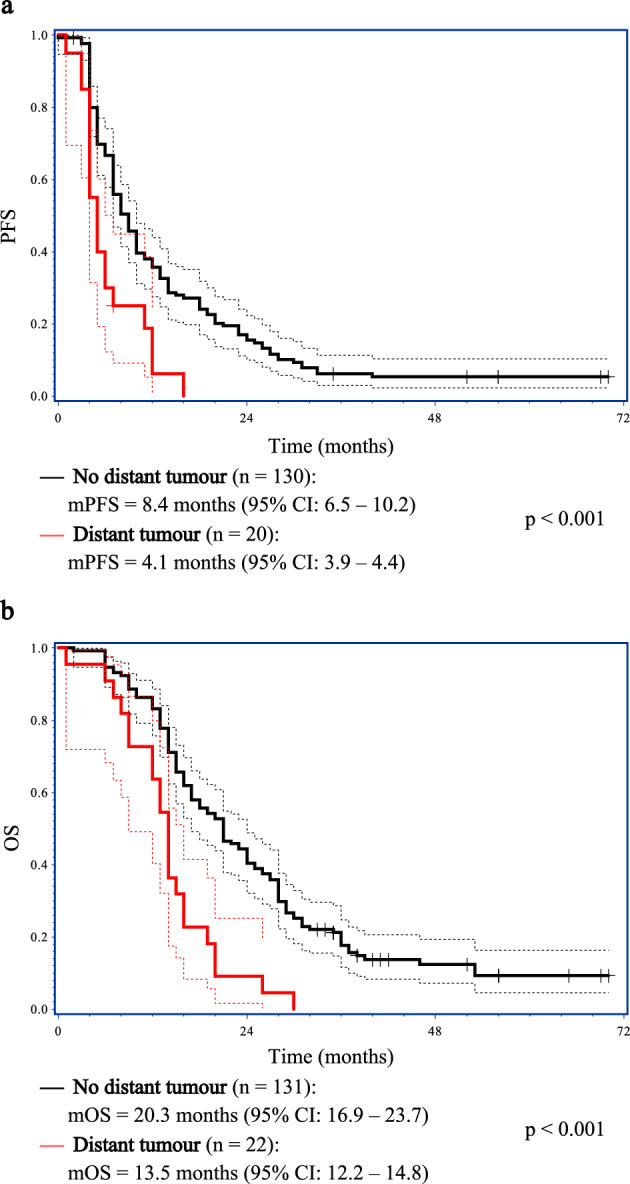
Kaplan–Meier plots with median progression-free survival (mPFS) (a) and median overall survival (mOS) (b) for patients with or without distant tumour. Dotted lines represent the 95% confidence intervals (CI), while vertical markers indicate censored patients. Median PFS and OS with 95% CIs are presented below each plot.
Figure 3
Figure 3
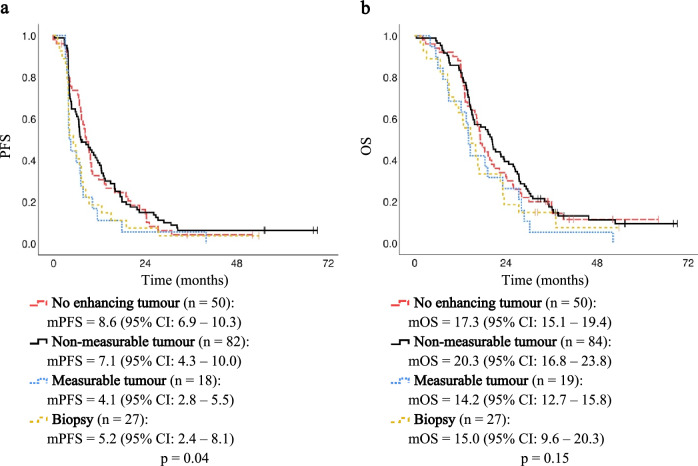
Kaplan–Meier plots with median progression-free survival (mPFS) (a) and median overall survival (mOS) (b) for patients with either no contrast-enhancing residual tumour, non-measurable contrast-enhancing residual tumour, measurable contrast-enhancing residual tumour, or biopsy. The vertical markers indicate censored patients. Median PFS and OS with 95% confidence intervals (CI) are presented below each plot.

References

    1. Helseth R, et al. Overall survival, prognostic factors, and repeated surgery in a consecutive series of 516 patients with glioblastoma multiforme. Acta Neurol. Scand. 2010;122:159–167. doi: 10.1111/j.1600-0404.2010.01350.x. - DOI - PubMed
    1. Stupp R, Tonn J-C, Brada M, Pentheroudakis G, ESMO Guidelines Working Group High-grade malignant glioma: ESMO Clinical Practice Guidelines for diagnosis, treatment and follow-up. Ann. Oncol. 2010;21:v190–193. doi: 10.1093/annonc/mdq187. - DOI - PubMed
    1. Stupp R, et al. Radiotherapy plus concomitant and adjuvant temozolomide for glioblastoma. N. Engl. J. Med. 2005;352:987–996. doi: 10.1056/NEJMoa043330. - DOI - PubMed
    1. Wen PY, et al. Glioblastoma in adults: A society for neuro-oncology (SNO) and European society of neuro-oncology (EANO) consensus review on current management and future directions. Neuro-Oncology. 2020;22:1073–1113. doi: 10.1093/neuonc/noaa106. - DOI - PMC - PubMed
    1. Abedi AA, et al. A prognostic model for glioblastoma patients treated with standard therapy based on a prospective cohort of consecutive non-selected patients from a single institution. Front. Oncol. 2021;11:597587. doi: 10.3389/fonc.2021.597587. - DOI - PMC - PubMed

MeSH terms