. 2024 May 14;12(1):89.
doi: 10.1186/s40168-024-01804-1.

Dietary fibre supplementation enhances radiotherapy tumour control and alleviates intestinal radiation toxicity

Affiliations

Dietary fibre supplementation enhances radiotherapy tumour control and alleviates intestinal radiation toxicity

Chee Kin Then et al. Microbiome. .

Abstract

Background: Non-toxic approaches to enhance radiotherapy outcomes are beneficial, particularly in ageing populations. Based on preclinical findings showing that high-fibre diets sensitised bladder tumours to irradiation by modifying the gut microbiota, along with clinical evidence of prebiotics enhancing anti-cancer immunity, we hypothesised that dietary fibre and its gut microbiota modification can radiosensitise tumours via secretion of metabolites and/or immunomodulation. We investigated the efficacy of high-fibre diets combined with irradiation in immunoproficient C57BL/6 mice bearing bladder cancer flank allografts.

Result: Psyllium plus inulin significantly decreased tumour size and delayed tumour growth following irradiation compared to 0.2% cellulose and raised intratumoural CD8+ cells. Post-irradiation, tumour control positively correlated with Lachnospiraceae family abundance. Psyllium plus resistant starch radiosensitised the tumours, positively correlating with Bacteroides genus abundance and increased caecal isoferulic acid levels, associated with a favourable response in terms of tumour control. Psyllium plus inulin mitigated the acute radiation injury caused by 14 Gy. Psyllium plus inulin increased caecal acetate, butyrate and propionate levels, and psyllium alone and psyllium plus resistant starch increased acetate levels. Human gut microbiota profiles at the phylum level were generally more like mouse 0.2% cellulose profiles than high fibre profiles.

Conclusion: These supplements may be useful in combination with radiotherapy in patients with pelvic malignancy. Video Abstract.

Keywords: Cancer; Dietary fibre; Gut microbiota; Immunomodulation; Isoferulic acid; Radiotherapy; Short-chain fatty acids.


Conflict of interest statement

The authors declare that they have no competing interests.

Figures
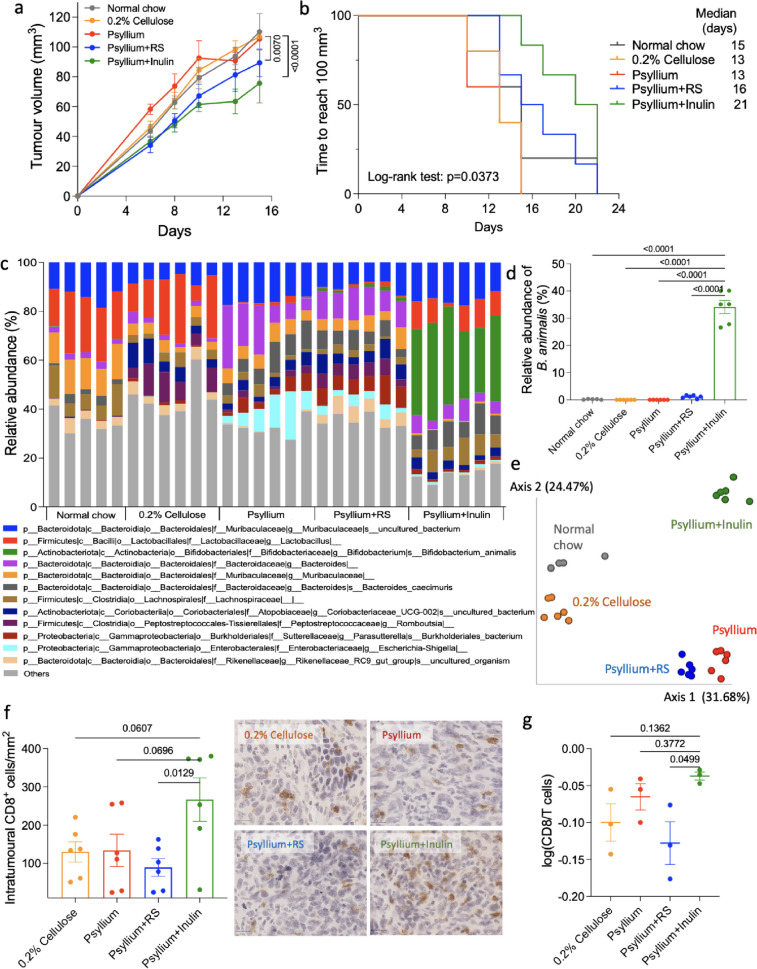
Fig. 1
Fig. 1
Psyllium plus RS and psyllium plus inulin cause increased tumour growth delay in bladder cancer cell allografts. a Treatment of UPPL1591 allografts with normal chow, low fibre (0.2% cellulose) and high fibre diets including psyllium, psyllium plus RS or inulin (n = 6 for each group). Slopes of tumour curves were calculated by linear regression to represent tumour growth rates. b Kaplan–Meier survival curve of mice with UPPL1591 allografts showing plots of time to tumour volume of 100 mm3. c Phylogenetic composition of the faecal microbiota when tumours reached 100 mm3. d Relative abundance of Bifidobacterium animalis of high fibre groups compared to psyllium plus inulin group. e Principal coordinate analysis of faecal microbiotas using Bray-Curtis dissimilarity. ADONIS test was used to confirm the existence of significant group differences in terms of gut microbiota composition. f IHC staining of CD8+ cells to assess the numbers of cytotoxic T cells in tumours (n = 6/group) and the representative images. One-way ANOVA with Bonferroni’s multiple comparison test was used to compare the means of different dietary groups. g NanoString analysis of CD8+ cells over T cells to assess the populations of cytotoxic T cells in tumours (n = 3/group). a, d, f and g One-way ANOVA with Bonferroni’s multiple comparison test was used to compare the means among different dietary groups. Data are presented as mean ± SEM
Fig. 2
Fig. 2
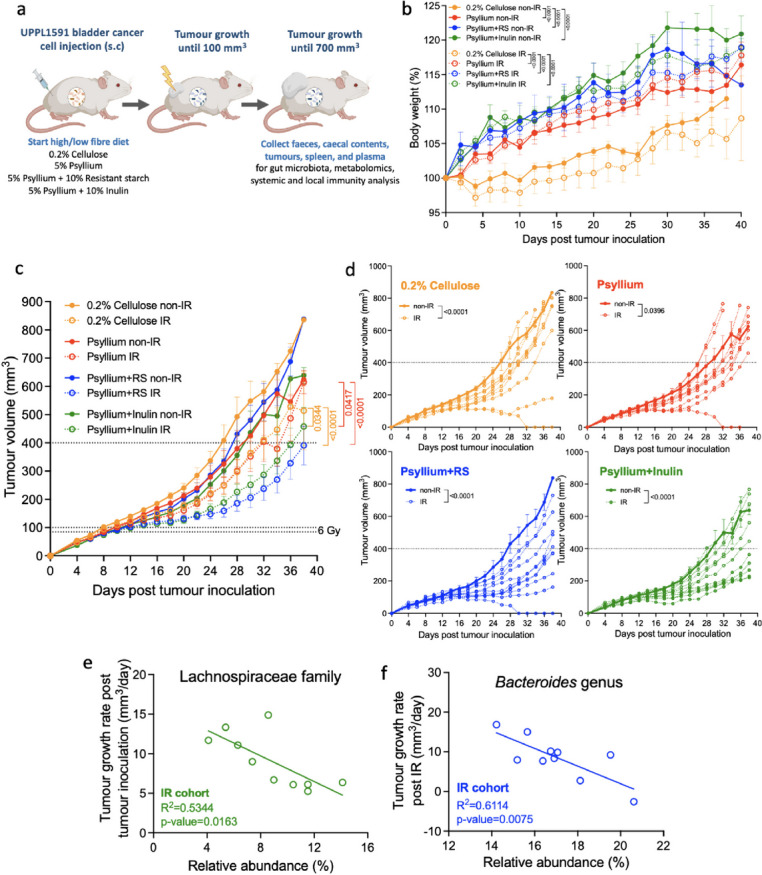
Psyllium plus RS or psyllium plus inulin enhanced tumour control combined with IR in bladder cancer cell allografts. a UPPL1591 bladder cancer cells were injected subcutaneously in the flank of C57BL/6 mice on the same day that they started on a low or high-fibre diet (n = 6/group). Tumours were irradiated with 6 Gy IR when they reached 80–100 mm3 and monitored until 700 mm3. Retrieved from https://app.biorender.com/biorender-templates. b Body weight changes of mice fed with modified diets across the whole experiment. The weight on the first day of tumour inoculation was set to 100%. c Growth curves of tumours that were irradiated with 6 Gy when they reached 80–100 mm3 and monitored until 700 mm3. Day 0 was the day of tumour inoculation and when the mice started taking modified diets. The overall growth curves of non-irradiated and irradiated mice were plotted in solid and dotted lines, respectively. Two-way ANOVA with Bonferroni’s multiple comparison test was used to compare the means of different dietary groups while taking irradiation into account. d Individual tumour growth curves stratified into non-IR and IR. Solid lines were the mean of tumour growth curves of non-IR mice and dotted lines were individual growth curves of IR mice. Slopes of tumour curves were calculated by linear regression to represent tumour growth rates. e Correlation between the Lachnospiraceae family relative abundance versus the tumour growth in non-IR and IR cohorts of psyllium plus inulin. Tumour curve slopes were calculated by linear regression to represent tumour growth rates. f Correlation between the Bacteroides species relative abundance versus the tumour growth in IR cohort of psyllium plus RS. e, f The associations were assessed using the Pearson correlation method
Fig. 3
Fig. 3
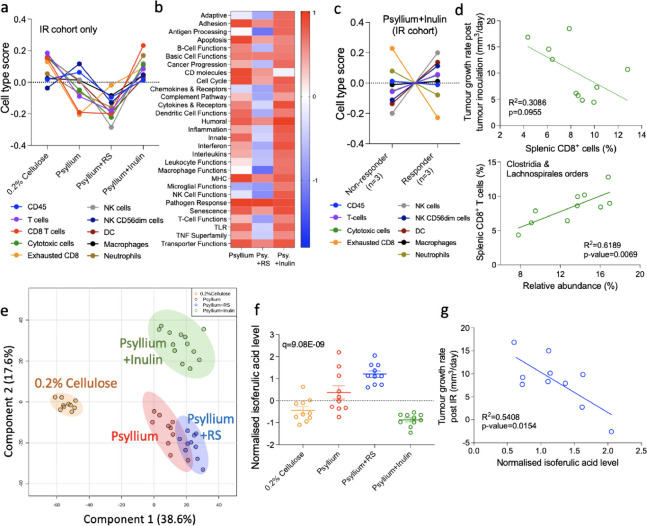
Modulation of local immune responses and caecal metabolites profile by psyllium plus either inulin or RS. a Immune cell profiling and b pathways of NanoString platform were used to study the local tumour immunity (n = 6/group). c Immune cell profiling in responders and non-responders to IR in psyllium plus inulin groups (n = 3/group). d Correlation of splenic cytotoxic T cells versus tumour growth rates in the IR cohort of psyllium plus inulin group. Correlations between the Clostridia and Lachnospirales orders versus the tumour growth rate and population of splenic cytotoxic T cells in the IR cohort of the psyllium plus inulin group. c, d The associations were assessed using Pearson’s correlation method. e Principal component analysis of caecal metabolites of different dietary groups. A notable clustering effect by diets was seen in the metabolites. ADONIS test was used to confirm the existence of significant differences among different dietary groups in terms of metabolite profiles. f Caecal isoferulic acid levels normalised by the median in all dietary groups. ANOVA test, followed by post-hoc analysis using Fisher’s LSD and p value adjustment using the Benjamin-Hochberg method, was used to assess the significance of differences among each dietary group. g Correlation between the caecal isoferulic acid level and tumour growth rate in the IR cohort of the psyllium plus RS was assessed using Pearson’s correlation method. Data are presented as mean ± SEM
Fig. 4
Fig. 4
Psyllium plus inulin mitigated the radiation injury from 14 Gy in intestinal crypt assays. a, b Overview of acute normal tissue toxicity experiment. Two weeks after starting low or high-fibre diets, C57BL/6 mice were treated supine with 10–14 Gy SARRP IR to their lower abdomen (n = 21/group). Tissues were collected 3.75 days after IR to assess the acute normal tissue responses. Retrieved from https://app.biorender.com/biorender-templates. c Small intestinal crypt assay survival for modified diets and IR (n = 6 per group, except for 0 Gy IR: n = 3). Data were normalised to mean crypts per mm of three mock samples. Kruskal-Wallis test and Dunn’s multiple comparison tests were used to compare the number of remaining crypts among the dietary groups. d Caecal SCFAs in non-tumour-bearing mice after a 3-week modified diet. One-way ANOVA with Bonferroni’s multiple comparison test was used to compare the means of different groups. Data are presented as mean ± SEM
Fig. 5
Fig. 5
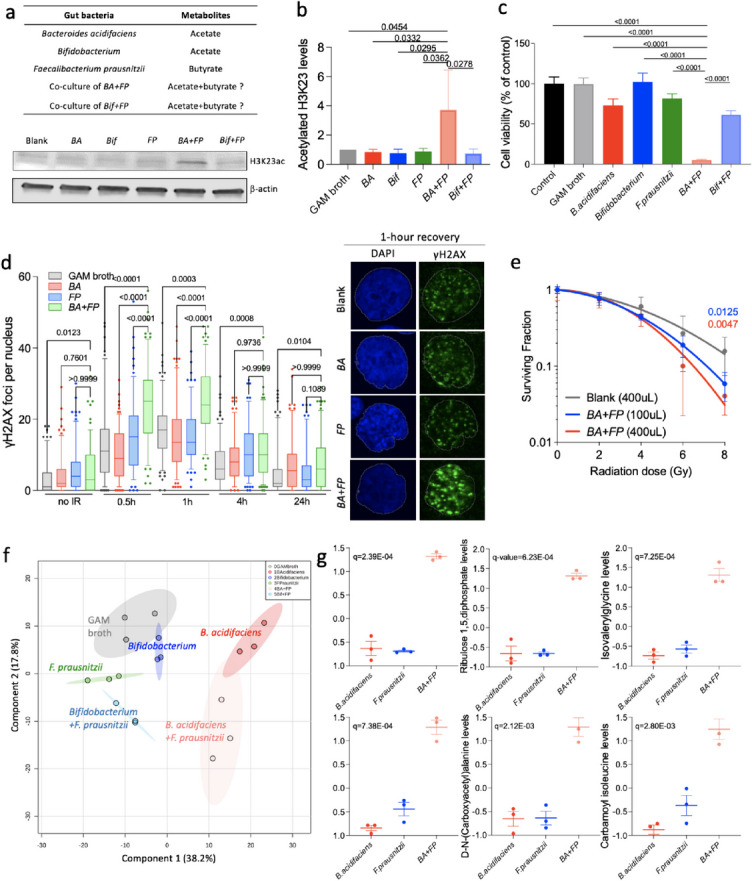
Bacterial supernatants from the cocultures of B. acidifaciens and F. prausnitzii conferred stronger anti-tumour phenotypes in bladder cancer cells. a The five bacterial supernatants used in this experiment. b Western blot analysis of histone acetylation (N = 3) of RT112 cells treated with different bacterial supernatants. Histone acetylation levels were determined after treating with 100 mL bacterial supernatants in 2 mL of medium for 24 h. c The cell survival of RT112 cells treated with 200 mL of GAM broth or bacterial supernatants in 500 mL of medium for 2 days (N = 3). d Immunofluorescence microscopy analysis of γ-H2AX levels (N = 3) in RT112 cells treated with 100 mL bacterial supernatants in 2 mL of medium for 24 h. DNA damage was evaluated after treating with 2 Gy IR. Kruskal-Wallis test and Dunn’s multiple comparison tests were conducted to compare the means of different groups. e Linear quadratic survival curves of RT112 cells treated with 100 or 400 μL bacterial supernatant from BA+FP for 24 h before receiving irradiation of 0–8 Gy (N = 3). b, c and e One-way ANOVA with Bonferroni’s multiple comparison test was used to compare the means of different dietary groups. f Principal component analysis of known metabolites of different bacterial supernatants. The clustering effect was assessed using the ADONIS test (R2 = 0.6495, Pr(>F) = 0.001). g Relative levels of metabolites enriched in the bacterial supernatant of BA+FP. ANOVA test, followed by post-hoc analysis using Fisher’s LSD and p value adjustment using the Benjamin-Hochberg method, was applied to identify the metabolites with significantly different levels across the groups. pHs of GAM broth and bacterial supernatants were all neutralised to 7.2. BA+FP denotes the co-culture of B. acidifaciens and F. prausnitzii, while Bif+FP denotes the co-culture of Bifidobacterium and F. prausnitzii. Data are presented as mean ± SD
Fig. 6
Fig. 6
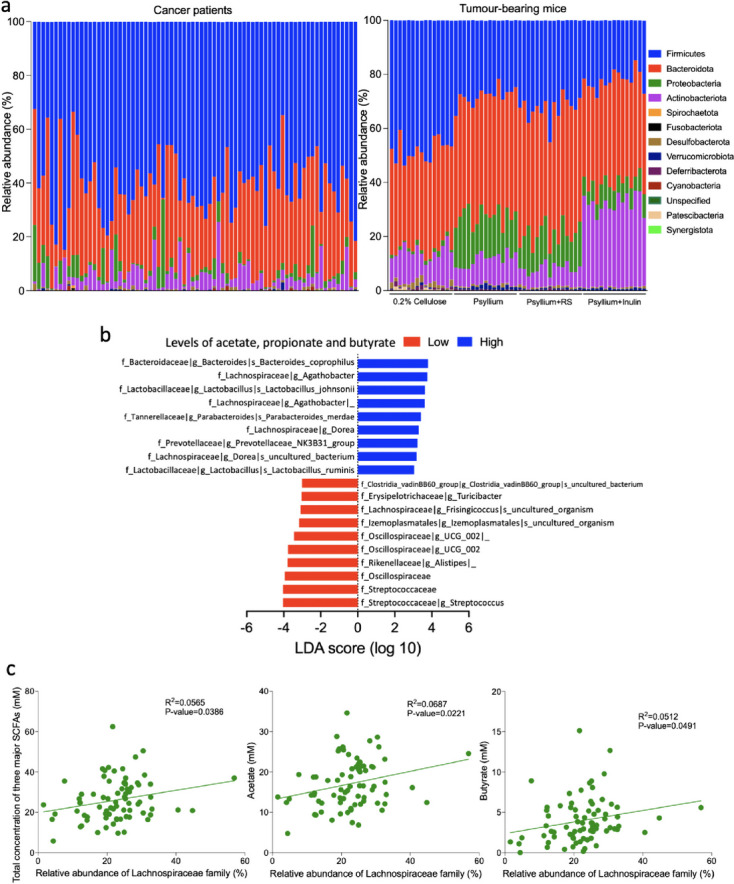
Comparison of gut microbiota from pelvic cancer patients and tumour-bearing mice treated with a low-fibre diet. a Relative abundances of bacteria at the phyla level between cancer patients and mice fed on different diets. b Linear discriminant analysis (LDA) scores were computed for differentially abundant taxa in the patients with either high or low faecal acetate, propionate and butyrate concentrations. Median of the three SCFAs combined was the cut-off between high and low levels. The alpha value was 0.05 for the Kruskal-Wallis test and the length of the bar indicates the effect size associated with a taxon. c Correlations between Lachnospiraceae family versus the total concentration of three major gut microbiota produced SCFAs, acetate and butyrate were assessed using Pearson’s correlation method

References

    1. James ND, Hussain SA, Hall E, Jenkins P, Tremlett J, Rawlings C, et al. Radiotherapy with or without chemotherapy in muscle-invasive bladder cancer. New Engl J Med. 2012;366(16):1477–1488. doi: 10.1056/NEJMoa1106106. - DOI - PubMed
    1. Boustani J, Bertaut A, Galsky MD, Rosenberg JE, Bellmunt J, Powles T, et al. Radical cystectomy or bladder preservation with radiochemotherapy in elderly patients with muscle-invasive bladder cancer: Retrospective International Study of Cancers of the Urothelial Tract (RISC) Investigators. Acta Oncol. 2018;57(4):491–497. doi: 10.1080/0284186X.2017.1369565. - DOI - PubMed
    1. Okumura R, Takeda K. Maintenance of intestinal homeostasis by mucosal barriers. Inflamm Regen. 2018;38:5. doi: 10.1186/s41232-018-0063-z. - DOI - PMC - PubMed
    1. Misheva M, Ilott NE, McCullagh JSO. Recent advances and future directions in microbiome metabolomics. Curr Opin Endocr Metab Res. 2021;20:100283. doi: 10.1016/j.coemr.2021.07.001. - DOI
    1. Gopalakrishnan V, Spencer CN, Nezi L, Reuben A, Andrews MC, Karpinets TV, et al. Gut microbiome modulates response to anti-PD-1 immunotherapy in melanoma patients. Science. 2018;359(6371):97–103. doi: 10.1126/science.aan4236. - DOI - PMC - PubMed