Review
. 2024 Apr 29:15:1353234.
doi: 10.3389/fphar.2024.1353234. eCollection 2024.

A review on the pharmacology, pharmacokinetics and toxicity of sophocarpine

Affiliations
Review

A review on the pharmacology, pharmacokinetics and toxicity of sophocarpine

Shichao Wei et al. Front Pharmacol. .

Abstract

Sophocarpine is a natural compound that belongs to the quinolizidine alkaloid family, and has a long history of use and widespread distribution in traditional Chinese herbal medicines such as Sophora alopecuroides L., Sophora flavescens Ait., and Sophora subprostrata. This article aims to summarize the pharmacology, pharmacokinetics, and toxicity of sophocarpine, evaluate its potential pharmacological effects in various diseases, and propose the necessity for further research and evaluation to promote its clinical application. A large number of studies have shown that it has anti-inflammatory, analgesic, antiviral, antiparasitic, anticancer, endocrine regulatory, and organ-protective effects as it modulates various signaling pathways, such as the NF-κB, MAPK, PI3K/AKT, and AMPK pathways. The distribution of sophocarpine in the body conforms to a two-compartment model, and sophocarpine can be detected in various tissues with a relatively short half-life. Although the pharmacological effects of sophocarpine have been confirmed, toxicity and safety assessments and reports on molecular mechanisms of its pharmacological actions have been limited. Given its significant pharmacological effects and potential clinical value, further research and evaluation are needed to promote the clinical application of sophocarpine.

Keywords: pharmacokinetics; pharmacology; review; sophocarpine; toxicity.


Conflict of interest statement

The authors declare that the research was conducted in the absence of any commercial or financial relationships that could be construed as a potential conflict of interest.

Figures

FIGURE 1
FIGURE 1
The molecular structure (A) and chemical 3D structure (B) of sophocarpine.
FIGURE 2
FIGURE 2
Antitumor effects of sophocarpine through multiple signaling pathways. The antitumor activity of sophocarpine is mainly achieved by interfering with multiple signaling pathways in tumor cells. It can inhibit the proliferation and invasion of tumor cells, as well as their migration and metastasis. Additionally, sophocarpine can regulate the apoptotic signaling pathway in tumor cells, promoting their apoptosis and thus inhibiting tumor growth and spread. Furthermore, sophocarpine also exhibited immunomodulatory effects on tumors. Overall, as a natural compound, sophocarpine has promising potential in the field of cancer treatment.
FIGURE 3
FIGURE 3
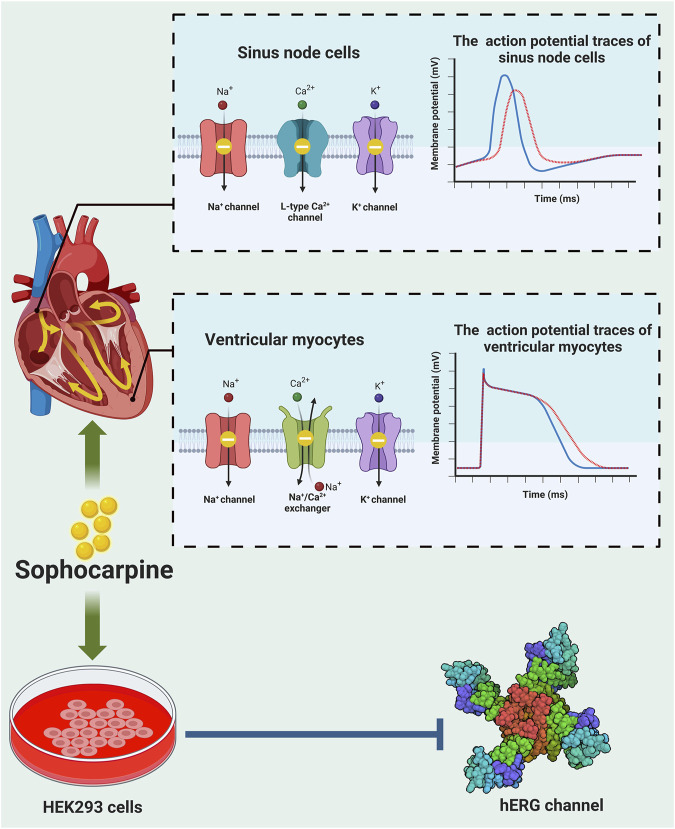
Anti-arrhythmic effects of sophocarpine. Sophocarpine has the property of blocks multiple ion channels, and its antiarrhythmic function is the result of its combined effect on these ion channels. Top: When sophocarpine was used to conduct action potential experiments on the sinoatrial node and ventricular muscles, it is found to significantly inhibit potassium, sodium, calcium ion channels and sodium-calcium exchangers (left), leading to a decrease in action potential (AP), prolongation of action potential duration (APD) and decrease in the action potential peak (right). blue strand: normal AP trace; red strand: AP trace after treatment with sophocarpine. Bottom: Sophocarpine can inhibit the hERG channel (PDB:7CN0) -mediated potassium ion tail current in HEK293 cells. These effects reverse the arrhythmias induced by isoproterenol.
FIGURE 4
FIGURE 4
Neurotoxicity and cardiotoxicity of sophocarpine. When zebrafish embryos are exposed to sophocarpine, their behavioral assessments show a decrease in activity and coordination, along with abnormal movement and swimming performance. In cardiac muscle cells, the cardiotoxicity of sophocarpine is associated with disruptions in calcium homeostasis and oxidative stress, leading to pathological apoptosis. These findings collectively indicate that sophocarpine may have adverse effects on the nervous system and the heart.

References

    1. Anders H. J., Saxena R., Zhao M. H., Parodis I., Salmon J. E., Mohan C. (2020). Lupus nephritis. Nat. Rev. Dis. Prim. 6, 7. 10.1038/s41572-019-0141-9 - DOI - PubMed
    1. Atanasov A. G., Zotchev S. B., Dirsch V. M., International Natural Product Sciences T., Supuran C. T. (2021). Natural products in drug discovery: advances and opportunities. Nat. Rev. Drug Discov. 20, 200–216. 10.1038/s41573-020-00114-z - DOI - PMC - PubMed
    1. Bao-Xin L. (2009). Pharmacokinetic properties of sophocarpine and sophoridine.
    1. Bian K., Toda N. (1988). Effects of sophoramine, an alkaloid from Sophora alopecuroides on isolated dog blood vessels. J. Ethnopharmacol. 24, 167–178. 10.1016/0378-8741(88)90148-1 - DOI - PubMed
    1. Butler A., Helliwell M. V., Zhang Y., Hancox J. C., Dempsey C. E. (2019). An update on the structure of hERG. Front. Pharmacol. 10, 1572. 10.3389/fphar.2019.01572 - DOI - PMC - PubMed

LinkOut - more resources