Nature of Parkinsonian features in multiple system atrophy
- PMID: 38746510
- PMCID: PMC11090571
- DOI: 10.25259/JNRP_445_2023
Nature of Parkinsonian features in multiple system atrophy
Abstract
Objectives: For this observational study, we evaluated the clinical profile of Parkinsonian features in multiple system atrophy (MSA), as there is no clarity about the specifics of these features in this disease compared to progressive supranuclear palsy (PSP) and Parkinson's disease (PD).
Materials and methods: Here, we selected 57 patients with MSA based on standard criteria and grouped them into two categories - Parkinsonian variant of MSA (MSA-P) and cerebellar variant of MSA (MSA-C). However, researchers did not distinguish among patients based on the nature of extrapyramidal syndrome or levodopa responsiveness. Then, we examined the patients at the time of their first visit to outpatient clinics or indoor wards and recorded and analyzed the specific extrapyramidal features or their variations.
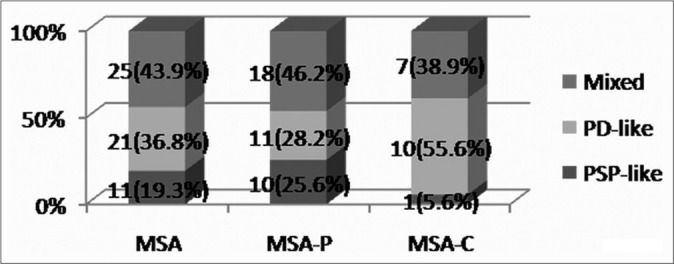
Results: The extrapyramidal features including levodopa responsiveness were highly variable among MSA-C as well as MSA-P patients. A subset of patients presented with features resembling PSP (symmetry [56.1%], axial rigidity [52.6%], backward falls [28.1%], and down-gaze restriction [17.5%]), while others presented with features resembling PD (asymmetry [43.9%], tremors [71.9%], and peripheral rigidity [40.4%]). After grouping patients based on predominant extrapyramidal features, 36.8% of patients had PD-like, 19.3% had PSP-like, and 43.9 % had mixed presentation. Moreover, 86% of patients had a perceptible levodopa response, including a sustained response for more than six months in 64% of patients.
Conclusion: Extrapyramidal features in MSA patients may be PD-like, PSP-like, or mixed. Moreover, an initial presentation resembling PSP or PD may be deceptive and one must follow it up for MSA.
Keywords: Multiple system atrophy; Parkinsonian variant of multiple system atrophy; Parkinson’s disease; Parkinson’s disease-like presentation; Progressive supranuclear palsy; Progressive supranuclear palsy-like presentation.
© 2024 Published by Scientific Scholar on behalf of Journal of Neurosciences in Rural Practice.
Conflict of interest statement
There are no conflicts of interest.
Figures

References
-
- Hwang I, Sohn CH, Kang KM, Jeon BS, Kim HJ, Choi SH, et al. Differentiation of Parkinsonism-predominant multiple system atrophy from idiopathic Parkinson's disease Using 3T susceptibility-weighted MR imaging, focusing on putaminal change and lesion asymmetry. AJNR Am J Neuroradiol. 2015;36:2227–34. doi: 10.3174/ajnr.A4442. - DOI - PMC - PubMed
LinkOut - more resources
Full Text Sources
Miscellaneous