


Strengthening and supporting nurses' communication with mechanically ventilated patients in the intensive care unit: Development of a communication intervention
- PMID: 38746735
- PMCID: PMC11080492
- DOI: 10.1016/j.ijnsa.2021.100025
Strengthening and supporting nurses' communication with mechanically ventilated patients in the intensive care unit: Development of a communication intervention
Abstract
Background: Nurse-patient communication in intensive care units is challenged by the fact that patients are voiceless due to intubation and mechanical ventilation. Difficult communication affects nurses negatively, and it requires knowledge and expertise to facilitate communication in this complex and technologically tense setting. Augmentative and alternative communication has been suggested as a way of optimising communication; several approaches can be combined in a multi-component intervention. Also, a communication algorithm has been proposed as a way of providing structure in patient communication. To enhance transparency and avoid poorly reported interventions, this paper describes the process, rationale and reflections behind developing a communication intervention called the ICU-COM.
Objectives: To present the development process of a communication intervention prototype that aims to support and strengthen nurses' communication with mechanically ventilated patients in an intensive care unit.
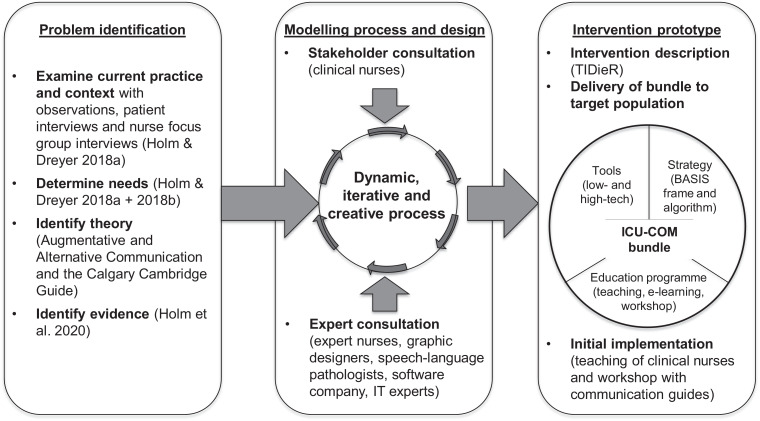
Design: The Medical Research Council's framework for developing complex interventions in health was applied. The approach was target-population centred.
Settings: The intervention was developed and tailored to four intensive care unit departments at Aarhus University Hospital in Denmark.
Participants: Intensive care nurses and various experts, namely, speech-language pathologists, graphic designers, a software company, the local Centre for E-learning and nurse specialists were involved in its development.
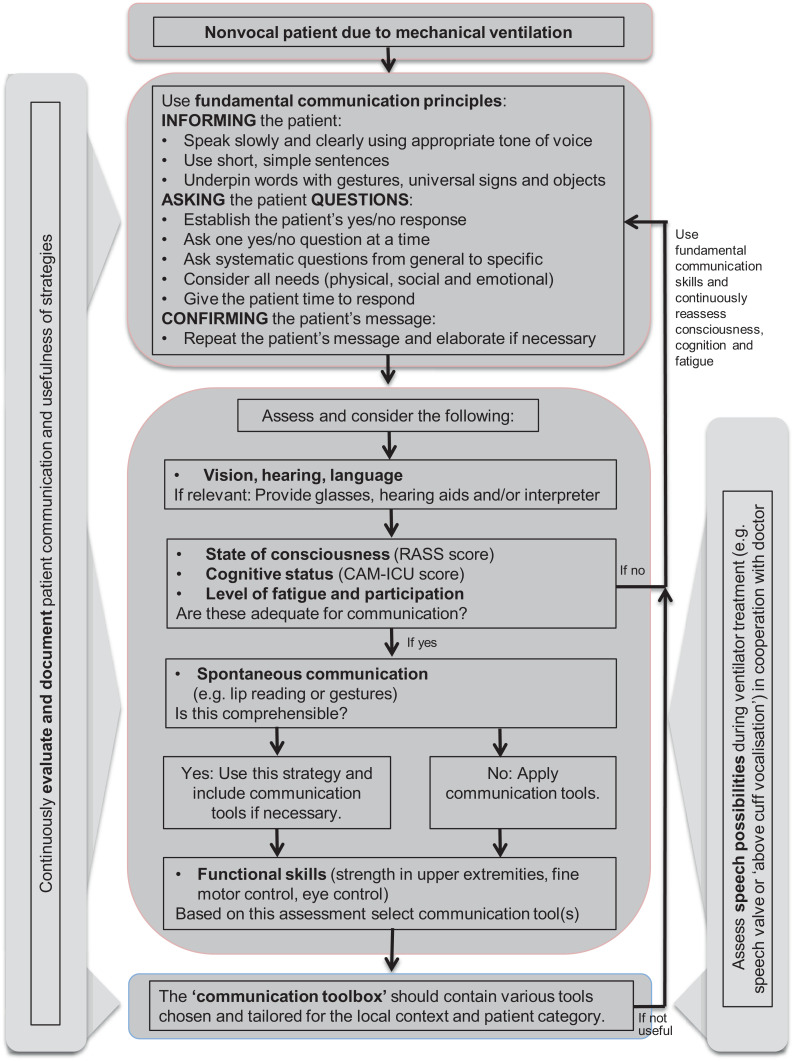
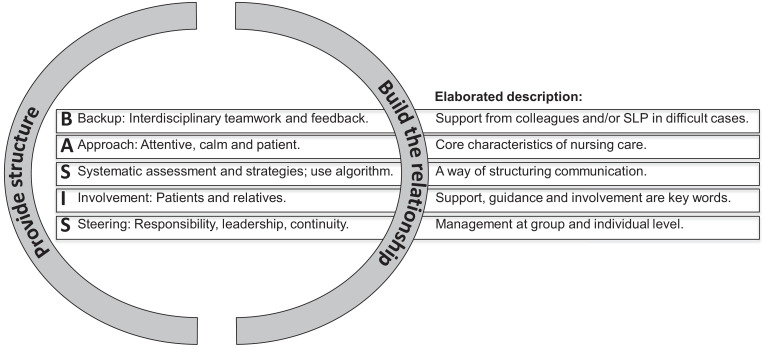
Results: An intervention consisting of: 1) a multi-component communication bundle, 2) delivery of the bundle via a teaching session and 3) initial implementation via nurse communication guides was developed. The communication bundle contained: 1) a communication strategy with a BASIS framework and algorithm, 2) a nurse education programme and 3) low-tech and high-tech communication tools.
Conclusions: A systematic approach was applied in the development process. However, the acceptability and feasibility of the intervention is at present unknown.
Keywords: Augmentative and alternative communication; Complex interventions; Critical care; Intensive care unit; Intervention development; Mechanical ventilation; Nurse-patient communication.
© 2021 The Authors.
Conflict of interest statement
None.
Figures
References
-
- Bartholomew Eldredge L.K., Markham C.M., Ruiter R.A.C., Kok G., Parcel G.S., Fernández M.E. John Wiley & Sons; Hoboken: 2016. Planning Health Promotion Programs: An Intervention Mapping Approach. Incorporated.
-
- Beukelman D.R., Garrett K.L., Yorkston K.M., editors. Augmentative Communication Strategies for Adults with Acute or Chronic Medical Conditions. Paul H. Brookes Pub. Co.; Baltimore: 2007.
-
- Blackstone S.W. Plural Publishing; San Diego, California: 2015. Patient-Provider Communication : Roles for Speech-Language Pathologists and Other Health Care Professionals.
LinkOut - more resources
Full Text Sources
