


Prevalence of missed nursing care and its association with work experience: A cross-sectional survey
- PMID: 38746807
- PMCID: PMC11080405
- DOI: 10.1016/j.ijnsa.2024.100196
Prevalence of missed nursing care and its association with work experience: A cross-sectional survey
Abstract
Background: Nurses faced with multiple demands in hospitals are often compelled to prioritize nursing care. Knowledge of missed nursing care provides insight into whether necessary nursing care is delivered, what is missed, and the reasons for missed nursing care. This insight is essential to support evidence-based policy and practice to improve patient care, enhance nursing practice, and optimize the work environment. Research on factors influencing missed nursing care is imperative to implement targeted strategies. However, studies investigating work experience as a predictor are inconclusive, and no identified studies have examined how nurses' work experience is associated with different elements of missed nursing care.
Objectives: To investigate the prevalence and reasons for missed nursing care and whether nurses' work experience was associated with missed nursing care.
Design: The design was cross-sectional, using the Danish version of the MISSCARE survey.
Setting: The study was conducted at a public Danish university hospital with 1,150 beds and approximately 10,350 employees.
Participants: Across 34 surgical, medical, and mixed bed wards for adults, 1,241 nurses were invited by email to respond anonymously to the Danish MISSCARE survey. Of these nurses, 50.3% responded, and 42.6% fully completed the questionnaire.
Methods: A total score mean and a mean score were calculated and then compared between experience (≤5 years/>5 years) in a linear regression model adjusting for unequally distributed variables.
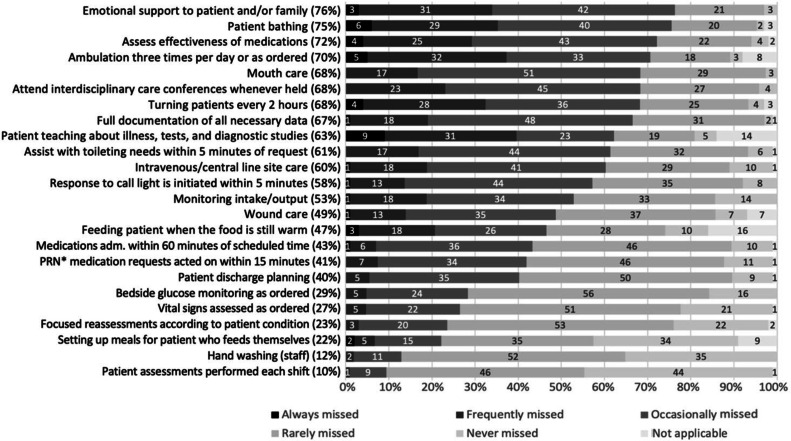
Results: More than two thirds of the nurses reported that emotional support, patient bathing, ambulation, mouth care, interdisciplinary conferences, documentation, and assessing effectiveness of medication were frequently missed elements of nursing care. The most significant reasons for missed nursing care were an inadequate number of nurses, an unexpected rise in patient volume, urgent patient situations, heavy admission, and discharge activity. Nurses with work experience of less than 5 years reported more missed nursing care, especially within fundamental care.
Conclusions: Nursing elements to avoid potentially critical situations and nursing related to treatment observations were rarely missed, while nursing care elements visible only to the patient and the nurse were most often missed. By increasing transparency and explicitness within nursing care, the results enable critical evaluation of prioritization of nursing care elements. The number of staff not balancing the number and acuity of patients was the main reason for missed nursing care. The perception of missed nursing care was most pronounced in less experienced nurses. The study contributes to the global research community to achieve a broader understanding of missed nursing care.
Tweetable abstract: Nursing to avoid potentially critical situations and treatment observations are prioritized over fundamental care, perceived mainly by less experienced nurses.
Keywords: Nursing Care; Nursing Staff, Hospital; Workload, Job Performance, Workforce, Work Experiences, Nurse Management, Nursing Shortage, Personnel Staffing and Scheduling.
© 2024 The Authors.
Conflict of interest statement
The study has no conflicts of interest.
Figures

References
-
- Ausserhofer D., Schubert M., Desmedt M., Blegen M.A., De Geest S., Schwendimann R. The association of patient safety climate and nurse-related organizational factors with selected patient outcomes: a cross-sectional survey. Int. J. Nurs. Stud. 2013;50(2):240–252. doi: 10.1016/j.ijnurstu.2012.04.007. - DOI - PubMed
LinkOut - more resources
Full Text Sources
