


Model-Based Approaches to Investigating Mismatch Responses in Schizophrenia
- PMID: 38751125
- PMCID: PMC11664892
- DOI: 10.1177/15500594241253910
Model-Based Approaches to Investigating Mismatch Responses in Schizophrenia
Abstract
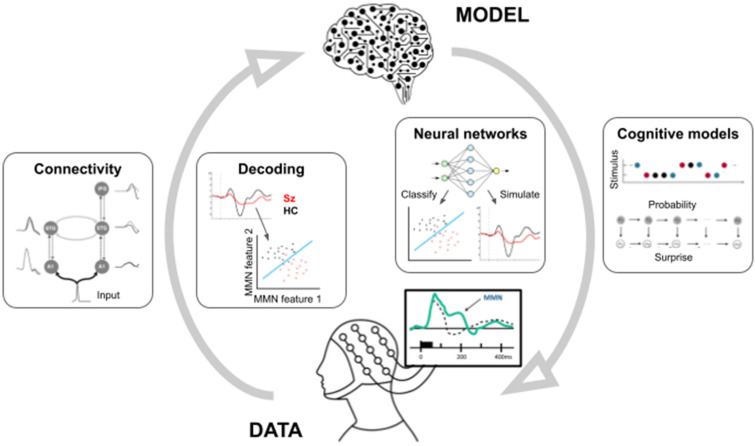
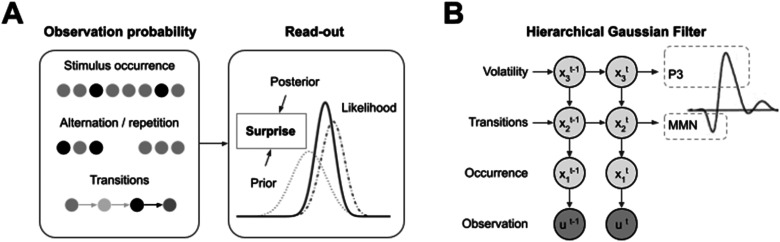
Alterations of mismatch responses (ie, neural activity evoked by unexpected stimuli) are often considered a potential biomarker of schizophrenia. Going beyond establishing the type of observed alterations found in diagnosed patients and related cohorts, computational methods can yield valuable insights into the underlying disruptions of neural mechanisms and cognitive function. Here, we adopt a typology of model-based approaches from computational cognitive neuroscience, providing an overview of the study of mismatch responses and their alterations in schizophrenia from four complementary perspectives: (a) connectivity models, (b) decoding models, (c) neural network models, and (d) cognitive models. Connectivity models aim at inferring the effective connectivity patterns between brain regions that may underlie mismatch responses measured at the sensor level. Decoding models use multivariate spatiotemporal mismatch response patterns to infer the type of sensory violations or to classify participants based on their diagnosis. Neural network models such as deep convolutional neural networks can be used for improved classification performance as well as for a systematic study of various aspects of empirical data. Finally, cognitive models quantify mismatch responses in terms of signaling and updating perceptual predictions over time. In addition to describing the available methodology and reviewing the results of recent computational psychiatry studies, we offer suggestions for future work applying model-based techniques to advance the study of mismatch responses in schizophrenia.
Keywords: computational psychiatry; connectivity; decoding; mismatch negativity; schizophrenia.
Conflict of interest statement
Declaration of Conflicting InterestsThe authors declared no potential conflicts of interest with respect to the research, authorship, and/or publication of this article.
Figures


References
-
- Näätänen R, Gaillard AW, Mäntysalo S. Early selective-attention effect on evoked potential reinterpreted. Acta Psychol. 1978;42(4):313-329. - PubMed
Publication types
MeSH terms
LinkOut - more resources
Full Text Sources
Medical
