


Antibodies to Aedes aegypti D7L salivary proteins as a new serological tool to estimate human exposure to Aedes mosquitoes
- PMID: 38751433
- PMCID: PMC11094246
- DOI: 10.3389/fimmu.2024.1368066
Antibodies to Aedes aegypti D7L salivary proteins as a new serological tool to estimate human exposure to Aedes mosquitoes
Abstract
Introduction: Aedes spp. are the most prolific mosquito vectors in the world. Found on every continent, they can effectively transmit various arboviruses, including the dengue virus which continues to cause outbreaks worldwide and is spreading into previously non-endemic areas. The lack of widely available dengue vaccines accentuates the importance of targeted vector control strategies to reduce the dengue burden. High-throughput tools to estimate human-mosquito contact and evaluate vector control interventions are lacking. We propose a novel serological tool that allows rapid screening of human cohorts for exposure to potentially infectious mosquitoes.
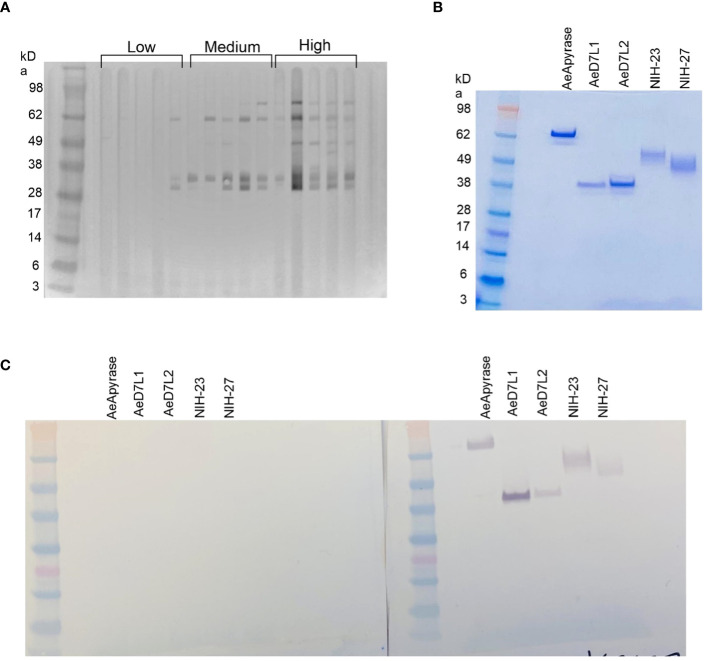
Methods: We tested 563 serum samples from a longitudinal pediatric cohort study previously conducted in Cambodia. Children enrolled in the study were dengue-naive at baseline and were followed biannually for dengue incidence for two years. We used Western blotting and enzyme-linked immunosorbent assays to identify immunogenic Aedes aegypti salivary proteins and measure total anti-Ae. aegypti IgG.
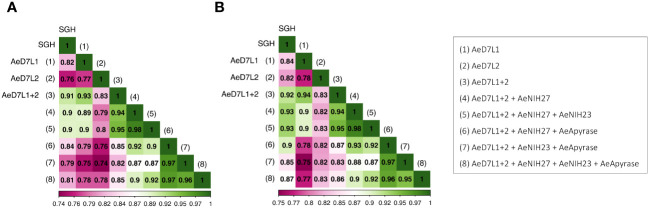
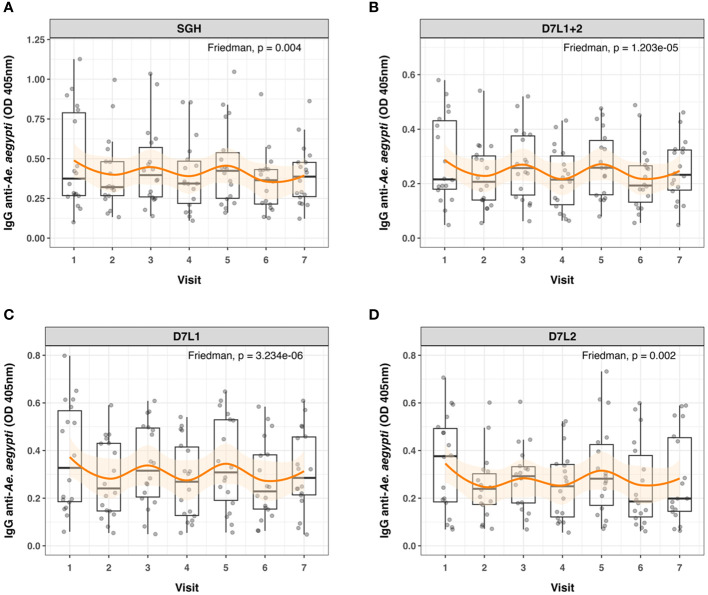
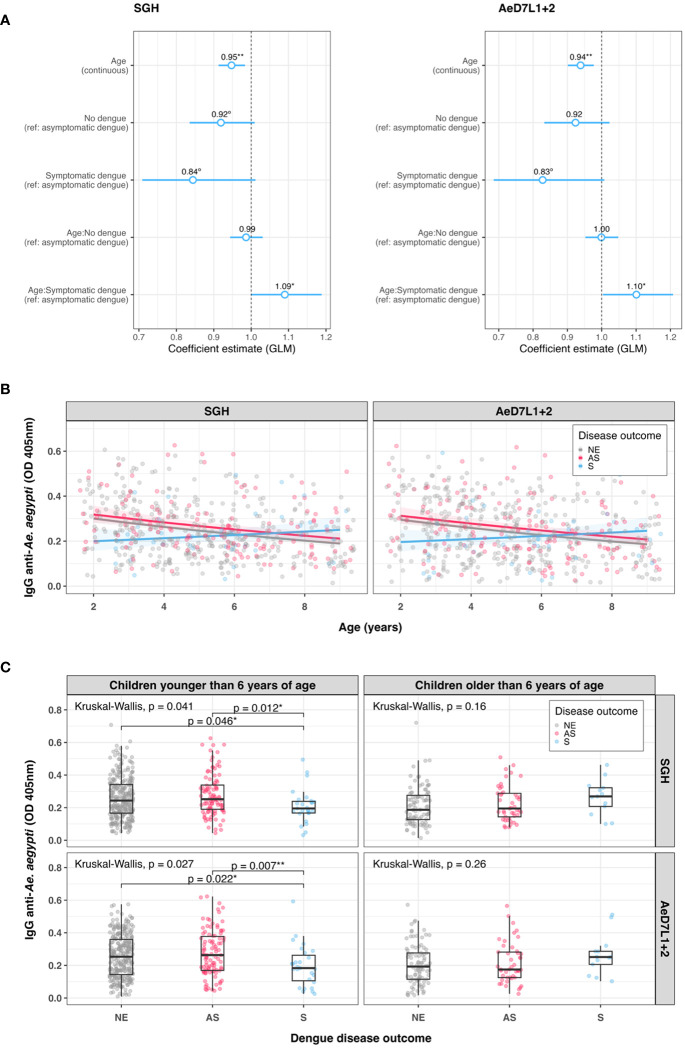
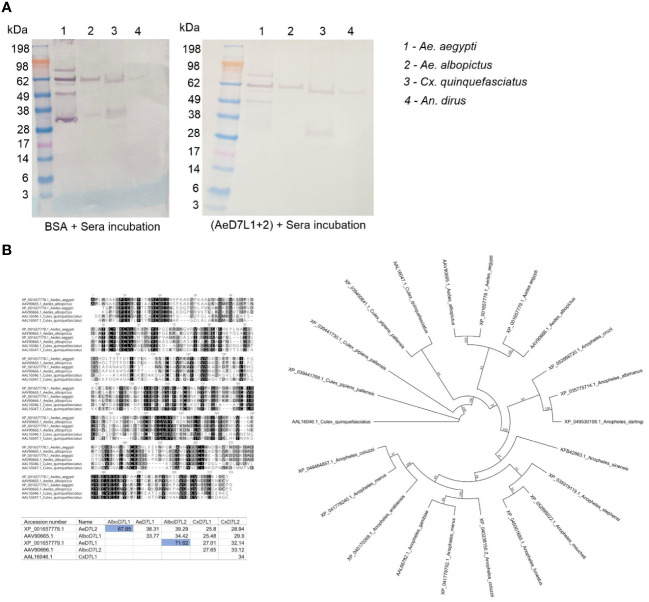
Results: We found a correlation (rs=0.86) between IgG responses against AeD7L1 and AeD7L2 recombinant proteins and those to whole salivary gland homogenate. We observed seasonal fluctuations of AeD7L1+2 IgG responses and no cross-reactivity with Culex quinquefasciatus and Anopheles dirus mosquitoes. The baseline median AeD7L1+2 IgG responses for young children were higher in those who developed asymptomatic versus symptomatic dengue.
Discussion: The IgG response against AeD7L1+2 recombinant proteins is a highly sensitive and Aedes specific marker of human exposure to Aedes bites that can facilitate standardization of future serosurveys and epidemiological studies by its ability to provide a robust estimation of human-mosquito contact in a high-throughput fashion.
Keywords: Aedes; Cambodia; ELISA; dengue; exposure marker; mosquito saliva.
Copyright © 2024 Chea, Willen, Nhek, Ly, Tang, Oristian, Salas-Carrillo, Ponce, Leon, Kong, Ly, Sath, Lon, Leang, Huy, Yek, Valenzuela, Calvo, Manning and Oliveira.
Conflict of interest statement
The authors declare that the research was conducted in the absence of any commercial or financial relationships that could be construed as a potential conflict of interest. The author(s) declared that they were an editorial board member of Frontiers, at the time of submission. This had no impact on the peer review process and the final decision.
Figures
Update of
-
Antibodies to Aedes aegypti D7L salivary proteins as a new serological tool to estimate human exposure to Aedes mosquitoes.medRxiv [Preprint]. 2023 Dec 24:2023.12.22.23300438. doi: 10.1101/2023.12.22.23300438. medRxiv. 2023. Update in: Front Immunol. 2024 May 01;15:1368066. doi: 10.3389/fimmu.2024.1368066. PMID: 38318204 Free PMC article. Updated. Preprint.
References
-
- WHO . Dengue and Severe Dengue. World Health Organisation; (2023). Available at: https://www.who.int/news-room/fact-sheets/detail/dengue-and-severe-dengue.
MeSH terms
Substances
LinkOut - more resources
Full Text Sources
Medical
Miscellaneous
