. 2024 May 16;14(1):11207.
doi: 10.1038/s41598-024-60896-9.

Reanalysis of cluster randomised trial data to account for exposure misclassification using a per-protocol and complier-restricted approach

Affiliations

Reanalysis of cluster randomised trial data to account for exposure misclassification using a per-protocol and complier-restricted approach

Suzanne M Dufault et al. Sci Rep. .

Abstract

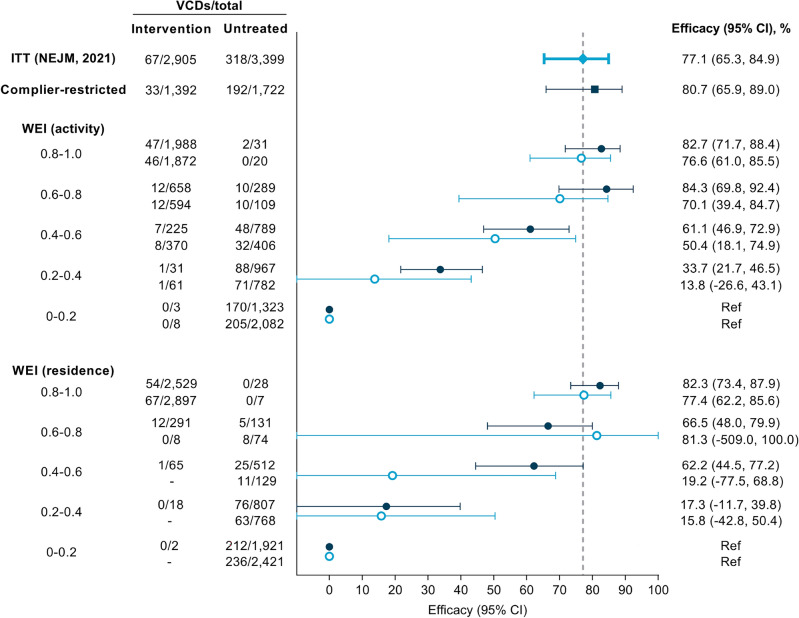
The intention-to-treat (ITT) analysis of the Applying Wolbachia to Eliminate Dengue (AWED) trial estimated a protective efficacy of 77.1% for participants resident in areas randomised to receive releases of wMel-infected Aedes aegypti mosquitoes, an emerging dengue preventive intervention. The limiting assumptions of ITT analyses in cluster randomised trials and the mobility of mosquitoes and humans across cluster boundaries indicate the primary analysis is likely to underestimate the full public health benefit. Using spatiotemporally-resolved data on the distribution of Wolbachia mosquitoes and on the mobility of AWED participants (n = 6306), we perform complier-restricted and per-protocol re-examinations of the efficacy of the Wolbachia intervention. Increased intervention efficacy was estimated in all analyses by the refined exposure measures. The complier-restricted analysis returned an estimated efficacy of 80.7% (95% CI 65.9, 89.0) and the per-protocol analysis estimated 82.7% (71.7, 88.4) efficacy when comparing participants with an estimated wMel exposure of 80% compared to those with <20%. These reanalyses demonstrate how human and mosquito movement can lead to underestimation of intervention effects in trials of vector interventions and indicate that the protective efficacy of Wolbachia is even higher than reported in the primary trial results.


Conflict of interest statement

The authors declare no competing interests.

Figures
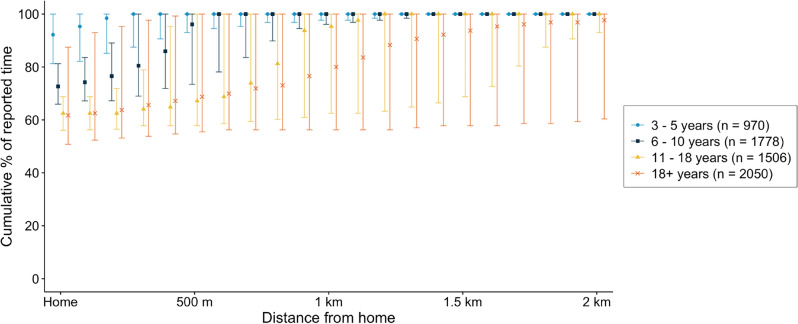
Figure 1
Figure 1
Mobility of AWED trial participants in Yogyakarta City during the 3–10 days prior to illness onset, based on self-reported travel (5 AM–9 PM). The graph shows the median and interquartile range of the time participants within each age group spent at home and cumulatively at increasing distances from home (children aged 3–5 years, 6–10 years, 11-18 years, and greater than 18 years).
Figure 2
Figure 2
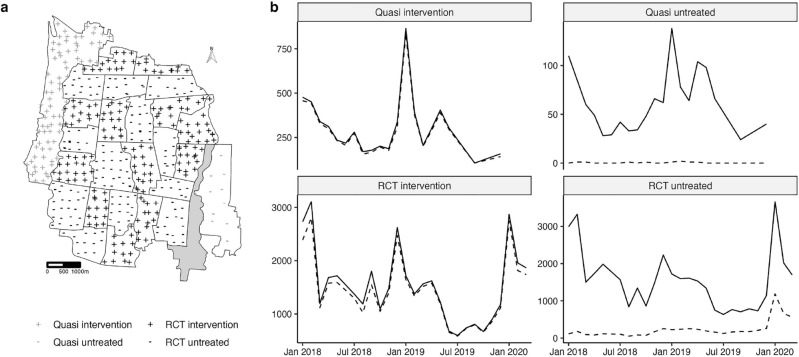
(a) Map of Yogyakarta City with geolocated trap locations. Shape is used to distinguish intervention areas where wMel releases occurred (‘+’) and untreated areas where wMel releases did not occur (‘−’). Traps within the AWED RCT study boundaries are denoted in black, while those in the quasi-experimental areas are marked in gray. (b) The total number of mosquitoes screened (solid line) and the number of mosquitoes with wMel detected (dashed line) per month by study area.
Figure 3
Figure 3
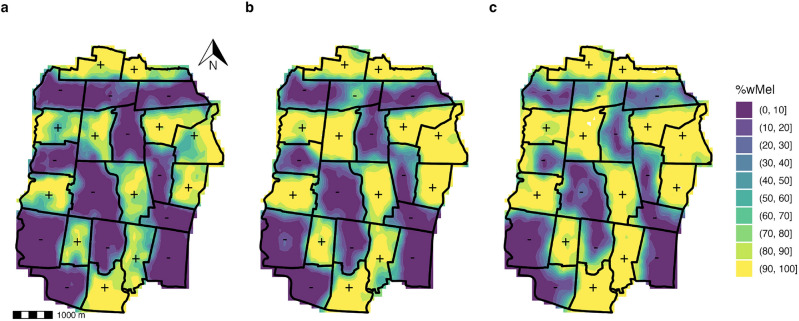
Spatiotemporal inverse density weighted maps of wMel% interpolated across a 100×100 meter grid overlaid on the AWED trial surface on January 1 each year of (a) 2018, (b) 2019, and (c) 2020, with RCT intervention areas (“+”) and RCT untreated areas (“−”) labeled.
Figure 4
Figure 4
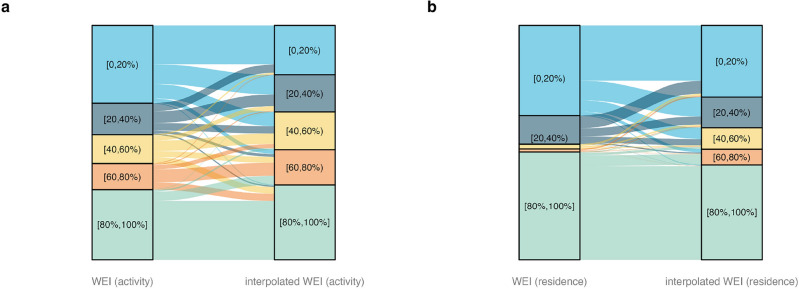
Changes in participant-level WEI values based on the method of estimation. (a) The original per-protocol individual-level WEI (activity) values (left) are compared to the individual-level WEI (activity) values from the interpolated surface (right). (b) The original per-protocol individual-level WEI (residence) values (left) are compared to the individual-level WEI (residence) values from the interpolated surface (right).
Figure 5
Figure 5
Forest plot comparing Wolbachia efficacy estimates from the primary analysis and reanalysis of the AWED trial in Yogyakarta, Indonesia. Included are the original ITT estimates (blue rhombus), the complier-restricted analysis results performed here (navy blue square), the new per-protocol estimates based on individuals’ spatio-temporally interpolated WEI (navy blue round), and the original per-protocol estimates based on individuals’ cluster-aggregate WEI (blue circle).

References

    1. Moreira LA, et al. A Wolbachia symbiont in Aedes aegypti limits infection with dengue, chikungunya, and plasmodium. Cell. 2009;139:1268–1278. doi: 10.1016/j.cell.2009.11.042. - DOI - PubMed
    1. Walker T, et al. The wMel Wolbachia strain blocks dengue and invades caged Aedes aegypti populations. Nature. 2011;476:450–453. doi: 10.1038/nature10355. - DOI - PubMed
    1. Aliota MT, Peinado SA, Velez ID, Osorio JE. The wMel strain of Wolbachia reduces transmission of Zika virus by Aedes aegypti. Sci. Rep. 2016;6:1–7. doi: 10.1038/srep28792. - DOI - PMC - PubMed
    1. Carrington LB, et al. Field-and clinically derived estimates of Wolbachia-mediated blocking of dengue virus transmission potential in Aedes aegypti mosquitoes. Proc. Natl. Acad. Sci. 2018;115:361–366. doi: 10.1073/pnas.1715788115. - DOI - PMC - PubMed
    1. Indriani C, et al. Reduced dengue incidence following deployments of Wolbachia-infected Aedes aegypti in Yogyakarta, Indonesia: A quasi-experimental trial using controlled interrupted time series analysis. Gates Open Res. 2020 doi: 10.1101/2020.03.15.20036566. - DOI - PMC - PubMed