


Laughter in everyday life: an event-based experience sampling method study using wrist-worn wearables
- PMID: 38756489
- PMCID: PMC11096579
- DOI: 10.3389/fpsyg.2024.1296955
Laughter in everyday life: an event-based experience sampling method study using wrist-worn wearables
Abstract
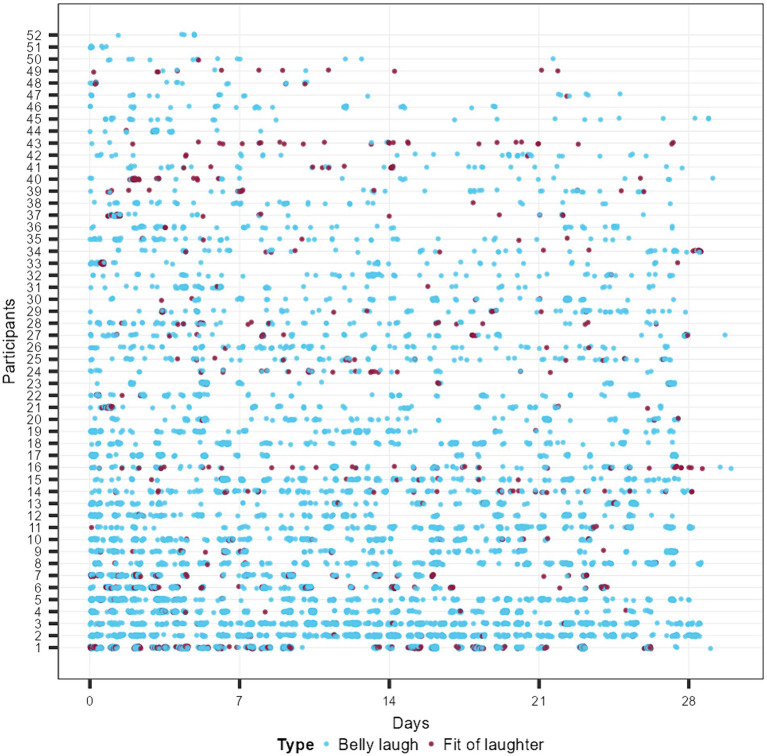
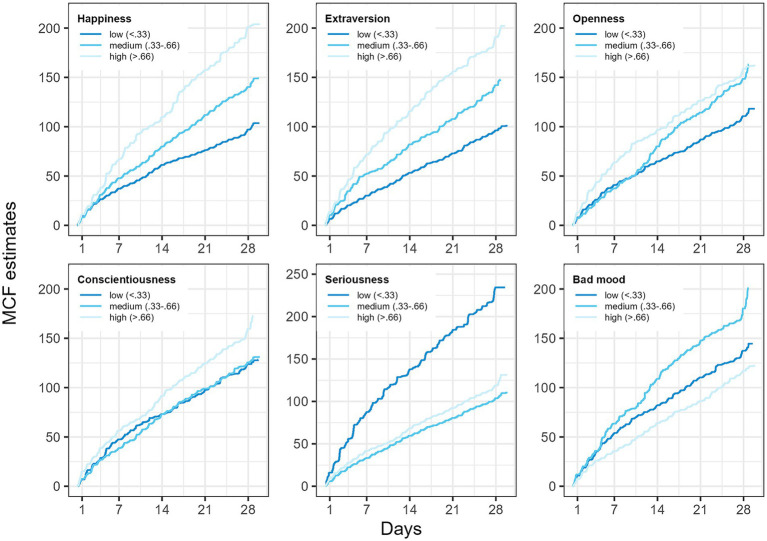
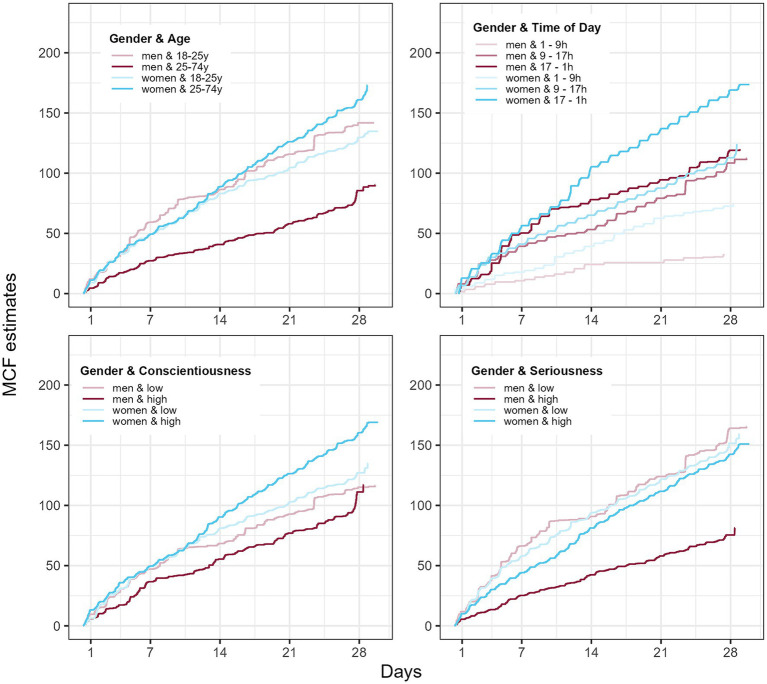
Laughter is a universal, nonverbal vocal expression of broad significance for humans. Interestingly, rather little is known about how often we laugh and how laughter is associated with our personality. In a large, event-based, experience sampling method study (N = 52; k = 9,261 assessments) using wrist-worn wearables and a physical analogue scale, we analyzed belly laughs and fit of laughter events in participants' everyday life for 4 weeks. Additionally, we assessed associations with laughter frequency such as personality, happiness, life satisfaction, gelotophobia (i.e., fear of being laughed at), and cheerfulness. Validating our new measurement approach (i.e., wearables, physical analogue scale), laughter events elicited higher happiness ratings compared to reference assessments, as expected. On average, participants reported 2.5 belly laughs per day and on every fourth day a fit of laughter. As expected, participants who were happier and more satisfied with their life laughed more frequently than unhappier, unsatisfied participants. Women and younger participants laughed significantly more than men and older participants. Regarding personality, laughter frequency was positively associated with openness and conscientiousness. No significant association was found for gelotophobia, and results for cheerfulness and related concepts were mixed. By using state-of-the-art statistical methods (i.e., recurrent event regression) for the event-based, multi-level data on laughter, we could replicate past results on laughing.
Keywords: experience sampling; fit of laughter; gelotophobia; gender; laughing; personality; physical analogue scale; wearable.
Copyright © 2024 Stieger, Volsa, Willinger, Lewetz and Batinic.
Conflict of interest statement
The authors declare that the research was conducted in the absence of any commercial or financial relationships that could be construed as a potential conflict of interest.
Figures
References
-
- Bates D., Mächler M., Bolker B., Walker S. (2015). Fitting linear mixed-effects models using lme4. J. Stat. Softw. 67, 1–48. doi: 10.18637/jss.v067.i01 - DOI
-
- Ben-Shachar M., Lüdecke D., Makowski D. (2020). Effectsize: estimation of effect size indices and standardized parameters. J. Open Source Softw. 5:2815. doi: 10.21105/joss.02815 - DOI
-
- Bolger N., Laurenceau J.-P. (2013). Intensive Longitudinal Methods: An Introduction to Diary and Experience Sampling Research, New York: Guilford Press.
-
- Brauer K., Proyer R. T. (2020). Judging dispositions toward ridicule and being laughed at from short self-descriptions at zero-acquaintance: testing self-other agreement, consensus, and accuracy. J. Res. Pers. 89:104016. doi: 10.1016/j.jrp.2020.104016 - DOI
Grants and funding
LinkOut - more resources
Full Text Sources
Research Materials
Miscellaneous
