Review
. 2024 Apr 27;10(9):e29950.
doi: 10.1016/j.heliyon.2024.e29950. eCollection 2024 May 15.

Astrocyte mitochondria: Potential therapeutic targets for epilepsy

Affiliations
Review

Astrocyte mitochondria: Potential therapeutic targets for epilepsy

Lu Chen et al. Heliyon. .

Abstract

Epilepsy is a chronic, relapsing neurological disorder, and current treatments focus primarily on neurons, yet one-third of patients still develop drug-resistant epilepsy. Therefore, there is an urgent need to explore new therapeutic targets. Interestingly, astrocytes can transfer their healthy mitochondria into neighboring neurons, thus preventing neuronal damage. Astrocyte mitochondria have been shown to have a therapeutic role in stroke and neurodegenerative diseases. However, their therapeutic effect in epilepsy and its related mechanisms have been less studied. In this review, we mainly summarize the regulatory role of astrocyte mitochondria in glutamate, calcium ion, and adenosine triphosphate (ATP) homeostasis and outline the protective role of astrocyte mitochondria in nervous system diseases, revealing a new target for epilepsy treatment.

Keywords: Adenosine triphosphate; Astrocyte mitochondria; Calcium homeostasis; Epilepsy; Glutamate.


Conflict of interest statement

The authors declare that they have no known competing financial interests or personal relationships that could have appeared to influence the work reported in this paper.

Figures
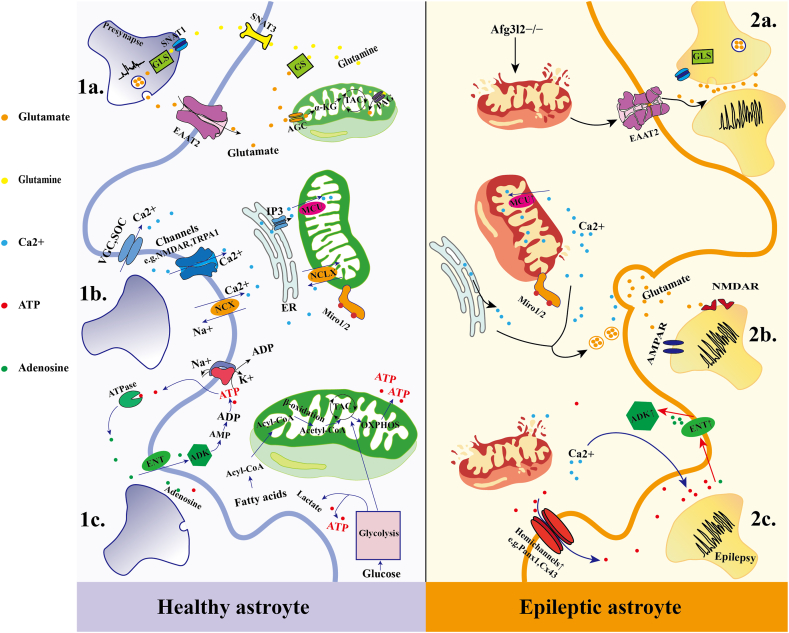
Fig. 1
Fig. 1
The function of astrocyte mitochondria. Mitochondrial dysfunction may lead to increased susceptibility to epilepsy. (1a) The mitochondria of astrocytes regulate the glutamate-glutamine cycle. (2a) Loss of Afg3l2 results in disruption of the mitochondrial network, loss of the mitochondrial ridge, accumulation of glutamate in the synaptic cleft, and ultimately increased neuronal excitability. (1b) Astrocyte mitochondria are involved in regulating calcium homeostasis. (2b) In animal models of epilepsy, Ca2+ levels within astrocytes were significantly increased. Additionally, the increased Ca2+ can induce the release of glutamate and increase the excitability of neurons. Inhibition of MCU on mitochondria or upregulation of Miro has antiepileptic effects. (1c) Astrocyte mitochondria take fatty acids and glucose as raw materials, producing ATP by β-oxidation and glycolysis. (2c) After epileptic insult, extracellular ATP content is significantly increased, which is mainly released by astrocytes, and hemichannels such as cox43 and panx1 that release ATP on the surface of astrocytes are also significantly increased. However, it is not clear whether astrocyte mitochondria are related to the changes in ATP content after epilepsy.

References

    1. Asadi-Pooya A.A., Brigo F., Lattanzi S., Blumcke I. Adult epilepsy. Lancet. 2023 doi: 10.1016/S0140-6736(23)01048-6. PMID: 37459868. - DOI - PubMed
    1. Ren E., Curia G. Synaptic reshaping and neuronal outcomes in the temporal lobe epilepsy. Int. J. Mol. Sci. 2021;22 doi: 10.3390/ijms22083860. PMID: 33917911. - DOI - PMC - PubMed
    1. Loscher W., Potschka H., Sisodiya S.M., Vezzani A. Drug resistance in epilepsy: clinical impact, potential mechanisms, and new innovative treatment options. Pharmacol. Rev. 2020;72:606–638. doi: 10.1124/pr.120.019539. PMID: 32540959. - DOI - PMC - PubMed
    1. Janson M.T., Bainbridge J.L. Continuing burden of refractory epilepsy. Ann. Pharmacother. 2021;55:406–408. doi: 10.1177/1060028020948056. PMID: 32795085. - DOI - PubMed
    1. Hadera M.G., Eloqayli H., Jaradat S., Nehlig A., Sonnewald U. Astrocyte‐neuronal interactions in epileptogenesis. J. Neurosci. Res. 2015;93:1157–1164. doi: 10.1002/jnr.23584. PMID: 25782696. - DOI - PubMed

LinkOut - more resources
