. 2024 Apr 9;15(19):7170-7177.
doi: 10.1039/d4sc00067f. eCollection 2024 May 15.

Mild chemistry synthesis of ultrathin Bi2O2S nanosheets exhibiting 2D-ferroelectricity at room temperature

Affiliations

Mild chemistry synthesis of ultrathin Bi2O2S nanosheets exhibiting 2D-ferroelectricity at room temperature

Riddhimoy Pathak et al. Chem Sci. .

Abstract

Modern technology demands miniaturization of electronic components to build small, light, and portable devices. Hence, discovery and synthesis of new non-toxic, low cost, ultra-thin ferroelectric materials having potential applications in various electronic and optoelectronic devices are of paramount importance. However, achieving room-temperature ferroelectricity in two dimensional (2D) ultra-thin systems remains a major challenge as conventional three-dimensional ferroelectric materials lose their ferroelectricity when the thickness is brought down below a critical value owing to the depolarization field. Herein, we report room-temperature ferroelectricity in ultra-thin single-crystalline 2D nanosheets of Bi2O2S synthesized by a simple, rapid, and scalable solution-based soft chemistry method. The ferroelectric ground state of Bi2O2S nanosheets is confirmed by temperature-dependent dielectric measurements as well as piezoelectric force microscopy and spectroscopy. High resolution transmission electron microscopy analysis and density functional theory-based calculations suggest that the ferroelectricity in Bi2O2S nanosheets arises due to the local distortion of Bi2O2 layers, which destroys the local inversion symmetry of Bi2O2S.


Conflict of interest statement

There are no conflicts to declare.

Figures
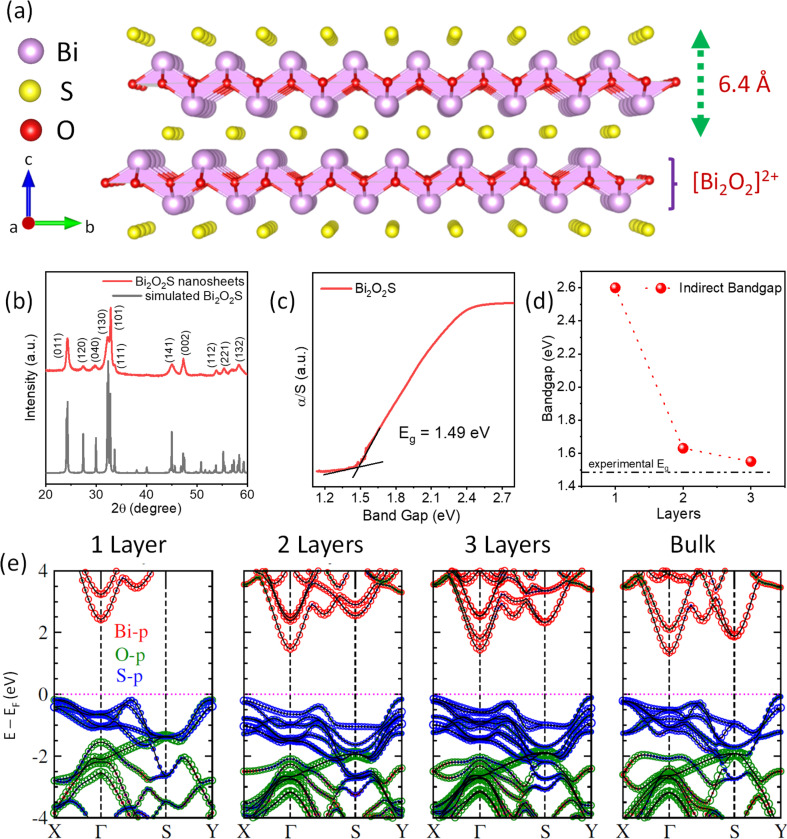
Fig. 1
Fig. 1. (a) Crystal structure of Bi2O2S showing the charged heterostructure layers. (b) Room temperature X-ray diffraction (XRD) pattern of the synthesized Bi2O2S nanosheets. (c) Room temperature band gap data of the synthesized Bi2O2S powders. (d) Variation of the indirect band gap with layers of Bi2O2S as per DFT calculations. (e) Electronic band structure of mono-, bi-, tri-layer and bulk Bi2O2S.
Fig. 2
Fig. 2. (a) Transmission electron microscopy (TEM) image of a single Bi2O2S nanosheet. (b) Selected area electron diffraction (SAED) pattern of the nanosheet along the 〈001〉 zone axis. (c) High resolution transmission electron microscopy (HRTEM) image of the nanosheet showing the (110) plane. (d) Atomic force microscopy (AFM) image of the Bi2O2S nanosheets.
Fig. 3
Fig. 3. (a) Temperature variation of the real part of the dielectric constant (ε′) of Bi2O2S nanosheets at 1 MHz, 0.5 MHz and 0.25 MHz. (b) Comparative differential scanning calorimetry (DSC) data of bulk and nanosheets of Bi2O2S. (c) Topography image of drop casted Bi2O2S nanosheets. (d) Phase images of Bi2O2S nanosheets obtained through piezoelectric force microscopy (PFM). (e) Phase signal and (f) amplitude signal of Bi2O2S nanosheets obtained through switching spectroscopy PFM.
Fig. 4
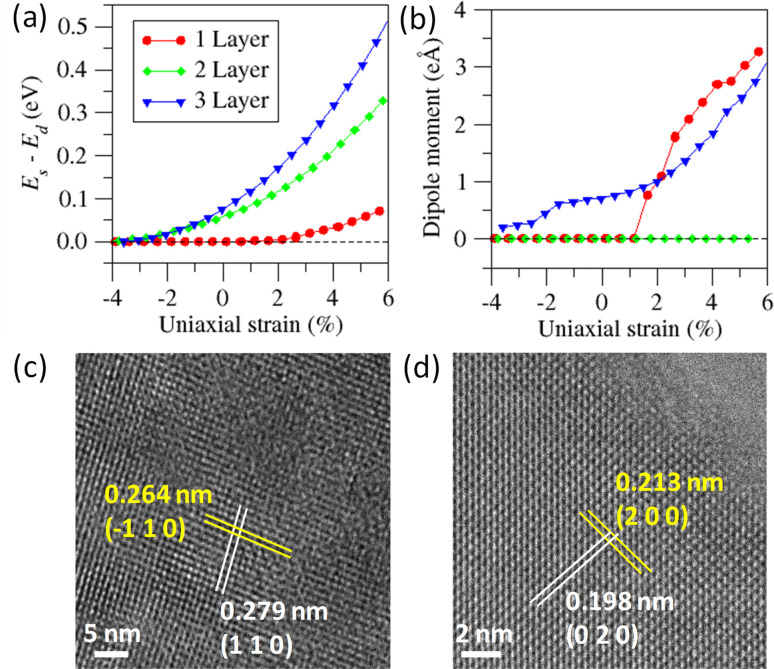
Fig. 4. (a) Variation of EsEd and (b) total dipole moment under strain for monolayer, bilayer, and trilayer Bi2O2S nanosheets (Es and Ed represent the total energy for symmetrical and distorted structures, respectively). (c) and (d) HRTEM image projected along the [001] direction exhibiting deviation between interatomic distances along (110) & (−110) and (200) & (020) directions.
Fig. 5
Fig. 5. Phonon dispersion of (a) bulk Bi2O2S and (b) trilayer Bi2O2S.

References

    1. Novoselov K. S. Geim A. K. Morozov S. V. Jiang D. Zhang Y. Dubonos S. V. Grigorieva I. V. Firsov A. A. Science. 2004;306:666–669. doi: 10.1126/science.1102896. - DOI - PubMed
    1. Hong H. Wu C. Zhao Z. Zuo Y. Wang J. Liu C. Zhang J. Wang F. Feng J. Shen H. Yin J. Wu Y. Zhao Y. Liu K. Gao P. Meng S. Wu S. Sun Z. Liu K. Xiong J. Nat. Photonics. 2021;15:510–515. doi: 10.1038/s41566-021-00801-2. - DOI
    1. Yu S. Wu X. Wang Y. Guo X. Tong L. Adv. Mater. 2017;29:1606128. doi: 10.1002/adma.201606128. - DOI - PubMed
    1. Ricciardulli A. G. Wang Y. Yang S. Samorì P. J. Am. Chem. Soc. 2022;144:3660–3666. doi: 10.1021/jacs.1c12931. - DOI - PubMed
    1. Sun Z. Martinez A. Wang F. Nat. Photonics. 2016;10:227–238. doi: 10.1038/nphoton.2016.15. - DOI