


"Let's get back to normal": emotions mediate the effects of persuasive messages on willingness to vaccinate for COVID-19
- PMID: 38756873
- PMCID: PMC11098132
- DOI: 10.3389/fpubh.2024.1377973
"Let's get back to normal": emotions mediate the effects of persuasive messages on willingness to vaccinate for COVID-19
Abstract
Objective: We examined the effectiveness of three different messages for persuading individuals to get vaccinated against COVID-19, and the role that emotions play in persuasion.
Methods: Four hundred-thirty-six participants reported their concern about the COVID-19 pandemic and confidence/hesitancy toward vaccines. Participants were randomly assigned to one of three text conditions: (1) self-interest: a persuasive message that focused on how much of a "serious threat COVID-19 is to you," and to get vaccinated to "protect yourself"; (2) self-interest + altruistic: a persuasive message that focused on the "threat to you and your community" and to get vaccinated to "protect you and your loved ones"; (3) self-interest + altruistic + normal: a persuasive message that included (2) but added "This is the only way we can get back to a normal life."; and, (4) a baseline control: no text. After reading, participants reported their emotions toward COVID-19 vaccines and their willingness to get vaccinated.
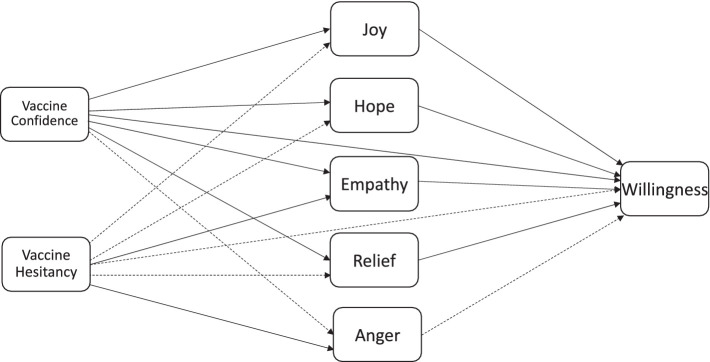
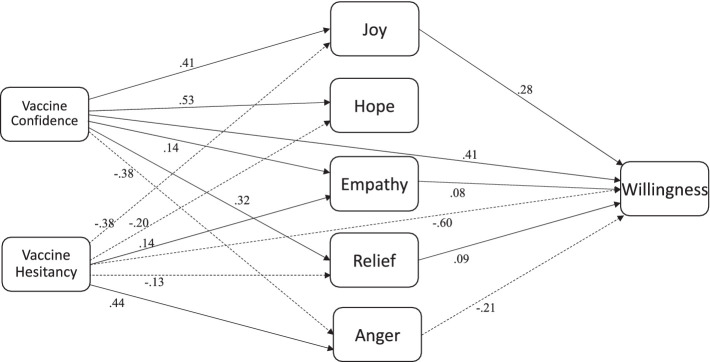
Results: Individuals in the self-interest + altruistic + normal condition were more willing to get vaccinated compared to the control condition and self-interest + altruistic condition. However, there were no differences in willingness between the self-interest + altruistic + normal condition and the self-interest condition. Moreover, emotions mediated relations between vaccine confidence/hesitancy and willingness.
Conclusion: A message that focuses on "getting back to normal" can achieve important public health action by increasing vaccine uptake to protect the population. Future work is needed across multiple countries and contexts (i.e., non-pandemic) to assess message effectiveness.
Keywords: COVID-19 vaccine; emotions; persuasion; public education messaging; vaccine hesitancy.
Copyright © 2024 Muis, Kendeou, Kohatsu and Wang.
Conflict of interest statement
The authors declare that the research was conducted in the absence of any commercial or financial relationships that could be construed as a potential conflict of interest.
Figures
References
-
- World Health Organization . Ten threats to global health. Geneva: World Health Organization; (2019).
-
- Petty R, Cacioppo J. The elaboration likelihood model of persuasion. J. Exp. Soc. Psychol. (1986) 19:123–205. doi: 10.1016/S0065-2601(08)60214-2 - DOI
-
- Murphy PK. Teaching as persuasion: a new metaphor for a new decade. Theory Pract. (2001) 40:224–7. doi: 10.1207/s15430421tip4004_2 - DOI
Publication types
MeSH terms
LinkOut - more resources
Full Text Sources
Medical
