


Deciphering the Neighborhood Atlas Area Deprivation Index: the consequences of not standardizing
- PMID: 38756979
- PMCID: PMC10986280
- DOI: 10.1093/haschl/qxad063
Deciphering the Neighborhood Atlas Area Deprivation Index: the consequences of not standardizing
Abstract
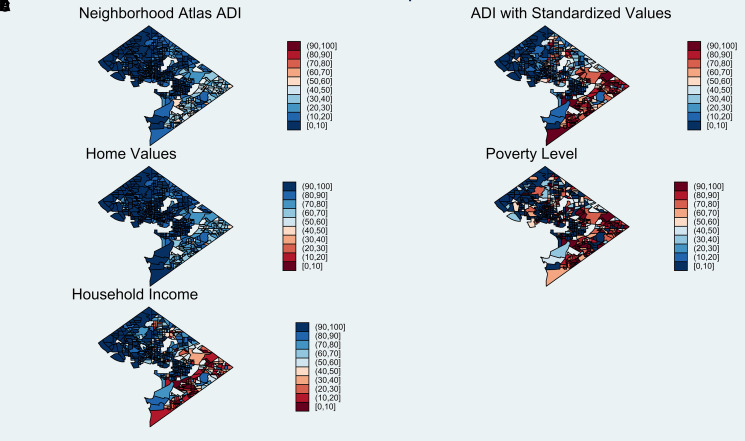
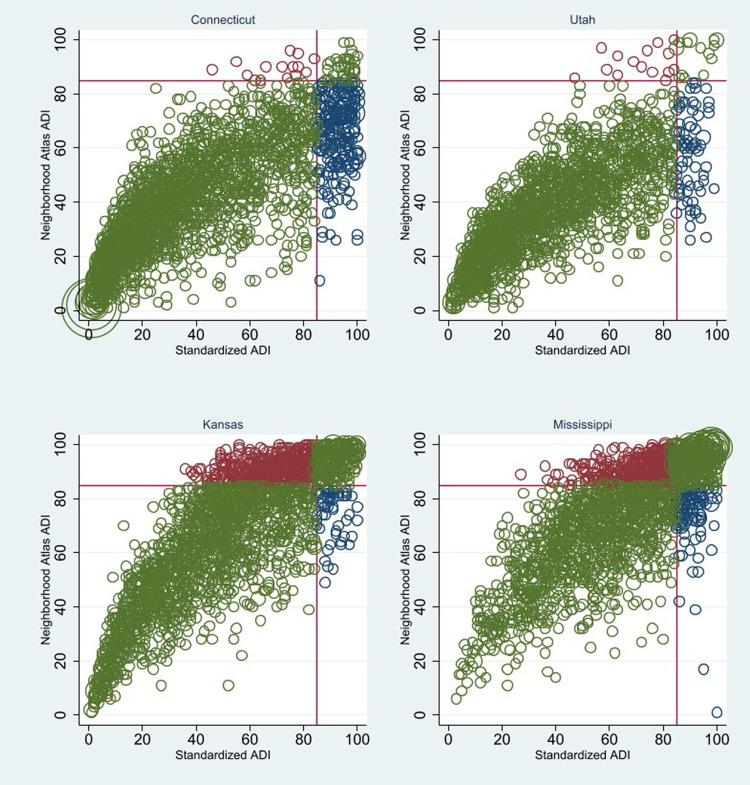
The Area Deprivation Index (ADI) is a widely used measure recently selected for several federal payment models that adjusts payments based on where beneficiaries live. A recent debate in Health Affairs focuses on seemingly implausible ADI rankings in major cities and across New York. At the root of the issue is the importance of standardization of measures prior to calculating index scores. Neighborhood Atlas researchers are implicitly arguing that their choice to not standardize is of little consequence. Using the same data and methods as the Neighborhood Atlas, this paper focuses on this choice by calculating and comparing standardized and unstandardized ADI scores. The calculated unstandardized ADI nearly perfectly matches the Neighborhood Atlas ADI (r > 0.9999), whereas the correlation with a standardized version is much lower (r = 0.7245). The main finding is that, without standardization, the ADI is reducible to a weighted average of just 2 measures-income and home values-certainly not the advertised multidimensional measure. Federal programs that have incorporated the ADI risk poorly allocating scarce resources meant to reduce health inequities.
Keywords: area measures of deprivation; health inequity; payment reform.
© The Author(s) 2023. Published by Oxford University Press on behalf of Project HOPE - The People-To-People Health Foundation, Inc.
Conflict of interest statement
Please see ICMJE form(s) for author conflicts of interest. These have been provided as supplementary materials.
Figures
References
-
- Link BG, Phelan J. Social conditions as fundamental causes of disease. J Health Soc Behav. 1995:Spec No:80-94. - PubMed
-
- Adler NE, Newman K. Socioeconomic disparities in health: pathways and policies. Health Aff (Millwood). 2002;21(2):60–76. - PubMed
-
- Health Resources and Services Administration . Negotiated Rulemaking Committee on the Designation of Medically Underserved Populations and Health Professional Shortage Areas: Final Report to the Secretary. Health Resources and Services Administration; 2011. https://www.ruralhealthinfo.org/assets/3262-13308/nrmcfinalreport.pdf
-
- Office of the Assistant Secretary for Planning and Evaluation (ASPE) . Landscape of area-level deprivation measures and other approaches to account for social risk and social determinants of health in health care payments. 2022. Accessed July 29, 2023. https://aspe.hhs.gov/sites/default/files/documents/8dc674c904723bf8a5ce4...
-
- Phillips RL, Liaw W, Crampton P, et al. How other countries use deprivation indices—and why the United States desperately needs one. Health Aff (Millwood). 2016;35(11):1991–1998. - PubMed
LinkOut - more resources
Full Text Sources