


Highly pathogenic avian influenza H5N1 virus infections in pinnipeds and seabirds in Uruguay: Implications for bird-mammal transmission in South America
- PMID: 38756986
- PMCID: PMC11096771
- DOI: 10.1093/ve/veae031
Highly pathogenic avian influenza H5N1 virus infections in pinnipeds and seabirds in Uruguay: Implications for bird-mammal transmission in South America
Abstract
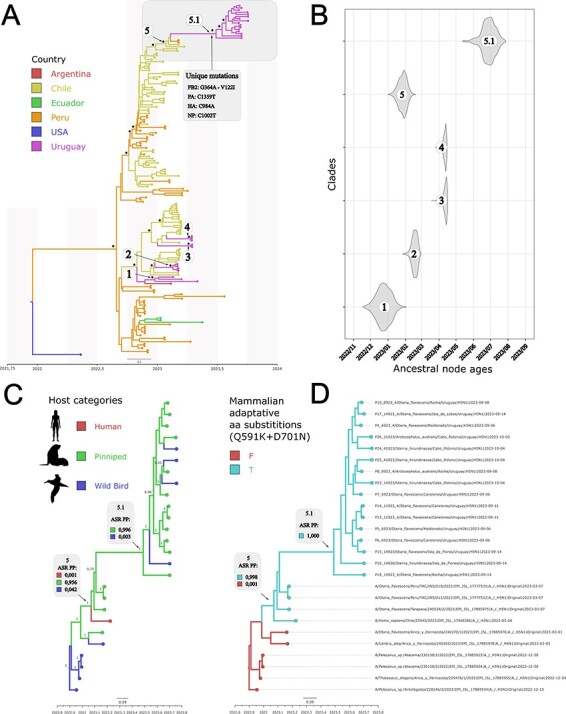
The highly pathogenic avian influenza viruses of clade 2.3.4.4b have caused unprecedented deaths in South American wild birds, poultry, and marine mammals. In September 2023, pinnipeds and seabirds appeared dead on the Uruguayan Atlantic coast. Sixteen influenza virus strains were characterized by real-time reverse transcription PCR and genome sequencing in samples from sea lions (Otaria flavescens), fur seals (Arctocephalus australis), and terns (Sterna hirundinacea). Phylogenetic and ancestral reconstruction analysis showed that these strains have pinnipeds most likely as the ancestral host, representing a recent introduction of clade 2.3.4.4b in Uruguay. The Uruguayan and closely related strains from Peru (sea lions) and Chile (sea lions and a human case) carry mammalian adaptative residues 591K and 701N in the viral polymerase basic protein 2 (PB2). Our findings suggest that clade 2.3.4.4b strains in South America may have spread from mammals to mammals and seabirds, revealing a new transmission route.
Keywords: South America; avian influenza; mammal adaptation; sea mammals; transmission.
© The Author(s) 2024. Published by Oxford University Press.
Conflict of interest statement
None declared.
Figures
References
-
- Arbiza J. et al. (2012) ‘Uruguayan Pinnipeds (Arctocephalus Australis and Otaria Flavescens): Evidence of Influenza Virus and Mycobacterium Pinnipedii Infections’, New Approaches to the Study of Marine Mammals, 2: 151–82.
LinkOut - more resources
Full Text Sources
