


Being able to be myself: Understanding autonomy and autonomy-support from the perspectives of autistic adults with intellectual disabilities
- PMID: 38757674
- PMCID: PMC11575095
- DOI: 10.1177/13623613241254432
Being able to be myself: Understanding autonomy and autonomy-support from the perspectives of autistic adults with intellectual disabilities
Abstract
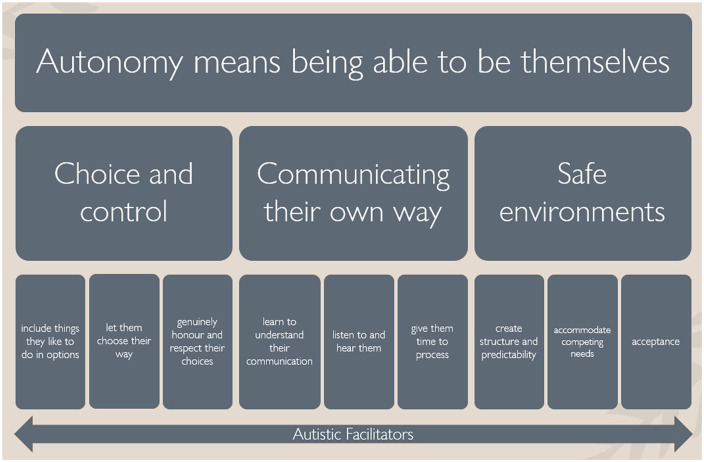
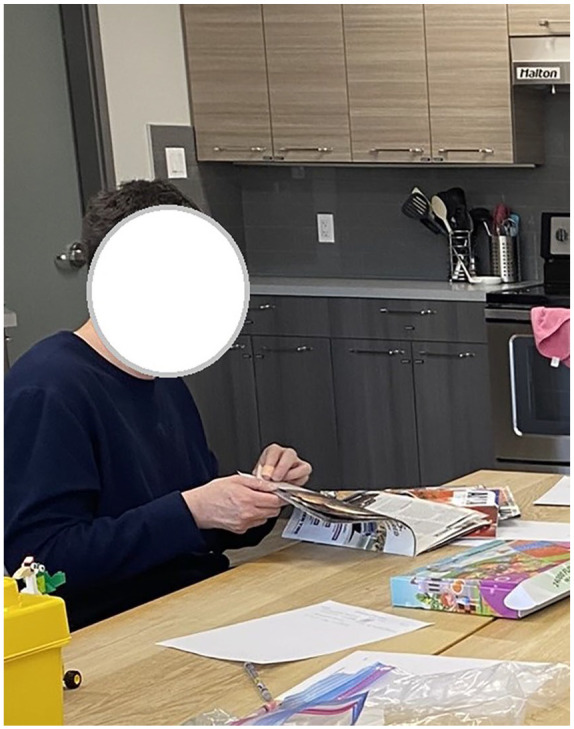
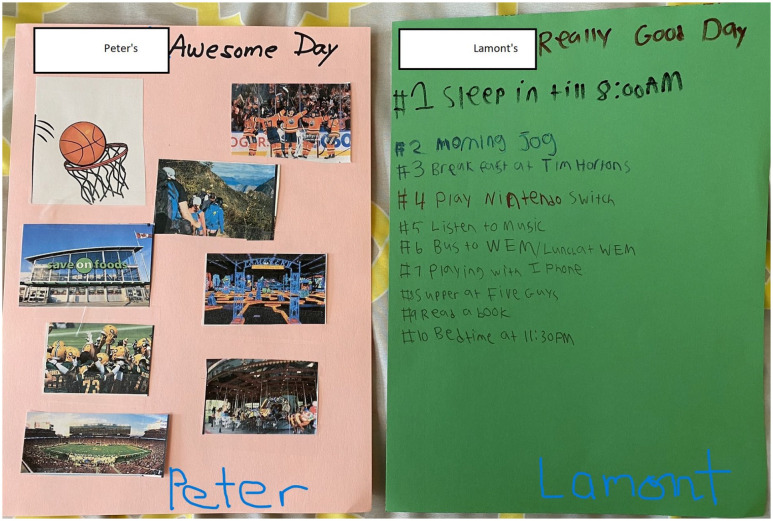
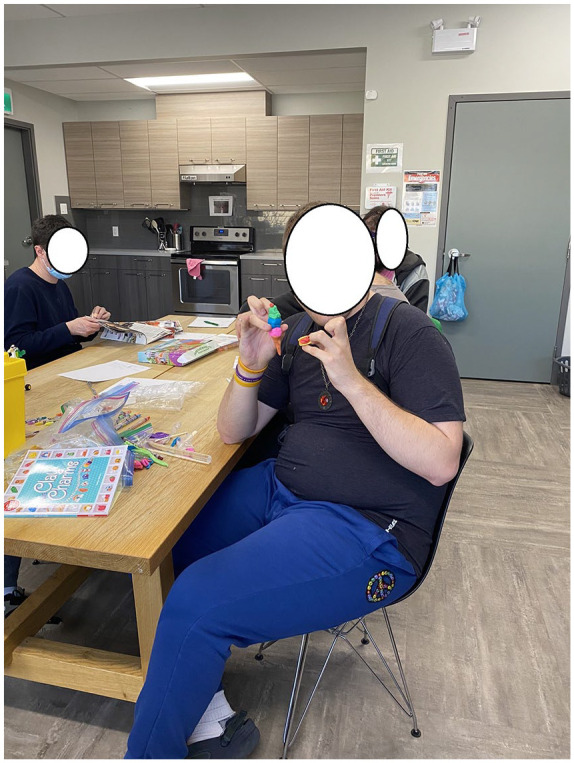
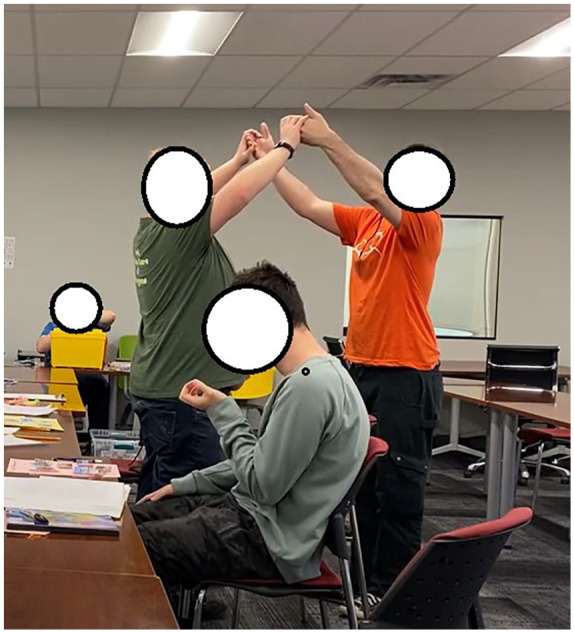
Autistic young adults with intellectual disabilities want to be autonomous but are less autonomous than other people. However, they can be autonomous with appropriate support. We wanted to learn how we can support autistic adults with intellectual disabilities to be more autonomous. We designed our study with help from five autistic community partners to make sure the research was relevant to autistic people and would improve their lives. We talked with eight autistic young adults with intellectual disabilities about autonomy. We defined "talk" as verbal language, as well as non-verbal cues such as body language, facial expressions, vocalizations, and laughter. We did art projects and played games while we talked. We met in small groups over multiple sessions. Our participants told us that being autonomous meant being able to be themselves. They told us three main ways to support their autonomy: (1) having choice and control, (2) being able to communicate in their own way, and (3) being in a safe environment. Families, support staff, and caregivers can use this information to help autistic young adults with intellectual disabilities to be autonomous.
Keywords: adulthood; autism; autonomy; choice; opportunity; qualitative; self-determination; support.
Conflict of interest statement
Declaration of conflicting interestsThe author(s) declared the following potential conflicts of interest with respect to the research, authorship, and/or publication of this article: At the time of data collection and analysis, J.R. was an employee of the autism service provider. Detailed information on how we navigated this is within the article. H.M.B. is a volunteer board member for the autism service provider with no involvement in day-to-day operations. The remaining authors have no competing interests to declare.
Figures

References
-
- Beaulne S. (2022). A clinician’s perspective on the communicative intention in autism: Call to reconsider our understanding of non-verbal behaviours, private and inner speech and echolalia in children with autism spectrum disorder. Journal on Developmental Disabilities, 27(3), 1–29.
-
- Braun V., Clarke V. (2019). Reflecting on reflexive thematic analysis. Qualitative Research in Sport, Exercise and Health, 11(4), 589–597. 10.1080/2159676X.2019.1628806 - DOI
-
- Braun V., Clarke V. (2021). To saturate or not to saturate? Questioning data saturation as a useful concept for thematic analysis and sample-size rationales. Qualitative Research in Sport, Exercise and Health, 13(2), 201–216. 10.1080/2159676X.2019.1704846 - DOI
-
- Braun V., Clarke V. (2022). Thematic analysis: A practical guide. Sage.
Publication types
MeSH terms
LinkOut - more resources
Full Text Sources
Miscellaneous
