


Time to first birth and its predictors among reproductive-age women in Ethiopia: multilevel analysis using shared frailty model
- PMID: 38760052
- PMCID: PMC11103229
- DOI: 10.1136/bmjopen-2023-082356
Time to first birth and its predictors among reproductive-age women in Ethiopia: multilevel analysis using shared frailty model
Abstract
Objective: To determine the time to first birth and its predictors among reproductive-age women in Ethiopia.
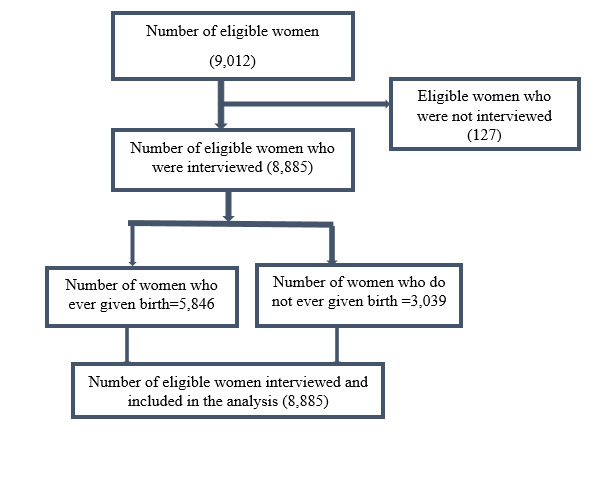
Design, setting and participants: Nationwide secondary data analysis using mini Ethiopian Demographic and Health Survey, 2019. A stratified, two-stage cluster sampling technique was used to select the sample. Among 9012 women of age 15-49 years, 8885 completed the interview yielding a response rate of 99%.
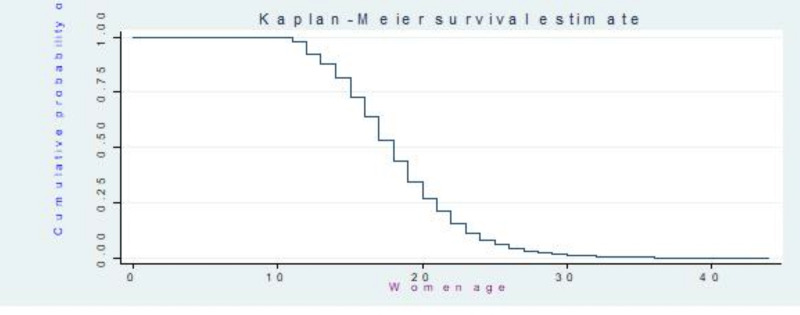
Main outcomes measured: Time to first birth was determined. Kaplan-Meier method was used to estimate the time to first birth. The lognormal inverse Gaussian shared frailty model was used to model the data at a 95% CI. CI and adjusted time ratio (ATR) were reported as effect size. Statistical significance was declared at p-value<0.05.
Results: The overall median time to give first birth was 18 years (IQR: 15, 21). Age 20-29 (ATR=1.08; 95% CI, 1.05 to 1.12), Age>29 years (ATR=1.08; 95% CI, 1.05 to 1.11), northern regions (ATR=1.06; 95% CI, 1.03 to 1.08), rural residence (ATR=0.95; 95% CI, 0.93 to 0.98), never using contraceptive methods (ATR=0.98; 95% CI, 0.96 to 0.99), sex of household head (ATR=1.01; 95% CI, 1 to 1.03), poorest wealth index (ATR=1.04; 95% CI, 1.02 to 1.06) and richest wealth index (ATR=1.07; 95% CI, 1.04 to 1.1) were the significant predictors of time to first birth among reproductive-age women.
Conclusion: In Ethiopia, women often gave birth to their first child at a younger age than what is recommended. Explicitly, women aged 20-29 and over 29, living in the northern region, leading a household as females, and belonging to the poorest or wealthiest wealth index tended to have a slightly delayed first childbirth. On the other hand, women in rural areas and those who had never used contraception were more likely to have an early first birth. The findings indicated the necessity of implementing targeted measures for rural Ethiopian women, especially those lacking knowledge about contraception.
Keywords: Demography; PUBLIC HEALTH; Subfertility.
© Author(s) (or their employer(s)) 2024. Re-use permitted under CC BY-NC. No commercial re-use. See rights and permissions. Published by BMJ.
Conflict of interest statement
Competing interests: None declared.
Figures
References
-
- UNFPA . Motherhood in Childhood Facing the Challenges of Adolescent Pregnancy. New York: Unfpa, 2013:ii–116.
-
- Temin M, Levine R. Start with a girl a new agenda for global health. A girls count report on adolescent girls. Center for Global Development; 2009.1–116.
-
- Shapiro D, Hinde A. On the pace of fertility decline in sub-Saharan Africa. DemRes 2017;37:1327–38. 10.4054/DemRes.2017.37.40 - DOI
-
- United Nations Department of Economic and Social Affairs . World fertility and family planning 2020. Dep Econ Soc Aff Popul Div; 2020.1–42.
MeSH terms
LinkOut - more resources
Full Text Sources
Miscellaneous
