. 2024 May 17;12(1):91.
doi: 10.1186/s40168-024-01796-y.

Giant viral signatures on the Greenland ice sheet

Affiliations

Giant viral signatures on the Greenland ice sheet

Laura Perini et al. Microbiome. .

Abstract

Background: Dark pigmented snow and glacier ice algae on glaciers and ice sheets contribute to accelerating melt. The biological controls on these algae, particularly the role of viruses, remain poorly understood. Giant viruses, classified under the nucleocytoplasmic large DNA viruses (NCLDV) supergroup (phylum Nucleocytoviricota), are diverse and globally distributed. NCLDVs are known to infect eukaryotic cells in marine and freshwater environments, providing a biological control on the algal population in these ecosystems. However, there is very limited information on the diversity and ecosystem function of NCLDVs in terrestrial icy habitats.

Results: In this study, we investigate for the first time giant viruses and their host connections on ice and snow habitats, such as cryoconite, dark ice, ice core, red and green snow, and genomic assemblies of five cultivated Chlorophyta snow algae. Giant virus marker genes were present in almost all samples; the highest abundances were recovered from red snow and the snow algae genomic assemblies, followed by green snow and dark ice. The variety of active algae and protists in these GrIS habitats containing NCLDV marker genes suggests that infection can occur on a range of eukaryotic hosts. Metagenomic data from red and green snow contained evidence of giant virus metagenome-assembled genomes from the orders Imitervirales, Asfuvirales, and Algavirales.

Conclusion: Our study highlights NCLDV family signatures in snow and ice samples from the Greenland ice sheet. Giant virus metagenome-assembled genomes (GVMAGs) were found in red snow samples, and related NCLDV marker genes were identified for the first time in snow algal culture genomic assemblies; implying a relationship between the NCLDVs and snow algae. Metatranscriptomic viral genes also aligned with metagenomic sequences, suggesting that NCLDVs are an active component of the microbial community and are potential "top-down" controls of the eukaryotic algal and protistan members. This study reveals the unprecedented presence of a diverse community of NCLDVs in a variety of glacial habitats dominated by algae.


Conflict of interest statement

The authors declare that they have no competing interests.

Figures

Fig. 1
Fig. 1
Greenland 2019 and 2020 sampling campaigns (GrIS19/Mit19 and GrIS20, respectively) for environmental samples. One location on the south side of the Greenland ice sheet (inset 1, bottom left). Three locations on the east side of the Greenland ice sheet: Bruckner Glacier (inset 2, top right), Heim Glacier (inset 3, top right), and Mittivakkat Glacier (inset 4, bottom right). Sample types include the following: cryoconite sediment, ice core, dark surface ice, and green and red snow. Circle sizes indicate the metagenome library’s average coverage depth. (Sample information can be found in Supplementary Table 1)
Fig. 2
Fig. 2
Quality-controlled counts of unfragmented NCLDV marker genes after homology searches against the NCBI nr reference database for each sample of this study. Analysis was carried out in 19 environmental metagenomes (MG) and 18 environmental metatranscriptomes (pooled) obtained from samples of cryoconite (n = 1), ice core (n = 3), green snow (n = 2), red snow (n = 5), dark ice (n = 8)), 1 metavirome (dark ice), and 5 snow algae genomic assemblies from the CCCryo collection. The points represent the total number of each marker gene in the samples with “total” indicating the overall count of marker genes in that sample. The “md” (more depth) notation following selected samples represents those that were re-sequenced with higher metagenomic coverage. Colored symbols on the left of the sample names represent the sample types
Fig. 3
Fig. 3
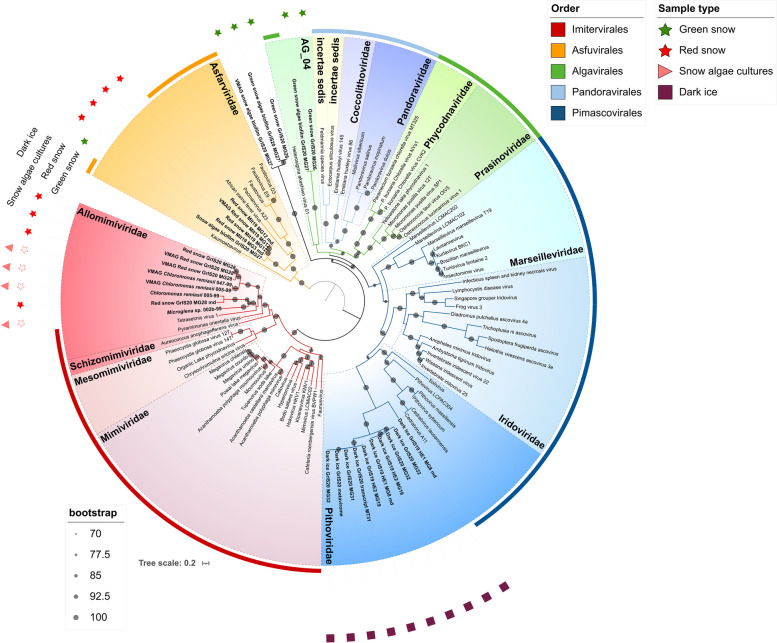
Maximum-likelihood phylogenetic tree of the NCLDV core gene DNA polymerase (PolB). Sequences recovered from the environmental samples are presented in bold at the tree node. Environmental sample types are specified in correspondence of each sequence. Branches are color-coded by order-level taxonomy. Viral families are specified in the colored ranges. The dark dots at the nodes represent the bootstrap support value of > 70
Fig. 4
Fig. 4
18S rRNA diversity of the 18 environmental samples from TotalRNA. Some eukaryotic phyla are made up of more than one individual. Bacterial phyla are not displayed but make up the empty space above each bar. Calculated relative abundance percentages can be found in Supplementary Table S9
Fig. 5
Fig. 5
Maximum-likelihood parsimony phylogenetic tree with 1171 external genomes from previously published GVMAGs and 10 GVMAGs from this study. According to the tree, the retrieved GVMAGs cluster in correspondence of the Asfuvirales (3), Imitervirales (6), and Algavirales (1) orders. VGMAGs originated from this study are highlighted by the corresponding environmental sample type symbol. Branches are color-coded by order-level taxonomy. Cultured isolate virus references of interest are labeled in their approximate location along the branches with the following abbreviations: African swine fever virus (ASFV), Heterosigma akashiwo Virus 01 isolate HaV53 (HaV53), Tetraselmis Virus (TetV), Pyramimonas orientalis Virus 01b (PoV-01b), Phaeocystis globosa Virus (PgV)

References

    1. Yallop ML, Anesio AM, Perkins RG, Cook J, Telling J, Fagan D, et al. Photophysiology and albedo-changing potential of the ice algal community on the surface of the Greenland ice sheet. ISME J. 2012;6:2302–13. Available from: 10.1038/ismej.2012.107. - PMC - PubMed
    1. Hoham RW, Remias D. Snow and glacial algae: a review. J Phycol. 2020;56:264–282. doi: 10.1111/jpy.12952. - DOI - PMC - PubMed
    1. Tanaka S, Takeuchi N, Miyairi M, Fujisawa Y, Kadota T, Shirakawa T, et al. Snow algal communities on glaciers in the Suntar-Khayata Mountain Range in eastern Siberia, Russia. Polar Sci. 2016;10:227–38. Available from: 10.1016/j.polar.2016.03.004.
    1. Uetake J, Tanaka S, Hara K, Tanabe Y, Samyn D, Motoyama H, et al. Novel biogenic aggregation of moss gemmae on a disappearing african glacier. PLoS One. 2014;9(11):e112510. doi: 10.1371/journal.pone.0112510. - DOI - PMC - PubMed
    1. Williamson CJ, Anesio AM, Cook J, Tedstone A, Poniecka E, Holland A, et al. Ice algal bloom development on the surface of the Greenland ice sheet. FEMS Microbiol Ecol. 2018;94(3):fiy025. doi: 10.1093/femsec/fiy025. - DOI - PMC - PubMed

LinkOut - more resources