


The Mediating Role of Kynurenine Pathway Metabolites on the Relationship Between Inflammation and Muscle Mass in Oldest-Old Men
- PMID: 38761087
- PMCID: PMC11163921
- DOI: 10.1093/gerona/glae131
The Mediating Role of Kynurenine Pathway Metabolites on the Relationship Between Inflammation and Muscle Mass in Oldest-Old Men
Abstract
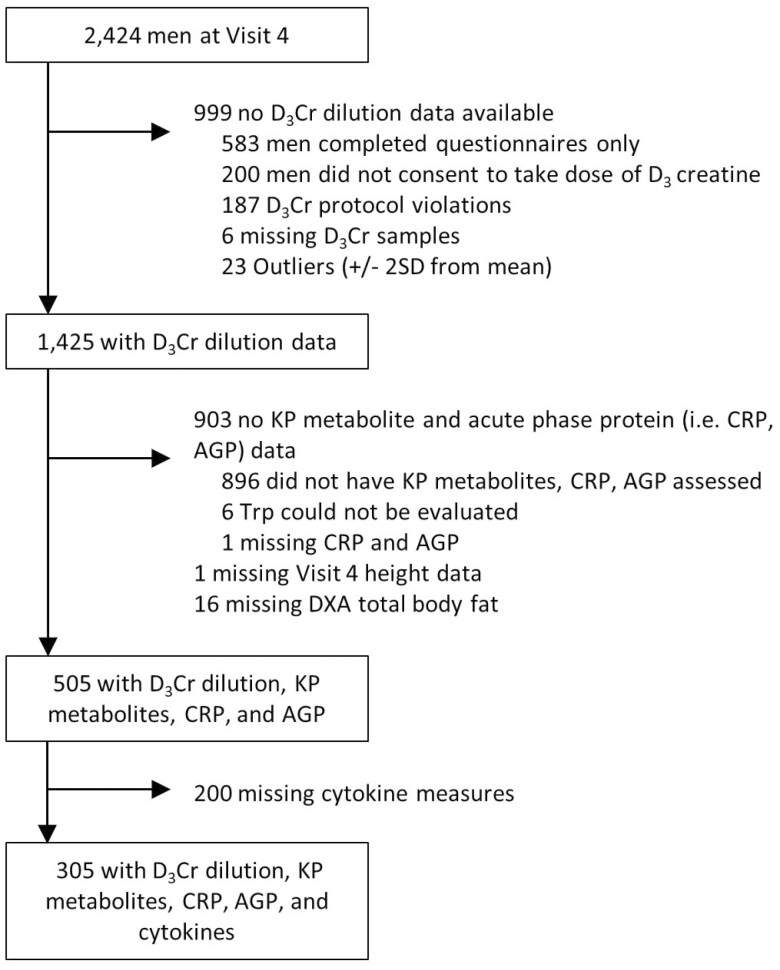
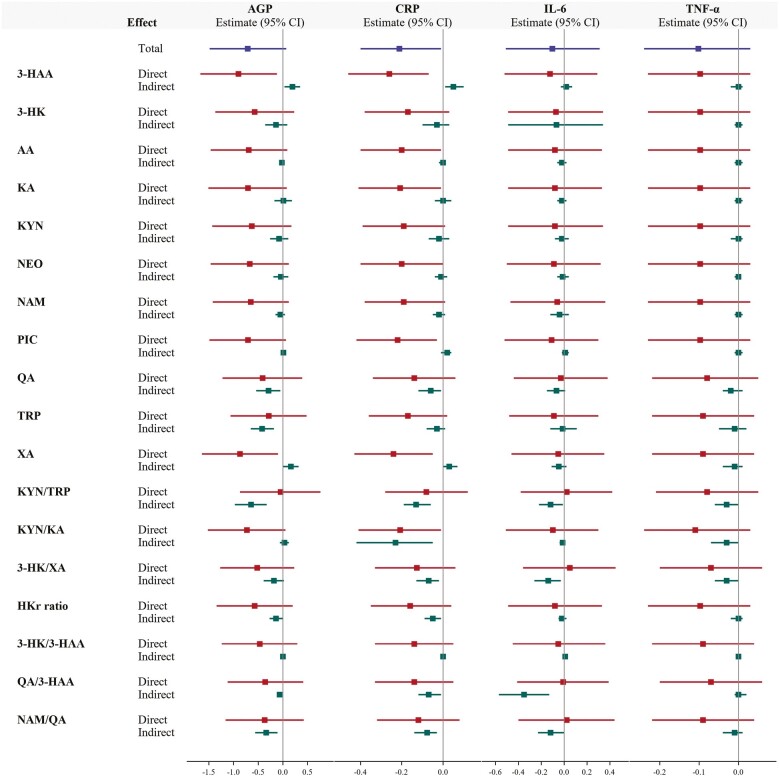
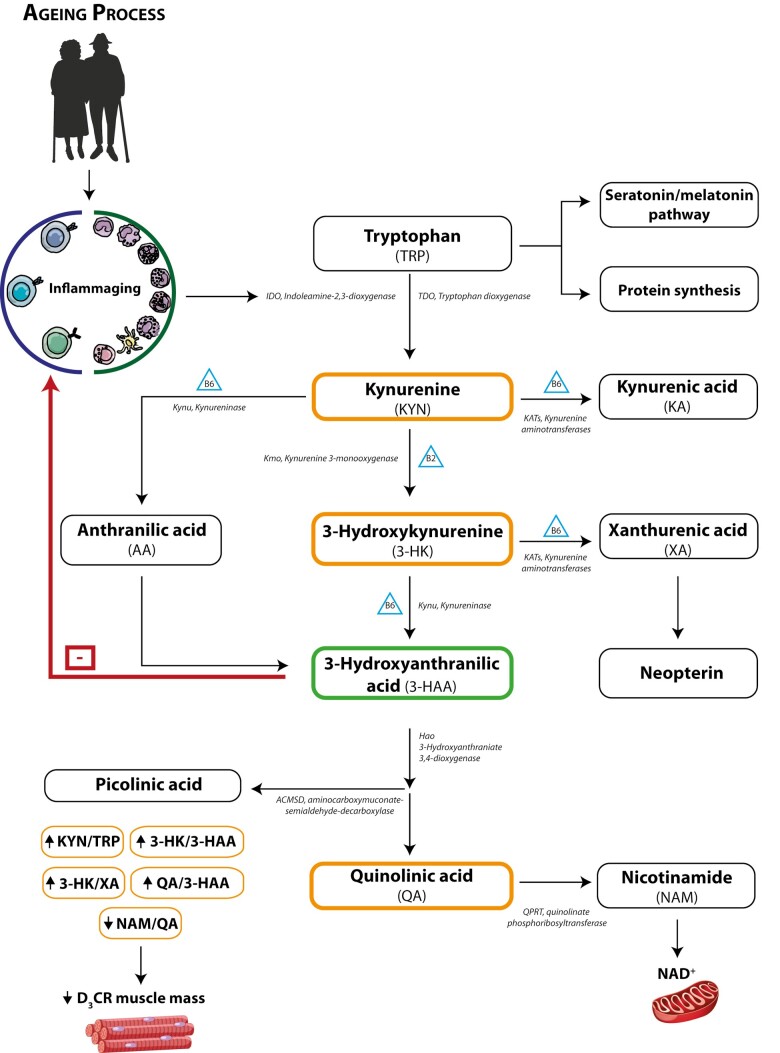
Tryptophan (TRP) metabolites along the kynurenine (KYN) pathway (KP) have been found to influence muscle. Proinflammatory cytokines are known to stimulate the degradation of TRP down the KP. Given that both inflammation and KP metabolites have been connected with loss of muscle, we assessed the potential mediating role of KP metabolites on inflammation and muscle mass in older men. Five hundred and five men (85.0 ± 4.2 years) from the Osteoporotic Fractures in Men cohort study with measured D3-creatine dilution (D3Cr) muscle mass, KP metabolites, and inflammation markers (C-reactive protein [CRP], alpha-1-acid glycoprotein [AGP] and a subsample [n = 305] with interleukin [IL-6, IL-1β, IL-17A] and tumor necrosis factor-α [TNF-α]) were included in the analysis. KP metabolites and inflammatory markers were measured using liquid chromatography-tandem mass spectrometry and immunoassays, respectively. 23%-92% of the inverse relationship between inflammatory markers and D3Cr muscle mass was mediated by KP metabolites (indirect effect p < .05). 3-hydroxyanthranilic acid (3-HAA), quinolinic acid (QA), TRP, xanthurenic acid (XA), KYN/TRP, 3-hydroxykynurenine (3-HK)/3-HAA, QA/3-HAA, and nicotinamide (NAM)/QA mediated the AGP relationship. 3-HAA, QA, KYN/TRP, 3-HK/XA, HKr ratio, 3-HK/3-HAA, QA/3-HAA, and NAM/QA mediated the CRP. KYN/TRP, 3-HK/XA, and NAM/QA explained the relationship for IL-6 and 3-HK/XA and QA/3-HAA for TNF-α. No mediation effect was observed for the other cytokines (indirect effect p > .05). KP metabolites, particularly higher ratios of KYN/TRP, 3-HK/XA, 3-HK/3-HAA, QA/3-HAA, and a lower ratio of NAM/QA, mediated the relationship between inflammation and low muscle mass. Our preliminary cross-sectional data suggest that interventions to alter D3Cr muscle mass may focus on KP metabolites rather than inflammation per se.
Keywords: Biomarkers; C-reactive protein; D3-creatine; Sarcopenia.
© The Author(s) 2024. Published by Oxford University Press on behalf of The Gerontological Society of America. All rights reserved. For commercial re-use, please contact reprints@oup.com for reprints and translation rights for reprints. All other permissions can be obtained through our RightsLink service via the Permissions link on the article page on our site—for further information please contact journals.permissions@oup.com.
Conflict of interest statement
P.M.C. owns stock in and consults with Myocorps, Inc. The other authors declare no conflict of interest.
Figures

References
Publication types
MeSH terms
Substances
Grants and funding
- U01 AG042140/AG/NIA NIH HHS/United States
- U01 AG042124/AG/NIA NIH HHS/United States
- UL1 TR002369/TR/NCATS NIH HHS/United States
- U01 AG042139/AG/NIA NIH HHS/United States
- U01 AG042143/AG/NIA NIH HHS/United States
- U01 AG027810/AG/NIA NIH HHS/United States
- U01 AR066160/AR/NIAMS NIH HHS/United States
- NH/NIH HHS/United States
- R01 AG066671/AG/NIA NIH HHS/United States
- U01 AG042168/AG/NIA NIH HHS/United States
- P30 AR075055/AR/NIAMS NIH HHS/United States
- U01 AG042145/AG/NIA NIH HHS/United States
- AG/NIA NIH HHS/United States
LinkOut - more resources
Full Text Sources
Research Materials
Miscellaneous
