


Optimizing resource allocation: Cost-effectiveness of specified D-dimer cut-offs in cancer patients with suspected venous thromboembolism
- PMID: 38762707
- PMCID: PMC11315745
- DOI: 10.1007/s11239-024-03000-2
Optimizing resource allocation: Cost-effectiveness of specified D-dimer cut-offs in cancer patients with suspected venous thromboembolism
Abstract
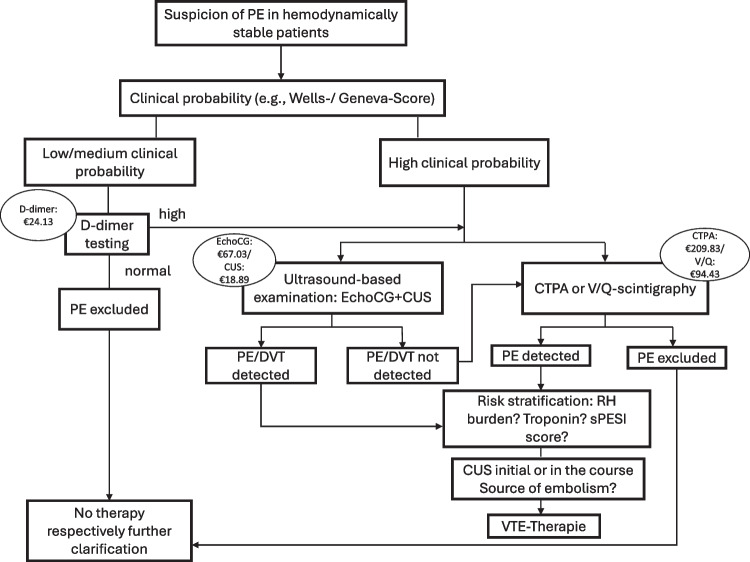
An accurate diagnosis of venous thromboembolism (VTE) is crucial, given the potential for high mortality in undetected cases. Strategic D-dimer testing may aid in identifying low-risk patients, preventing overdiagnosis and reducing imaging costs. We conducted a retrospective, comparative analysis to assess the potential cost savings that could be achieved by adopting different approaches to determine the most effective D-dimer cut-off value in cancer patients with suspected VTE, compared to the commonly used rule-out cut-off level of 0.5 mg/L. The study included 526 patients (median age 65, IQR 55-75) with a confirmed cancer diagnosis who underwent D-dimer testing. Among these patients, the VTE prevalence was 29% (n = 152). Each diagnostic strategy's sensitivity, specificity, negative likelihood ratio (NLR), as well as positive likelihood ratio (PLR), and the proportion of patients exhibiting a negative D-dimer test result, were calculated. The diagnostic strategy that demonstrated the best balance between specificity, sensitivity, NLR, and PLR, utilized an inverse age-specific cut-off level for D-dimer [0.5 + (66-age) × 0.01 mg/L]. This method yielded a PLR of 2.9 at a very low NLR for the exclusion of VTE. We observed a significant cost reduction of 4.6% and 1.0% for PE and DVT, respectively. The utilization of an age-adjusted cut-off [patient's age × 0.01 mg/L] resulted in the highest cost savings, reaching 8.1% for PE and 3.4% for DVT. Using specified D-dimer cut-offs in the diagnosis of VTE could improve economics, considering the limited occurrence of confirmed cases among patients with suspected VTE.
Keywords: Cancer; Cost-effectiveness analysis; D-dimer; Deep vein thrombosis; Pulmonary embolism; Venous thromboembolism.
© 2024. The Author(s).
Figures

References
-
- Federführende Fachgesellschaft: Deutsche Gesellschaft für Angiologie – Gesellschaft für Gefäßmedizin. AWMF-S2k-Leitlinie: Diagnostik und Therapie der Venenthrombose und Lungenembolie. https://register.awmf.org/assets/guidelines/065-002l_S2k_Venenthrombose-... (awmf.org). Accessed 10 Apr 2024
-
- Virani SS, Alonso A, Benjamin EJ et al (2020) Heart Disease and Stroke Statistics—2020 Update: A Report From the American Heart Association. Circulation. 141(9). 10.1161/CIR.0000000000000757 - PubMed
MeSH terms
Substances
LinkOut - more resources
Full Text Sources
Medical
