


Predictors contributing to the estimation of pulmonary tuberculosis among adults in a resource-limited setting: A systematic review of diagnostic predictions
- PMID: 38764538
- PMCID: PMC11100385
- DOI: 10.1177/20503121241243238
Predictors contributing to the estimation of pulmonary tuberculosis among adults in a resource-limited setting: A systematic review of diagnostic predictions
Abstract
Background: Although tuberculosis is highly prevalent in low- and middle-income countries, millions of cases remain undetected using current diagnostic methods. To address this problem, researchers have proposed prediction rules.
Objective: We analyzed existing prediction rules for the diagnosis of pulmonary tuberculosis and identified factors with a moderate to high strength of association with the disease.
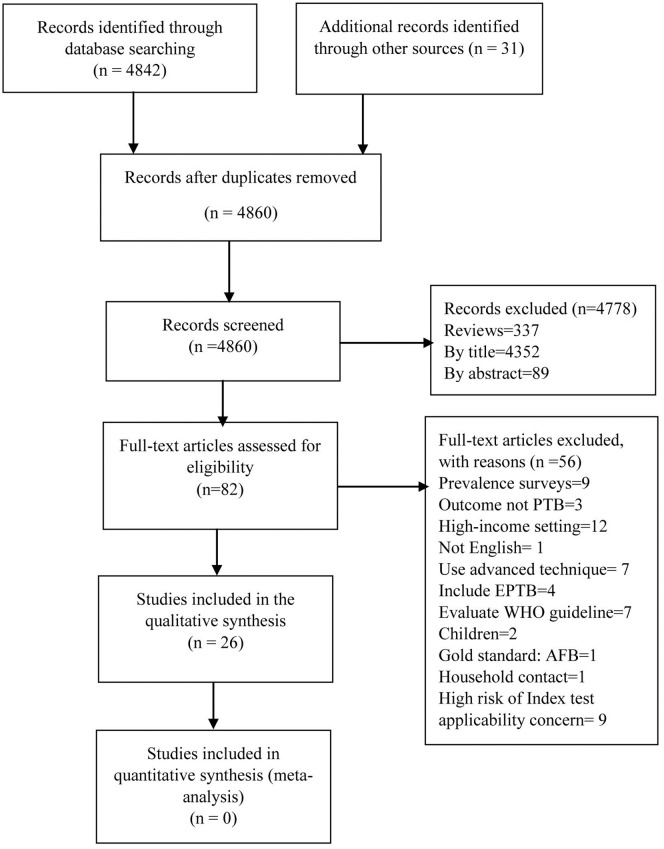
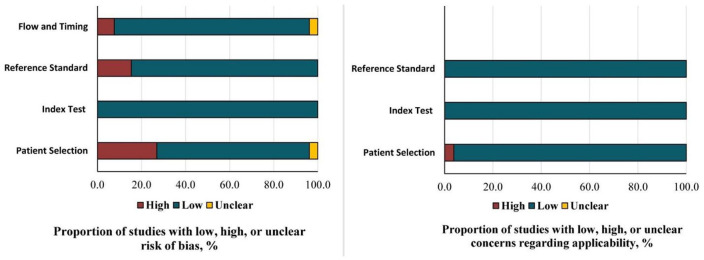
Methods: We conducted a comprehensive search of relevant databases (MEDLINE/PubMed, Cochrane Library, Science Direct, Global Health for Reports, and Google Scholar) up to 14 November 2022. Studies that developed diagnostic algorithms for pulmonary tuberculosis in adults from low and middle-income countries were included. Two reviewers performed study screening, data extraction, and quality assessment. The study quality was assessed using the Quality Assessment of Diagnostic Accuracy Studies-2. We performed a narrative synthesis.
Results: Of the 26 articles selected, only half included human immune deficiency virus-positive patients. In symptomatic human immune deficiency virus patients, radiographic findings and body mass index were strong predictors of pulmonary tuberculosis, with an odds ratio of >4. However, in human immune deficiency virus-negative individuals, the biomarkers showed a moderate association with the disease. In symptomatic human immune deficiency virus patients, a C-reactive protein level ⩾10 mg/L had a sensitivity and specificity of 93% and 40%, respectively, whereas a trial of antibiotics had a specificity of 86% and a sensitivity of 43%. In smear-negative patients, anti-tuberculosis treatment showed a sensitivity of 52% and a specificity of 63%.
Conclusions: The performance of predictors and diagnostic algorithms differs among patient subgroups, such as in human immune deficiency virus-positive patients, radiographic findings, and body mass index were strong predictors of pulmonary tuberculosis. However, in human immune deficiency virus-negative individuals, the biomarkers showed a moderate association with the disease. A few models have reached the World Health Organization's recommendation. Therefore, more work should be done to strengthen the predictive models for tuberculosis screening in the future, and they should be developed rigorously, considering the heterogeneity of the population in clinical work.
Keywords: Predictors; diagnostic algorithm; performance; pulmonary tuberculosis.
© The Author(s) 2024.
Conflict of interest statement
The author(s) declared no potential conflicts of interest with respect to the research, authorship, and/or publication of this article.
Figures
References
-
- WHO. Global tuberculosis report 2023. Geneva: World Health Organization, 2023.
-
- The Global Fund. Make a global priority of finding missing cases of tuberculosis. The Global Fund to Fight AIDS, Tuberculosis and Malaria, https://www.theglobalfund.org/en/blog/2017-10-10-make-a-global-priority-... (2017, accessed 20 September 2022).
Publication types
LinkOut - more resources
Full Text Sources
Research Materials
