This is a preprint.
Serving Up FLAN. A Food Literacy and Nutrition Intervention to Fend Off Food Insecurity
- PMID: 38766254
- PMCID: PMC11100874
- DOI: 10.21203/rs.3.rs-4331290/v1
Serving Up FLAN. A Food Literacy and Nutrition Intervention to Fend Off Food Insecurity
Update in
-
Serving up FLAN. a food literacy and nutrition intervention to fend off food insecurity.BMC Nutr. 2024 Jul 23;10(1):102. doi: 10.1186/s40795-024-00909-y. BMC Nutr. 2024. PMID: 39044224 Free PMC article.
Abstract
Background: Food insecurity, an ongoing and accelerating problem in the U.S., is an economic and social condition involving limited or uncertain access to adequate food. Some of the highest rates of food insecurity in 2022 were found among individuals who were Hispanic-Latinx (20.8%), a population that already faces disproportionate health and socioeconomic disadvantages. There remains an urgent health-related need to identify sustainable strategies to prevent food insecurity in the Latinx population.
Methods: A first-generation pilot investigation was conducted using data derived from a sub-study connected to the Computerized Physical Activity Support for Seniors (COMPASS) Trial, a 12-month cluster-randomized controlled trial among older Latinx adults. The sub-study focused on two nutrition interventions that included 1) the Food Literacy and Nutrition (FLAN) curriculum, and 2) a nutrition information-only control. Research hypotheses aimed to determine whether the FLAN intervention reduced food insecurity and increased daily fruit and vegetable servings.
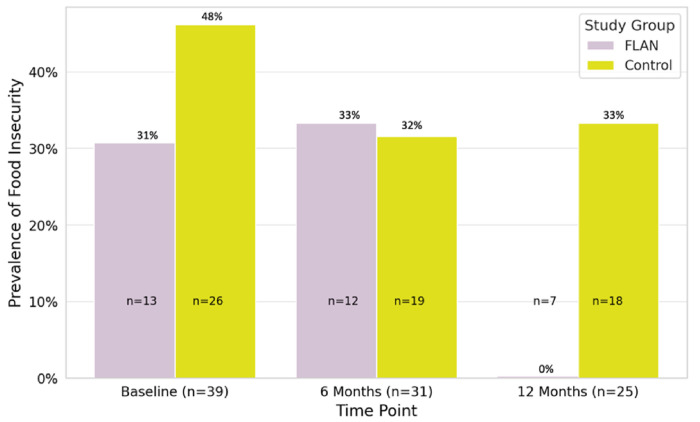
Results: On average, participants (n = 39) were 61.5 years of age (SD = 6.7), mostly female (69%), and reported Spanish as their primary language (69%). The FLAN intervention was associated with decreased odds of food insecurity at 12 months (AOR = 0.71, 95% CI = 0.54, 0.95; p = 0.03) when compared to the nutrition-information only control intervention. Although no between-group differences in daily fruit and vegetable servings were found, there was a significant correlation between changes in daily fruit and vegetable servings from baseline to six months and changes in food insecurity from baseline to 12 months (r = -0.51, p = 0.01).
Conclusions: The FLAN intervention, a bilingual and culturally tailored educational curriculum, yielded 12-month improvements in food security among a small sample of older Latinx adults. Evidence from this investigation suggests the potential utility of implementing the FLAN curriculum among individuals who are at an increased risk of food insecurity. Further investigation in a larger sample is merited to determine whether the 12-month decreases in food insecurity that were produced by the FLAN intervention can be replicated.
Trial registration: ClinicalTrials.gov Identifier: NCT02111213.
Keywords: Hispanic; Latinx; education; food insecurity; food literacy; fruit and vegetable; intervention; nutrition; pilot; randomized controlled trial.
Conflict of interest statement
Competing Interests: The authors declare that they have no competing interests.
Figures
References
-
- Coleman-Jensen A, Rabbitt MP, Hashad RM, Hales L, Gregory CA. Definitions of Food Security: Ranges of Food Security and Food Insecurity. United States Department of Agriculture, Economic Research Service. 2023;https://www.ers.usda.gov/topics/food-nutrition-assistance/food-security-....
-
- Rabbit MP, Hales LJ, Burke MP, Coleman-Jensen A. Household food security in the United States in 2022. US Department Agric Economic Res Service. 2023;https://www.ers.usda.gov/webdocs/publications/107703/err-325.pdf?v=5569.8.
-
- To QG, Frongillo EA, Gallegos D, Moore JB. Household food insecurity is associated with less physical activity among children and adults in the US population. J Nutr. 2014;144(11):1797–802. - PubMed
-
- Royer MF, Ojinnaka CO, Bruening M. Food insecurity is related to disordered eating behaviors among college students. J Nutr Educ Behav. 2021;53(11):951–6. - PubMed
Publication types
Associated data
Grants and funding
LinkOut - more resources
Full Text Sources
Medical