


Disparate outcomes in Hispanic patients with metabolic dysfunction-associated steatotic liver disease/steatohepatitis and type 2 diabetes: Large cohort study
- PMID: 38766421
- PMCID: PMC11099377
- DOI: 10.4239/wjd.v15.i5.886
Disparate outcomes in Hispanic patients with metabolic dysfunction-associated steatotic liver disease/steatohepatitis and type 2 diabetes: Large cohort study
Abstract
Background: Metabolic dysfunction-associated steatotic liver disease (MASLD) and metabolic dysfunction-associated steatohepatitis (MASH) are a growing health burden across a significant portion of the global patient population. However, these conditions seem to have disparate rates and outcomes between different ethnic populations. The combination of MASLD/MASH and type 2 diabetes increases the risk of hepatocellular carcinoma (HCC), and Hispanic patients experience the greatest burden, particularly those in South Texas.
Aim: To compare outcomes between Hispanic and non-Hispanic patients in the United States, while further focusing on the Hispanic population within Southeast Texas to determine whether the documented disparity in outcomes is a function of geographical circumstance or if there is a more widespread reason that all clinicians must account for in prognostic consideration.
Methods: This cohort analysis was conducted with data obtained from TriNetX, LLC ("TriNetX"), a global federated health research network that provides access to deidentified medical records from healthcare organizations worldwide. Two cohort networks were used: University of Texas Medical Branch (UTMB) hospital and the United States national database collective to determine whether disparities were related to geographic regions, like Southeast Texas.
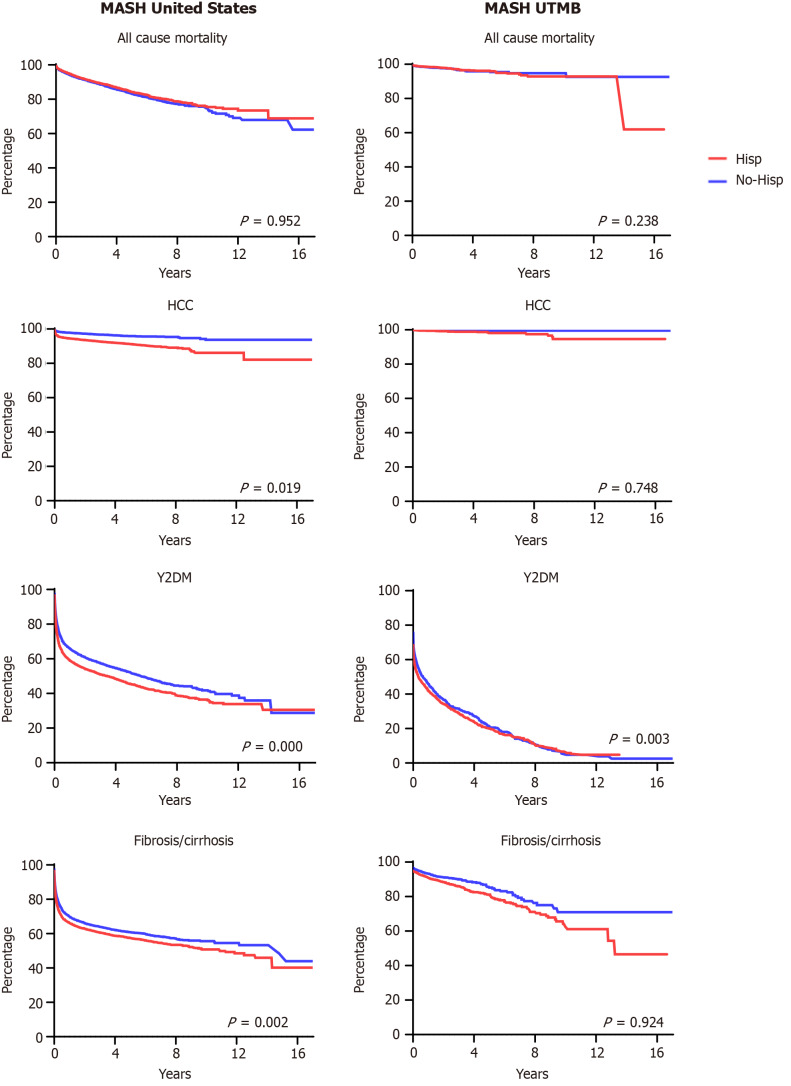
Results: This study findings revealed Hispanics/Latinos have a statistically significant higher occurrence of HCC, type 2 diabetes mellitus, and liver fibrosis/cirrhosis in both the United States and the UTMB Hispanic/Latino groups. All-cause mortality in Hispanics/Latinos was lower within the United States group and not statistically elevated in the UTMB cohort.
Conclusion: This would appear to support that Hispanic patients in Southeast Texas are not uniquely affected compared to the national Hispanic population.
Keywords: Diabetes mellitus; Hepatocellular carcinoma; Hispanic; Metabolic dysfunction-associated steatohepatitis; Metabolic dysfunction-associated steatotic liver disease; Non-alcoholic fatty liver disease; Non-alcoholic steatohepatitis; Steatotic liver disease; TriNetX.
©The Author(s) 2024. Published by Baishideng Publishing Group Inc. All rights reserved.
Conflict of interest statement
Conflict-of-interest statement: All the authors report no relevant conflicts of interest for this article.
Figures
References
-
- Stepanova M, Kabbara K, Mohess D, Verma M, Roche-Green A, AlQahtani S, Ong J, Burra P, Younossi ZM. Nonalcoholic steatohepatitis is the most common indication for liver transplantation among the elderly: Data from the United States Scientific Registry of Transplant Recipients. Hepatol Commun. 2022;6:1506–1515. - PMC - PubMed
-
- Noureddin M, Vipani A, Bresee C, Todo T, Kim IK, Alkhouri N, Setiawan VW, Tran T, Ayoub WS, Lu SC, Klein AS, Sundaram V, Nissen NN. NASH Leading Cause of Liver Transplant in Women: Updated Analysis of Indications For Liver Transplant and Ethnic and Gender Variances. Am J Gastroenterol. 2018;113:1649–1659. - PMC - PubMed
-
- Song SJ, Lai JC, Wong GL, Wong VW, Yip TC. Can we use old NAFLD data under the new MASLD definition? J Hepatol. 2024;80:e54–e56. - PubMed
Grants and funding
LinkOut - more resources
Full Text Sources
