


Association between daily sitting time and kidney stones based on the National Health and Nutrition Examination Survey (NHANES) 2007-2016: a cross-sectional study
- PMID: 38768465
- PMCID: PMC11325893
- DOI: 10.1097/JS9.0000000000001560
Association between daily sitting time and kidney stones based on the National Health and Nutrition Examination Survey (NHANES) 2007-2016: a cross-sectional study
Abstract
Background: Kidney stones are among the most common urological conditions affecting ~9% of the world population. Although some unhealthy diets and unhealthy lifestyles are reportedly risk factors for kidney stone, the association between daily sitting time and kidney stone has not been explored.
Materials and methods: This large-scale, cross-sectional study was conducted using data from the National Health and Nutrition Examination Survey (NHANES) database 2007-2016. Kidney stone history and daily sitting time were retrieved from the questionnaire and 24 hour (h) recall interviews. Logistic regression and subgroup analysis were conducted to investigate the association. The analysis was further stratified by vigorous recreational activity.
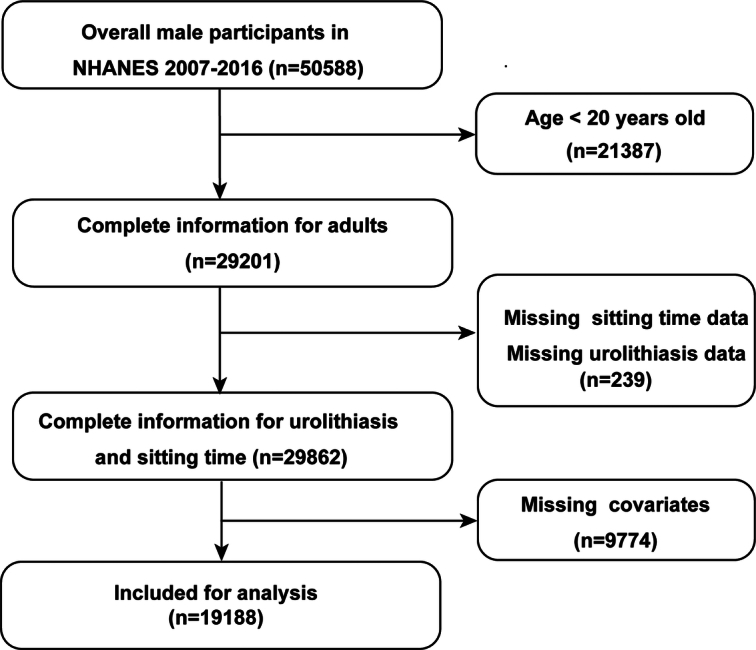
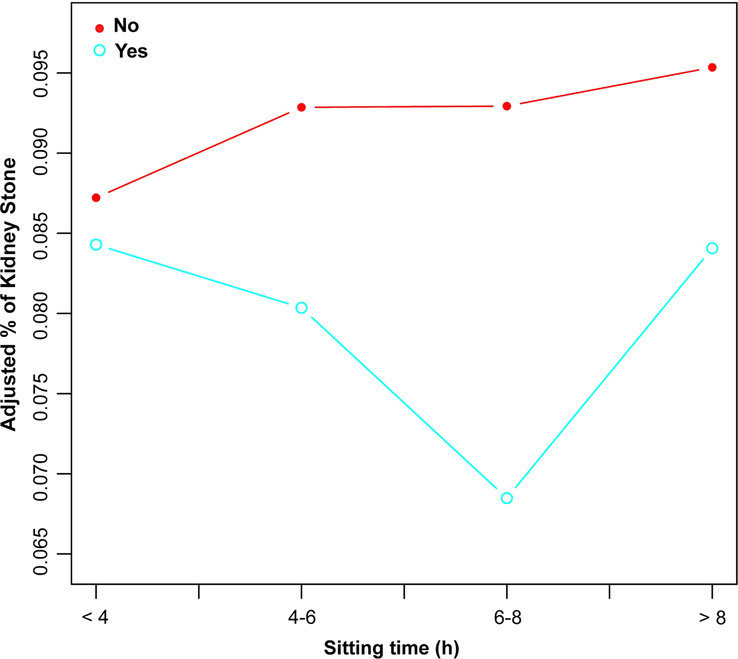
Results: A total of 19 188 participants aged ≥20 years with complete information were included in this study. The overall prevalence of kidney stone was 9.6%. Among participants without vigorous recreational activity, a trend towards an increasing prevalence of kidney stone was observed with increased daily sitting time. However, the trend was not observed in individuals who participated in vigorous recreational activity, as they experienced a decreased risk of kidney stone despite having a daily sitting time of 6-8 h (crude model OR=0.659, 95% CI: 0.457-0.950, P =0.028), indicating that vigorous recreational activity may partially attenuate the detrimental effect of prolonged sitting time.
Conclusion: Our study revealed an increasing trend of prevalence of kidney stone with increased daily sitting time among the population not performing vigorous recreational activity despite the difference was nonsignificant. Vigorous recreational activity may modify the association between daily sitting time and kidney stone. More prospective cohort studies are warranted to further examine this association.
Copyright © 2024 The Author(s). Published by Wolters Kluwer Health, Inc.
Conflict of interest statement
We declare that there are no conflicts of interests.
Figures
References
-
- Zeng G, Mai Z, Xia S, et al. . Prevalence of kidney stones in China: an ultrasonography based cross-sectional study. BJU Int 2017;120:109–116. - PubMed
-
- Yasui T, Okada A, Hamamoto S, et al. . Pathophysiology-based treatment of urolithiasis. Int J Urol 2017;24:32–38. - PubMed
-
- Sasmaz M, Kirpat V. The relationship between the severity of pain and stone size, hydronephrosis and laboratory parameters in renal colic attack. Am J Emerg Med 2019;37:2107–2110. - PubMed
MeSH terms
LinkOut - more resources
Full Text Sources
