Randomized Controlled Trial
. 2024 Aug;78(8):726-731.
doi: 10.1038/s41430-024-01448-2. Epub 2024 May 20.

Measurement of diamine oxidase (DAO) during low-histamine or ordinary diet in patients with histamine intolerance

Affiliations
Randomized Controlled Trial

Measurement of diamine oxidase (DAO) during low-histamine or ordinary diet in patients with histamine intolerance

Georgios Rentzos et al. Eur J Clin Nutr. 2024 Aug.

Abstract

Background/objectives: Quantification of diamine oxidase (DAO) concentrations in serum has been proposed as an adjunctive diagnostic modality for the evaluation of histamine intolerance (HIT). Limited empirical data exist concerning the influence of dietary patterns on DAO levels.

Subjects/methods: In the context of a prospective study employing a crossover design, 18 individuals diagnosed with HIT were randomized to initiate either a low histamine diet (LHD) or a conventional mixed diet (MXD). Serum DAO concentrations were measured at the commencement of the study and following each dietary phase. A control group underwent analogous DAO assessments without imposition of dietary constraints.

Results: During the time when a diet restricted in histamine was implemented, noticeable differences in changes in DAO levels did not become apparent when compared to the changes observed during the mixed (MXD) phase. Specifically, among the group, 10 of the 18 patients exhibited elevated DAO values subsequent to the LHD regimen, while the remaining eight displayed either reduced or unchanging DAO levels. The prevalence of elevated DAO levels in the LHD group did not differ significantly from that observed in the control group during the MXD phase. Additionally, during the LHD phase, patients reported a significant reduction in gastrointestinal and cutaneous symptoms.

Conclusions: This prospective investigation underscores the enduring utility of a histamine-restricted diet, coupled with structured dietary reintroduction, as an efficacious diagnostic approach for individuals presenting with suspected food-related histamine hypersensitivity. Notably, the measurement of DAO levels appears to furnish only a limited capacity to discern dietary-induced fluctuations. Notwithstanding, the dynamics of DAO alteration do not appear to exhibit a discernible association with specific dietary patterns, a finding consistent across both patient and control groups.


Conflict of interest statement

The authors declared no competing interests.

Figures

Fig. 1
Fig. 1. Setup of the study.
Patients were randomly assigned to undergo two different 3-week dietary interventions: a low histamine diet (LHD) and a regular mixed diet (MXD). Blood samples were collected at three specific time points for measuring the levels of diamine oxidase (DAO) in both groups. The first sampling (DAO 1) occurred before the dietary interventions started, the second after three weeks of adhering to the mixed diet (DAO 2), and the third after three weeks of switching between the low histamine and mixed diets (DAO 3). Throughout the entire six-week dietary intervention, patients diligently recorded their symptoms in designated diaries. The control group did not undergo any dietary interventions, but blood samples for DAO quantification were collected at the same three-time points as in the patient group.
Fig. 2
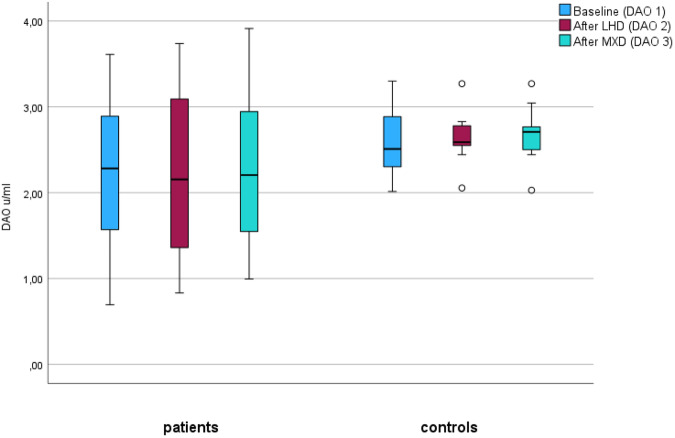
Fig. 2. Patient group.
Analysis of the diamine oxidase (DAO) values in patients during three phases of a crossover dietary intervention - baseline, Low Histamine Diet (LHD), and Mixed Diet (MXD). Control group: Analysis of the DAO values in a control group without dietary restrictions. No significant fluctuations or differences in DAO levels were observed either between patients and the control group or among the different dietary phases within the patient group (p > 0.05). This assessment was performed using the non-parametric Friedman’s ANOVA test.
Fig. 3
Fig. 3. Symptom score and the various symptoms reported by the patient groups while following the Low Histamine Diet (LHD), specifically gastrointestinal pain (dpain), skin-related symptoms (dskin), and headaches (dhead), compared to the symptom scores during the Mixed Diet (MXD), including pain (mpain), skin-related issues (mskin), and headaches (mhead).
Symptoms from the gastrointestinal tract (mpain) and skin (mskin) were found significant higher (p < 0.05) during the MXD compared to LHD. Aggregated symptom scores are defined whereas daily symptom values for an individual are added for a particular symptom (gastrointestinal pain, skin symptoms, headache) and a diet (LHD respectively MXD) to provide one single aggregate value for that symptom per individual and per diet.

References

    1. EFSA Panel on Biological Hazards. Scientific Opinion on risk based control of biogenic amine formation in fermented foods. EFSA J. 2011;9:2393.10.2903/j.efsa.2011.2393 - DOI
    1. Johansson SG, Bieber T, Dahl R, Friedmann PS, Lanier BQ, Lockey RF, et al. Revised nomenclature for allergy for global use: Report of the Nomenclature Review Committee of the World Allergy Organization, October 2003. J Allergy Clin Immunol. 2004;113:832–6. 10.1016/j.jaci.2003.12.591 - DOI - PubMed
    1. Colombo FM, Cattaneo P, Confalonieri E, Bernardi C. Histamine food poisonings: A systematic review and meta-analysis. Crit Rev Food Sci Nutr. 2018;58:1131–51. 10.1080/10408398.2016.1242476 - DOI - PubMed
    1. Maintz L, Novak N. Histamine and histamine intolerance. Am J Clin Nutr. 2007;85:1185–96. 10.1093/ajcn/85.5.1185 - DOI - PubMed
    1. Tuck CJ, Biesiekierski JR, Schmid-Grendelmeier P, Pohl D. Food Intolerances. Nutrients 2019; 11. 10.3390/nu11071684. - PMC - PubMed

Publication types

Substances

LinkOut - more resources