Clinical Trial
. 2024 May;30(5):1276-1283.
doi: 10.1038/s41591-024-02940-9. Epub 2024 May 20.

Non-invasive spinal cord electrical stimulation for arm and hand function in chronic tetraplegia: a safety and efficacy trial

Affiliations
Clinical Trial

Non-invasive spinal cord electrical stimulation for arm and hand function in chronic tetraplegia: a safety and efficacy trial

Chet Moritz et al. Nat Med. 2024 May.

Abstract

Cervical spinal cord injury (SCI) leads to permanent impairment of arm and hand functions. Here we conducted a prospective, single-arm, multicenter, open-label, non-significant risk trial that evaluated the safety and efficacy of ARCEX Therapy to improve arm and hand functions in people with chronic SCI. ARCEX Therapy involves the delivery of externally applied electrical stimulation over the cervical spinal cord during structured rehabilitation. The primary endpoints were safety and efficacy as measured by whether the majority of participants exhibited significant improvement in both strength and functional performance in response to ARCEX Therapy compared to the end of an equivalent period of rehabilitation alone. Sixty participants completed the protocol. No serious adverse events related to ARCEX Therapy were reported, and the primary effectiveness endpoint was met. Seventy-two percent of participants demonstrated improvements greater than the minimally important difference criteria for both strength and functional domains. Secondary endpoint analysis revealed significant improvements in fingertip pinch force, hand prehension and strength, upper extremity motor and sensory abilities and self-reported increases in quality of life. These results demonstrate the safety and efficacy of ARCEX Therapy to improve hand and arm functions in people living with cervical SCI. ClinicalTrials.gov identifier: NCT04697472 .


Conflict of interest statement

The Up-LIFT study investigators hold various patents in relation with the present work, act as consultants to ONWARD Medical and may be minority shareholders of ONWARD Medical.

Figures
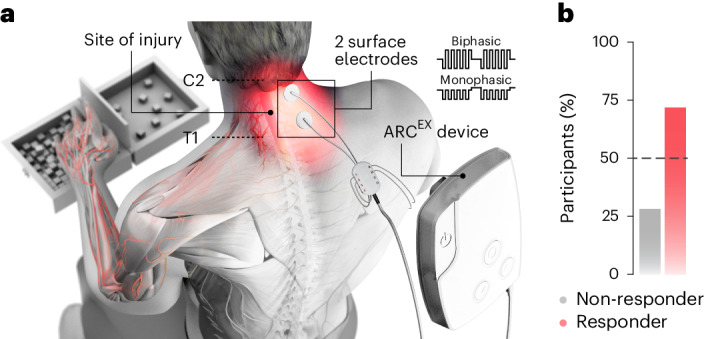
Fig. 1
Fig. 1. Overview and efficacy of ARCEX Therapy.
a, ARCEX Therapy consists of delivering externally applied electrical stimulation to the cervical spinal cord during structured rehabilitation. The stimulating electrodes are located above and below the injury. b, The primary effectiveness endpoint tested the hypothesis that the majority of the participants would demonstrate significant improvements in selected strength and functional performance domains from the end of the rehabilitation-alone period to the end of the ARCEX Therapy period.
Fig. 2
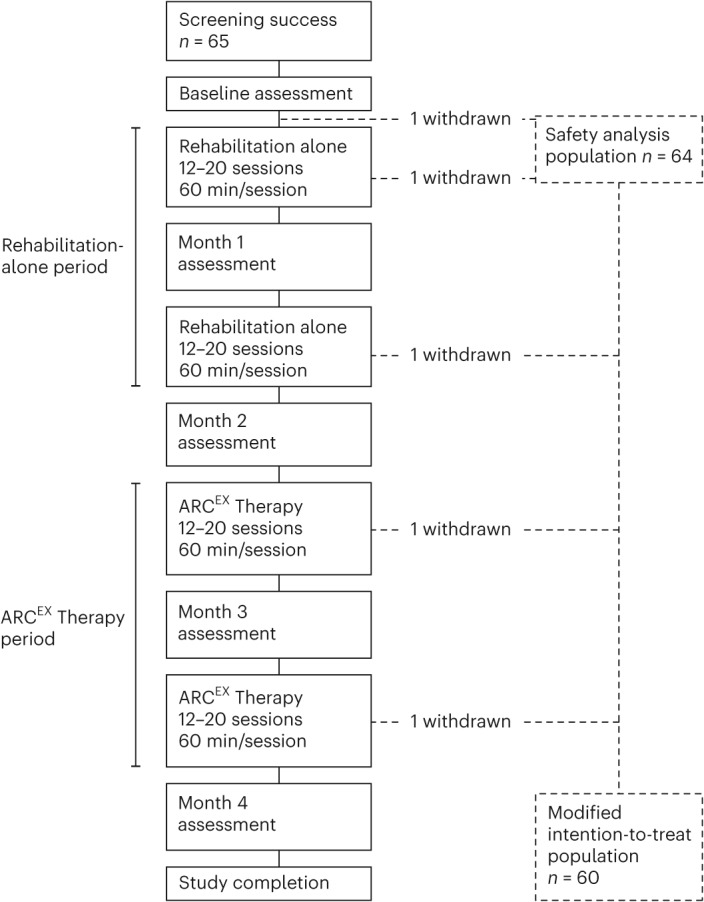
Fig. 2. Screening and treatment exposure during the Up-LIFT trial.
The Up-LIFT trial was a prospective, single-arm, multicenter, non-significant risk trial designed to evaluate the safety and efficacy of ARCEX Therapy to improve arm and hand functions in people with chronic cervical SCI. Participants were screened and enrolled after a baseline assessment. They then underwent a period of rehabilitation alone followed by ARCEX Therapy for the same period of time. Participants were considered to have completed the trial after finishing all sessions of rehabilitation alone, ARCEX Therapy and all study assessments.
Fig. 3
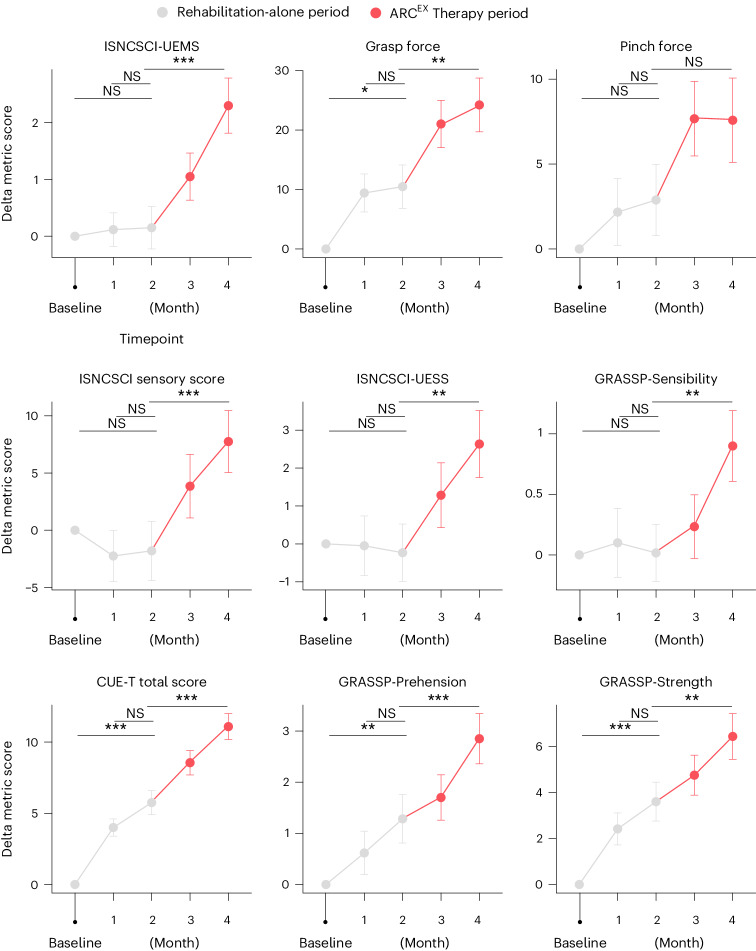
Fig. 3. Effect of ARCEX Therapy on force, sensory and functional performance.
Improvements in outcomes of strength and functional performance domains during the rehabilitation-alone period and during the ARCEX Therapy period. These results suggest that a longer period of ARCEX Therapy may promote additional benefits. Red color indicates the period of ARCEX Therapy. Statistics represent one-way repeated-measures ANOVA with Tukey’s HSD post hoc testing. *P < 0.05, **P < 0.01 and ***P < 0.001. NS, not significant.
Extended Data Fig. 1
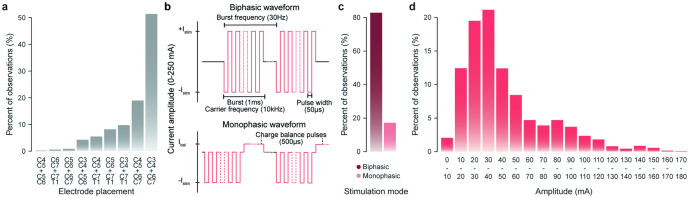
Extended Data Fig. 1. Location and stimulation parameters across study participants and sessions.
a, Location of the two cathodes with respect to spinal segments. b, Profile of electrical stimulation waveforms. c, Percent of sessions with monophasic versus biphasic stimulation models. d, Range of amplitudes delivered during ARCEX Therapy.
Extended Data Fig. 2
Extended Data Fig. 2. Responder status for each outcome of the strength and functional domains.
Participants were considered responders for each outcome (top panel) if they met the minimally important difference (MID), which was calculated as the change in score between the beginning of the ARCEX Therapy period and the end of the ARCEX Therapy period. The beginning of the ARCEX Therapy period coincides with the end of the rehabilitation alone period. Outcomes related to the functional domain included the Capabilities of Upper Extremity Test (CUE-T; MID = 4-point improvement) and the GRASSP Prehension Performance score (MID = 2-point improvement). Outcomes related to the strength domain included the Pinch force (MID = greater than or equal to 2.4N improvement), Grasp force (MID = greater than or equal to 6N improvement), the GRASSP Strength score (GRASSP-Strength; MID = 4-point improvement), and the International Standards for Neurological Classification of Spinal Cord Injury Upper Extremity Motor Score (ISNCSCI-UEMS; MID = 2-point improvement). To be classified as a ‘Function Responder’ or ‘Strength Responder’ participants must have met the MID criteria for at least one outcome in each domain. To be considered an ‘Overall Responder’, participants must have been classified as both a ‘Function Responder’ and a ‘Strength Responder’. Color indicates responder status for each row.
Extended Data Fig. 3
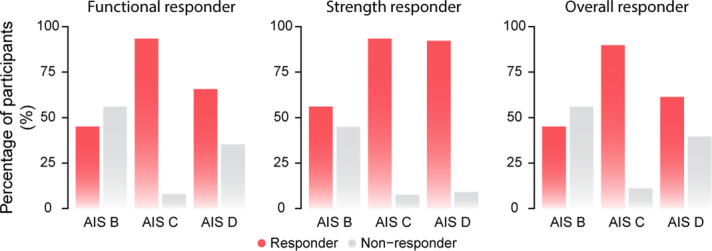
Extended Data Fig. 3. Influence of injury severity.
The percentage of participants classified as responders versus non-responders are classified based on their American Spinal Injury Association Impairment Scale (AIS) at enrollment.
Extended Data Fig. 4
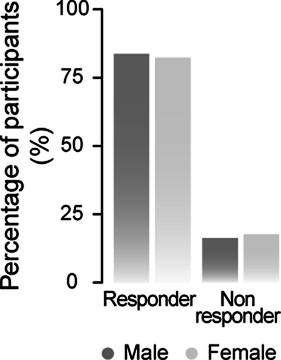
Extended Data Fig. 4. Influence of sex.
The percentage of participants classified as responders versus non-responders are classified by sex.
Extended Data Fig. 5
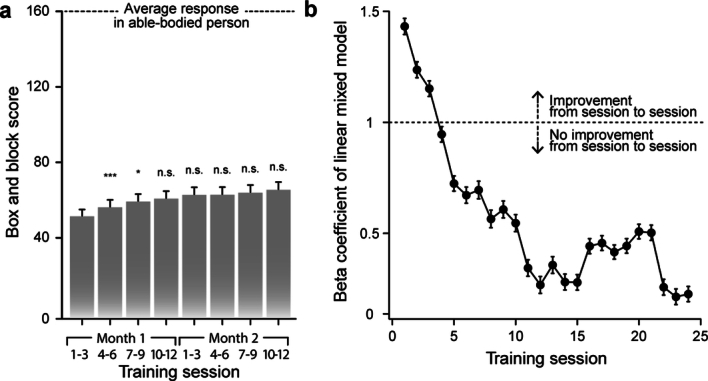
Extended Data Fig. 5. Improvements of hand and arm functions plateau in response to intense rehabilitation well before the end of the rehabilitation alone period.
a, During each training session, the participant completed the box and block test. These systematic quantifications allowed to monitor improvements in this task over the rehabilitation alone period. During the first three weeks of the rehabilitation alone period, we detected a significant increase in the scores in the box and block test, normalized to the baseline score at enrollment for each participant. No statistically significant improvement of scores was detected during the following 5 weeks of the rehabilitation alone period. Statistics refers to a repeated measures one-way ANOVA with post hoc testing using the Tukey HSD method. * indicates p < 0.05. ** indicates p < 0.01. *** indicates p < 0.001. n.s. indicates non-significant. Bar graph indicates mean and standard error of the mean for each time point. Statistics provided in Supplementary Data 3. b, A rolling linear regression coefficient was calculated from the score of each box and block test for each participant using a mixed model linear regression. The dotted line coincides with a coefficient of one, above which improvements remain linear. Dot represents the coefficient of the linear model at each timepoint, and the whiskers represent the standard error of the mean on this model. The linear relationship between training sessions and improvements of scores in the box and block test vanished after three weeks (12 sessions) of rehabilitation alone, wherein the coefficient approached 0. Together these findings reveal the occurrence of a plateau in the improvement of arm and hand functions after three weeks of rehabilitation alone. Since participants performed the box and block test during each session, the initial improvement observed may be partially attributed to increased familiarity with the test through repeated practice.
Extended Data Fig. 6
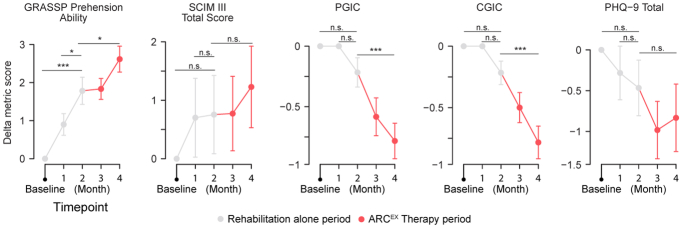
Extended Data Fig. 6. Effect of ARCEX Therapy on additional secondary outcomes.
Improvements in secondary outcome domains during the rehabilitation alone period, and during the ARCEX Therapy period. Lower values of PGIC, CGIC and PHQ-9 represent improved quality of life. These results suggest that a longer period of ARCEX Therapy may promote additional benefits. Red color indicates the period of ARCEX Therapy. Statistics represent one-way repeated measures ANOVA with Tukey HSD post-hoc testing. * = p < 0.05. ** = p < 0.01. *** = p < 0.001. Line graphs represent the mean and standard error of the mean for each outcome measure. Statistics provided in Supplementary Data 3.
Extended Data Fig. 7
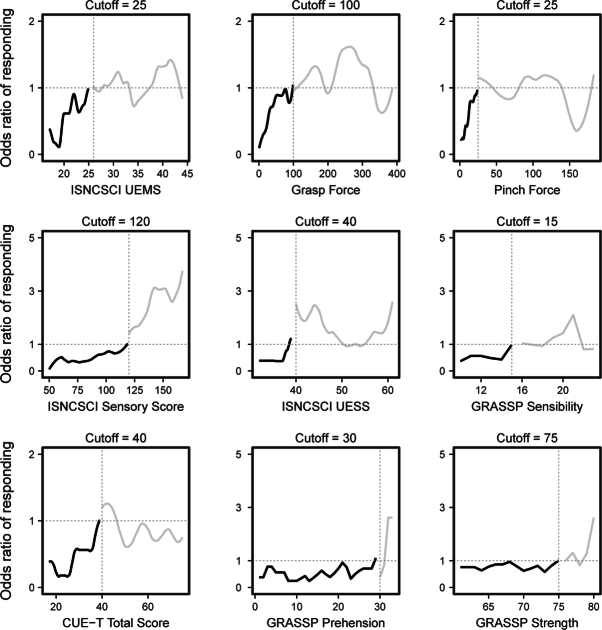
Extended Data Fig. 7. Identification of initial baseline characteristics that best predicted responder status.
This analysis included sequential logistic regression models whereby participants were binarized into two groups: above or below a single numerical threshold,. Odds ratios were then calculated, which reflected the odds of being a responder based on sequential thresholds for each outcome measure included in the primary and secondary effectiveness end points. The sequential models were halted when the odds ratio crossed 1 (black traces), indicating a threshold above which participants demonstrated positive odds of responding to ARCEX Therapy. This analysis revealed cutoffs for ISNCSCI-UEMS (cutoff = 25), Grasp force (cutoff = 100N), Pinch force (cutoff = 25N), CUE-T (cutoff = 40), ISNCSCI Sensory Score (cutoff = 120), ISNCSCI Upper Extremity Sensory Score (cutoff = 40), and GRASSP-Sensibility score (cutoff = 15).

References

    1. Anderson, M. A. et al. Natural and targeted circuit reorganization after spinal cord injury. Nat. Neurosci. 25, 1584–1596 (2022). - PubMed
    1. Courtine G, Sofroniew MV. Spinal cord repair: advances in biology and technology. Nat. Med. 2019;25:898–908. doi: 10.1038/s41591-019-0475-6. - DOI - PubMed
    1. Wilson J, Hashimoto R, Dettori J, Fehlings M. Spinal cord injury and quality of life: a systematic review of outcome measures. Evid. Based Spine Care. 2011;2:37–44. doi: 10.1055/s-0030-1267085. - DOI - PMC - PubMed
    1. Kokotilo KJ, Eng JJ, Curt A. Reorganization and preservation of motor control of the brain in spinal cord injury: a systematic review. J. Neurotrauma. 2009;26:2113–2126. doi: 10.1089/neu.2008.0688. - DOI - PMC - PubMed
    1. Gomes-Osman J, Cortes M, Guest J, Pascual-Leone A. A systematic review of experimental strategies aimed at improving motor function after acute and chronic. J. Neurotrauma. 2016;33:425–438. doi: 10.1089/neu.2014.3812. - DOI - PMC - PubMed

MeSH terms

Associated data