


Systematic review of patients' and healthcare professionals' views on patient-initiated follow-up in treated cancer patients
- PMID: 38771977
- PMCID: PMC10469665
- DOI: 10.1002/cam4.6243
Systematic review of patients' and healthcare professionals' views on patient-initiated follow-up in treated cancer patients
Abstract
Background: Current follow-up models in cancer are seen to be unsustainable and inflexible, and there is growing interest in alternative models, such as patient-initiated follow-up (PIFU). It is therefore important to understand whether PIFU is acceptable to patients and healthcare professionals (HCPs).
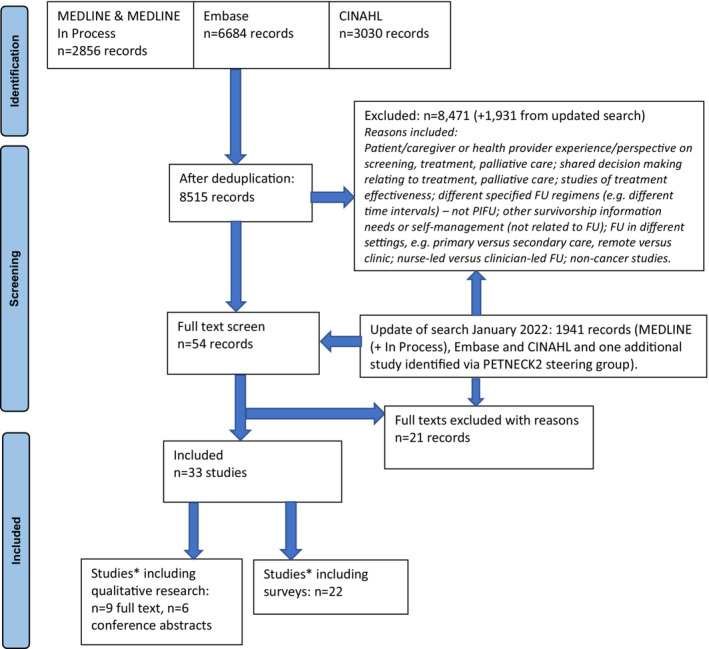
Methods: Standard systematic review methodology aimed at limiting bias was used for study identification (to January 2022), selection and data extraction. Thematic synthesis was undertaken for qualitative data, and survey findings were tabulated and described.
Results: Nine qualitative studies and 22 surveys were included, mainly in breast and endometrial cancer. Women treated for breast or endometrial cancer and HCPs were mostly supportive of PIFU. Facilitators for PIFU included convenience, control over own health and avoidance of anxiety-inducing clinic appointments. Barriers included loss of reassurance from scheduled visits and lack of confidence in self-management. HCPs were supportive of PIFU but concerned about resistance to change, unsuitability of PIFU for some patients and costs.
Conclusion: PIFU is viewed mostly positively by women treated for breast or endometrial cancer, and by HCPs, but further evidence is needed from a wider range of cancers, men, and more representative samples. A protocol was registered with PROSPERO (CRD42020181412).
Keywords: attitude; cancer; patient‐initiated follow‐up; qualitative research; survey; systematic review.
© 2023 The Authors. Cancer Medicine published by John Wiley & Sons Ltd.
Conflict of interest statement
Three of the authors (AL, HM and PN) are authors of one of the studies included in this systematic review. None of the other authors report any conflicts of interest.
Figures
References
-
- World Health Organization . WHO report on cancer: setting priorities, investing wisely and providing care for all. Geneva. 2020. Contract No.: Licence: CC BY‐NC‐SA 3.0 IGO.
-
- Amercian Cancer Society . Cancer survivorship. Available from: https://canceratlas.cancer.org/the‐burden/cancer‐survivorship/.
-
- Frew G, Smith A, Zutshi B, et al. Results of a quantitative survey to explore both perceptions of the purposes of follow‐up and preferences for methods of follow‐up delivery among service users, primary care practitioners and specialist clinicians after cancer treatment. Clin Oncol (R Coll Radiol). 2010;22(10):874‐884. - PubMed
Publication types
MeSH terms
Grants and funding
LinkOut - more resources
Full Text Sources
