


Investigation of the causal association between Parkinson's disease and autoimmune disorders: a bidirectional Mendelian randomization study
- PMID: 38774879
- PMCID: PMC11106379
- DOI: 10.3389/fimmu.2024.1370831
Investigation of the causal association between Parkinson's disease and autoimmune disorders: a bidirectional Mendelian randomization study
Abstract
Background: To date, an increasing number of epidemiological evidence has pointed to potential relationships between Parkinson's disease (PD) and various autoimmune diseases (AIDs), however, no definitive conclusions has been drawn about whether PD is causally related to AIDs risk.
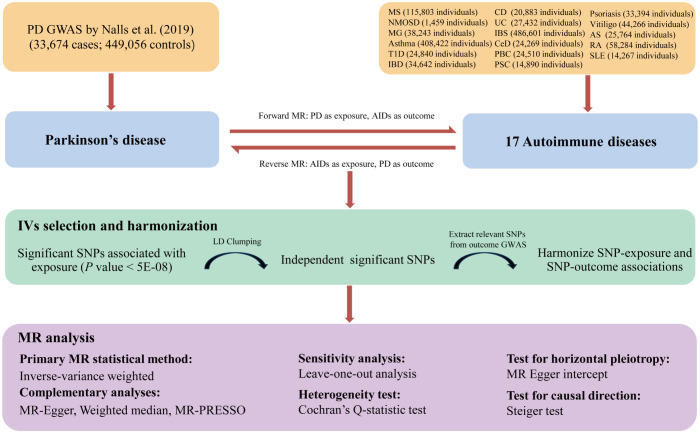
Methods: By employing summary statistics from the latest and most extensive genome-wide association studies (GWAS), we performed a bidirectional two-sample Mendelian randomization (MR) analysis to investigate the causal associations between PD and a variety of 17 AIDs, encompassing multiple sclerosis, neuromyelitis optica spectrum disorder, myasthenia gravis, asthma, inflammatory bowel disease, Crohn's disease, ulcerative colitis, irritable bowel syndrome, celiac disease, primary biliary cirrhosis, primary sclerosing cholangitis, type 1 diabetes, ankylosing spondylitis, rheumatoid arthritis, systemic lupus erythematosus, psoriasis and vitiligo. Inverse-variance weighted (IVW) was adopted as the main statistical approach to obtain the causal estimates of PD on different AIDs, supplemented by a series of complementary analyses (weighted median, MR Egger regression, and MR-PRESSO) for further strengthening the robustness of results.
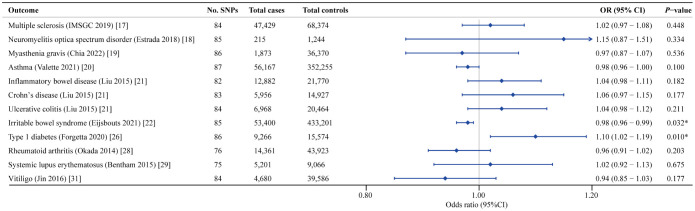
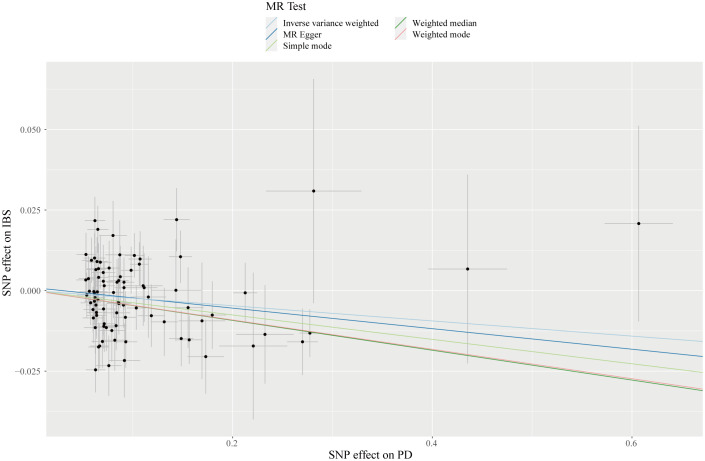
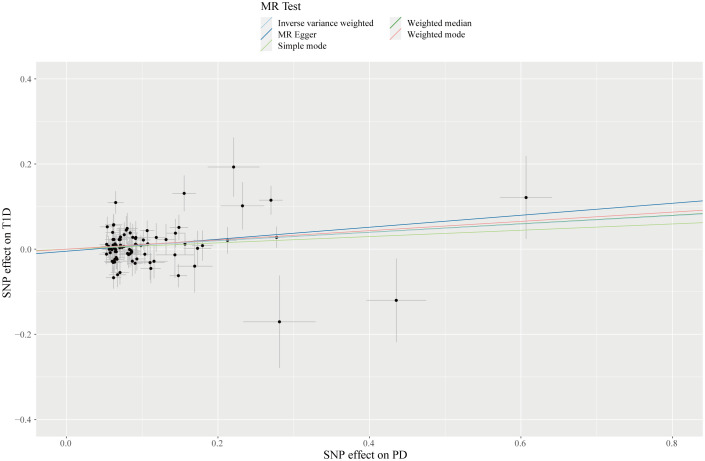
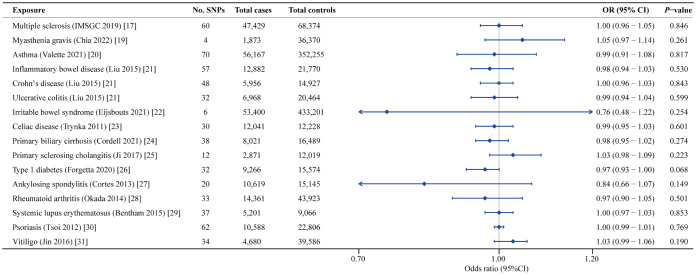
Results: Our MR findings suggested that genetically predicted higher liability to PD was causally associated with a decreased risk of irritable bowel syndrome (OR = 0.98; 95% CI: 0.96-0.99; P = 0.032). On the contrary, IVW analysis showed a potential positive correlation between genetically determined PD and the incidence of type 1 diabetes (OR = 1.10; 95%CI: 1.02-1.19; P = 0.010). Subsequent MR tests ended up in similar results, confirming our findings were reliable. Additionally, in the reverse MR analyses, we did not identify any evidence to support the causal relationship of genetic predisposition to AIDs with PD susceptibility.
Conclusion: In general, a bifunctional role that PD exerted on the risk of developing AIDs was detected in our studies, both protecting against irritable bowel syndrome occurrence and raising the incidence of type 1 diabetes. Future studies, including population-based observational studies and molecular experiments in vitro and in vivo, are warranted to validate the results of our MR analyses and refine the underlying pathological mechanisms involved in PD-AIDs associations.
Keywords: Mendelian randomization; Parkinson’s disease; autoimmune diseases; causal effect; irritable bowel syndrome; type 1 diabetes.
Copyright © 2024 Yang, Lin, Ma, Song, Mu, Wu, Han, Zhang and Liu.
Conflict of interest statement
The authors declare that the research was conducted in the absence of any commercial or financial relationships that could be construed as a potential conflict of interest.
Figures
References
-
- Cicchetti F, Brownell AL, Williams K, Chen YI, Livni E, Isacson O. Neuroinflammation of the nigrostriatal pathway during progressive 6-ohda dopamine degeneration in rats monitored by immunohistochemistry and pet imaging. Eur J Neurosci. (2002) 15:991–8. doi: 10.1046/j.1460-9568.2002.01938.x - DOI - PubMed
MeSH terms
LinkOut - more resources
Full Text Sources
Medical
Research Materials
