. 2024 Jul 1;79(7):1657-1667.
doi: 10.1093/jac/dkae161.

Azithromycin resistance in Escherichia coli and Salmonella from food-producing animals and meat in Europe

Affiliations

Azithromycin resistance in Escherichia coli and Salmonella from food-producing animals and meat in Europe

Mirena Ivanova et al. J Antimicrob Chemother. .

Abstract

Objectives: To characterize the genetic basis of azithromycin resistance in Escherichia coli and Salmonella collected within the EU harmonized antimicrobial resistance (AMR) surveillance programme in 2014-18 and the Danish AMR surveillance programme in 2016-19.

Methods: WGS data of 1007 E. coli [165 azithromycin resistant (MIC > 16 mg/L)] and 269 Salmonella [29 azithromycin resistant (MIC > 16 mg/L)] were screened for acquired macrolide resistance genes and mutations in rplDV, 23S rRNA and acrB genes using ResFinder v4.0, AMRFinder Plus and custom scripts. Genotype-phenotype concordance was determined for all isolates. Transferability of mef(C)-mph(G)-carrying plasmids was assessed by conjugation experiments.

Results: mph(A), mph(B), mef(B), erm(B) and mef(C)-mph(G) were detected in E. coli and Salmonella, whereas erm(C), erm(42), ere(A) and mph(E)-msr(E) were detected in E. coli only. The presence of macrolide resistance genes, alone or in combination, was concordant with the azithromycin-resistant phenotype in 69% of isolates. Distinct mph(A) operon structures were observed in azithromycin-susceptible (n = 50) and -resistant (n = 136) isolates. mef(C)-mph(G) were detected in porcine and bovine E. coli and in porcine Salmonella enterica serovar Derby and Salmonella enterica 1,4, [5],12:i:-, flanked downstream by ISCR2 or TnAs1 and associated with IncIγ and IncFII plasmids.

Conclusions: Diverse azithromycin resistance genes were detected in E. coli and Salmonella from food-producing animals and meat in Europe. Azithromycin resistance genes mef(C)-mph(G) and erm(42) appear to be emerging primarily in porcine E. coli isolates. The identification of distinct mph(A) operon structures in susceptible and resistant isolates increases the predictive power of WGS-based methods for in silico detection of azithromycin resistance in Enterobacterales.


Figures

Figure 1.
Figure 1.
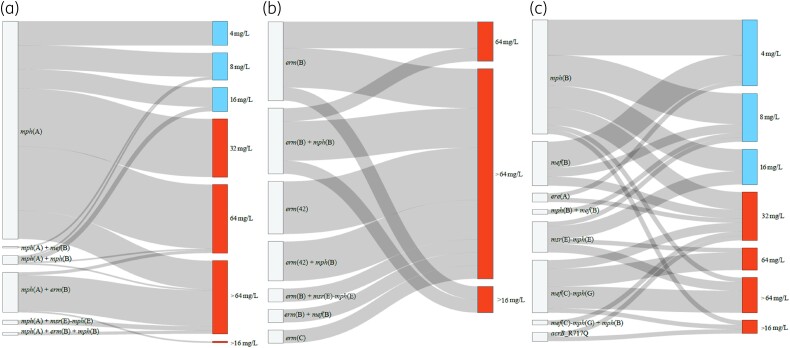
Sankey plots showing macrolide resistance genes/mutations and azithromycin MICs in the E. coli and Salmonella isolates in this study. mph(A) gene and its combinations with other macrolide resistance genes (a), erm genes and their combinations with other macrolide resistance genes (b), other macrolide resistance genes (c). The rplDV non-synonymous mutations detected in seven susceptible isolates were not included in the graph (Table S4). It is important to note that in resistant isolates harbouring mph(A) in combination with mph(B) or mef(B), the full mph(A) operon was present, and the promoter region was complete in all cases (Table S4). The 10 resistant isolates (MIC > 16 mg/L) without known azithromycin resistance mechanisms are not included in the graph. This figure appears in colour in the online version of JAC and in black and white in the print version of JAC.
Figure 2.
Figure 2.
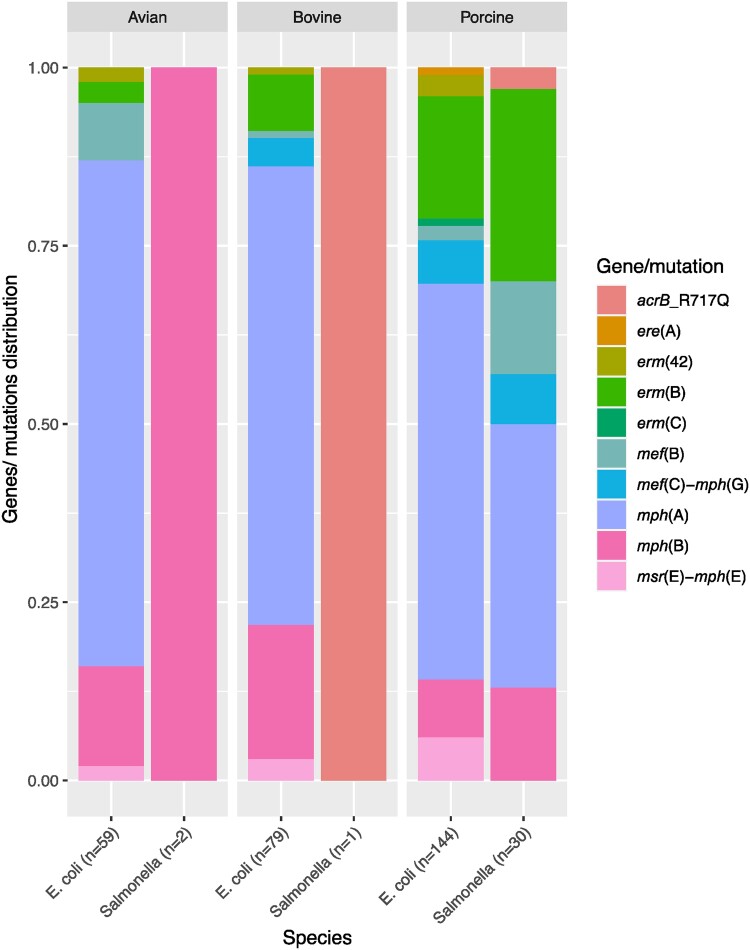
Distribution of macrolide resistance genes in E. coli and Salmonella isolates in this study according to their origin. Twenty-one percent (n = 51) of the isolates carried more than one macrolide resistance gene and are included under each of the genes they carry. The total number of genes in each species or from each source is given in parentheses. Two mph(A)- and two mph(B)-harbouring E. coli isolates for which isolation sources are not available are not included. This figure appears in colour in the online version of JAC and in black and white in the print version of JAC.
Figure 3.
Figure 3.
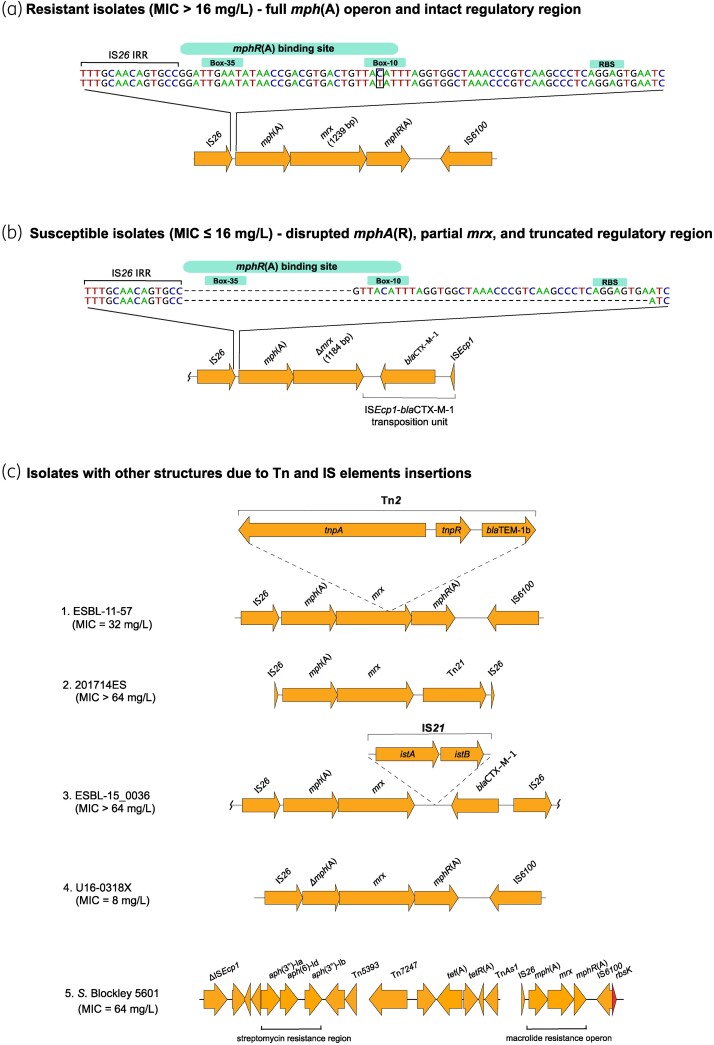
mph(A) operon structure in azithromycin-resistant isolates (MIC > 16 mg/L) (a), azithromycin-susceptible isolates (MIC ≤ 16 mg/L) (b), and in isolates with Tn and IS insertions (c). S. Blockley 5601 (c5) carries the mph(A) operon as part of an MDR region, consisting of the streptomycin resistance cluster aph(3′)-Ibaph(6)-Idaph(3′)-Ia and the tet(A) gene. NCBI blastn revealed 99.24%–100% identity and 100% coverage between the whole streptomycin and azithromycin resistance genomic region of S. Blockley isolate 5601 and S. Blockley strain 159383 (GenBank accession number CP043662.1: 4326383-4352831). The MDR region was reconstructed using Bandage (http://github.com/rrwick/Bandage). istA—IS21-like element IS21 family transposase IstA, istB—IS21-like element IS21 family helper ATPase IstB. In (a), the difference between the two sequences is T instead of C in the −10 region. Wavy lines at the end(s) of diagrams show where only part of the contig is included. This figure appears in colour in the online version of JAC and in black and white in the print version of JAC.
Figure 4.
Figure 4.
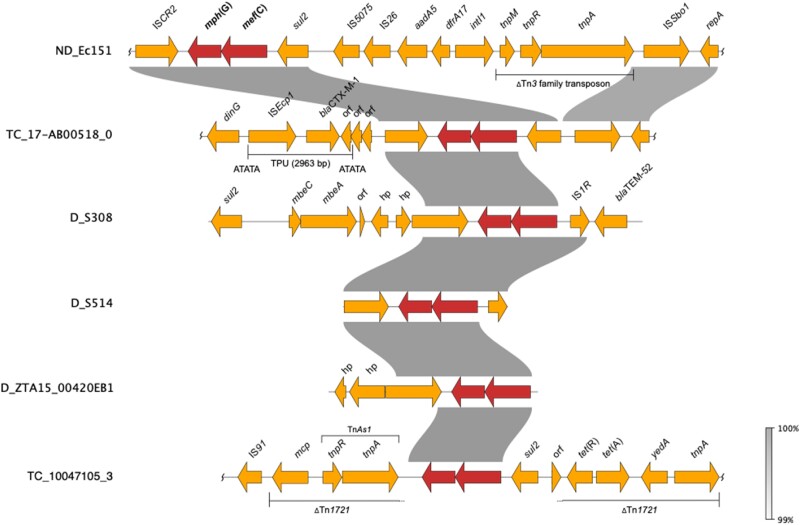
Comparative analyses of contigs harbouring mef(C)-mph(G) in E. coli and Salmonella. D, donor (included for isolates that did not yield TCs), ND, conjugation not performed. Wavy lines at the end(s) of diagrams show where only part of the contig is included. This figure appears in colour in the online version of JAC and in black and white in the print version of JAC.

References

    1. WHO . The WHO list of Critically Important Antimicrobials. 2019. https://www.who.int/groups/advisory-group-on-the-who-list-of-critically-....

    1. Hooda Y, Sajib MS, Rahman H et al. Molecular mechanism of azithromycin resistance among typhoidal Salmonella strains in Bangladesh identified through passive pediatric surveillance. PLoS Negl Trop Dis 2019; 13: e0007868. 10.1371/journal.pntd.0007868 - DOI - PMC - PubMed
    1. Lübbert C. Antimicrobial therapy of acute diarrhoea: a clinical review. Expert Rev Anti Infect Ther 2016; 14: 193–206. 10.1586/14787210.2016.1128824 - DOI - PubMed
    1. Darton TC, Tuyen HT, The HC et al. Azithromycin resistance in Shigella spp. in Southeast Asia. Antimicrob Agents Chemother 2018; 62: e01748-17. 10.1128/AAC.01748-17 - DOI - PMC - PubMed
    1. Timmermans M, Latour S, Ceyssens P-J et al. The AMR-ARRAY: a modular bead array detecting β-lactam, (fluoro) quinolone, colistin, aminoglycoside and macrolide resistance determinants in Gram-negative bacteria. J Microbiol Methods 2022; 196: 106472. 10.1016/j.mimet.2022.106472 - DOI - PubMed

Publication types

MeSH terms