


Characterization of new cellulosic fiber derived from Lasia spinosa (L.) thwaites rhizome and its potential use as biodegradable textile material
- PMID: 38778970
- PMCID: PMC11109880
- DOI: 10.1016/j.heliyon.2024.e31117
Characterization of new cellulosic fiber derived from Lasia spinosa (L.) thwaites rhizome and its potential use as biodegradable textile material
Abstract
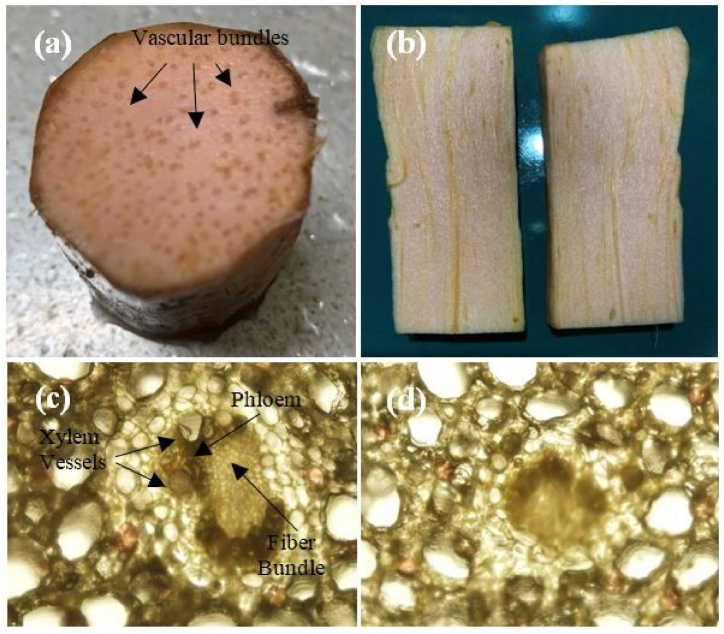
Fibers extracted from Lasia spinosa (L.) thwaites (LS) were characterized to investigate their potential use as biodegradable textile materials. Mechanical and alkali extraction methods were followed to extract LS rhizome fibers. The morphological, physical, chemical, mechanical, and thermal properties of the mechanically extracted rhizome fibers from the commonly available LS species of Lamina-dissected type [LDT] and Sagittate type [SG] were investigated. No previous studies have been done to characterize the LS rhizome fibers. Examination of rhizome fiber morphology using scanning electron microscopy (SEM) revealed that fibers within the dispersed vascular bundles of the rhizome possess a natural crimp.The FTIR result confirmed that the fibers are rich in cellulose. X-RD results confirm a 43 % and 58 % crystallinity index of LDT and SG fibers, respectively, indicating higher amorphous regions and lower crystal phases. Moisture regain of 12.5 % and 14.5 %, single fiber tensile strength of 213.92 MPa and 216.97 MPa, elongation at break of 16.65 % and 17.67 %, and Young's modulus of 1.32 GPa and 1.26 GPa were observed for LDT and SG fibers respectively. Thermogravimetric analysis confirmed thermal stability up to 230 °C for both fiber types confirming their ability to withstand textile processing.
Keywords: Crystallinity index; FTIR; Lasia spinosa (L.) thwaites; Scanning electron microscopy; Tensile strength; X-ray diffraction.
© 2024 The Authors. Published by Elsevier Ltd.
Conflict of interest statement
The authors declare that they have no known competing financial interests or personal relationships that could have appeared to influence the work reported in this paper.
Figures



References
-
- Toprak T., Anis P. Textile industry's environmental effects and approaching cleaner production and sustainability: an overview. J. Textile Eng. Fashion Technol. Aug. 2017;2(4) doi: 10.15406/jteft.2017.02.00066. - DOI
-
- Wright T., Mahmud-Ali A., Bechtold T. Surface coated cellulose fibres as a biobased alternative to functional synthetic fibres. J. Clean. Prod. Dec. 2020;275 doi: 10.1016/j.jclepro.2020.123857. - DOI
-
- Gapsari F., Purnowidodo A., Hidayatullah S., Suteja S. Characterization of Timoho Fiber as a reinforcement in green composite. J. Mater. Res. Technol. Jul. 2021;13:1305–1315. doi: 10.1016/j.jmrt.2021.05.049. - DOI
-
- Fletcher K. second ed. Routledge; New York: 2012. Sustainable Fashion and Textiles: Design Journeys; pp. 11–12.
LinkOut - more resources
Full Text Sources
Miscellaneous
