


Systematic review of recent advancements in antibody-drug and bicycle toxin conjugates for the treatment of urothelial cancer
- PMID: 38779496
- PMCID: PMC11110528
- DOI: 10.1177/17562872241249073
Systematic review of recent advancements in antibody-drug and bicycle toxin conjugates for the treatment of urothelial cancer
Abstract
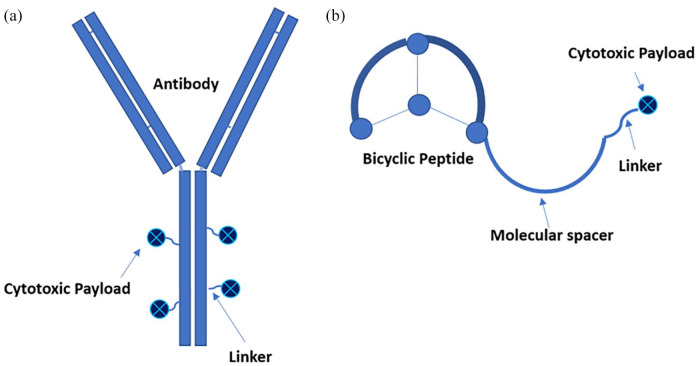
Antibody-drug conjugates and bicycle toxin conjugates represent a tremendous advance in drug delivery technology and have shown great promise in the treatment of urothelial cancer. Previously approved systemic therapies, including chemotherapy and immunotherapy, are often impractical due to comorbidities, and outcomes for patients with advanced disease remain poor, even when receiving systemic therapy. In this setting, antibody-drug and bicycle toxin conjugates have emerged as novel treatments, dramatically altering the therapeutic landscape. These drugs harness unique designs consisting of antibody or bicycle peptide, linker, and cytotoxic payload with more targeted delivery than conventional chemotherapy, thus eliminating malignant cells while reducing systemic toxicities. Potential targets investigated in urothelial cancer include Nectin-4, TROP2, HER2, and EphA2. Initial clinical trials demonstrated efficacy in treatment of refractory advanced urothelial cancer, as well as improvement in quality of life. These initial studies led to FDA approval of two antibody-drug conjugates, enfortumab vedotin and sacituzumab govitecan. Moreover, antibody-drug and bicycle toxin conjugates are being studied in ongoing clinical trials in frontline treatment of advanced disease as well as for localized cancer. These studies highlight the potential for additional future therapies with novel targets, novel antibodies, cytotoxic and immunomodulatory payloads, and unique structural designs enhancing efficacy and safety. There is increasing evidence that combinations with other cancer therapies, especially immunotherapy, improve treatment outcomes. The combination of enfortumab vedotin and pembrolizumab was recently approved for first-line treatment of advanced urothelial carcinoma. Despite the great promise of these novel drugs, robust predictive biomarkers are needed to determine the patients who would maximally benefit. This review surveys the rationale and current state of the evidence for these new drugs and describes future directions actively being explored.
Keywords: ASG-15ME; antibody-drug conjugates; bicycle toxin conjugates; bladder cancer; disitamab vedotin; enfortumab vedotin; sacituzumab govitecan; trastuzumab deruxtecan; trastuzumab emtansine; urothelial cancer.
Plain language summary
Review of recent advances in novel treatments of urothelial cancer Two new types of drugs, called antibody-drug conjugates (ADCs) and bicycle toxin conjugates (BTCs) have shown great promise in treating urothelial cancer. Both types of drugs consist of a structure targeting a specific protein on bladder cancer cells, linked to a drug that can kill cells. This allows for effective treatment of cancer with potentially less toxicity due to the targeted nature of these treatments. We discuss the potential targets in urothelial cancer and the drugs in these classes that could treat each target. Two of these drugs, enfortumab vedotin and sacituzumab govitecan, are in clinical use for cancers that have spread, while the others are in clinical trials. Moreover, the combination of enfortumab vedotin and pembrolizumab, an immunotherapy drug, has excellent results and was recently approved for first-line treatment of urothelial cancer that has spread. Additional studies are looking into these treatments for cancers that have not spread. In the future, management of side effects, determination of which patients benefit, and overcoming when the drugs become no longer effective will be important.
© The Author(s), 2024.
Conflict of interest statement
The authors declare that there is no conflict of interest.
Figures
References
-
- Lenis AT, Lec PM, Chamie K. Bladder cancer. JAMA 2020; 324: 1980–1980. - PubMed
-
- Mar N, Dayyani F. Management of urothelial bladder cancer in clinical practice: real-world answers to difficult questions. J Oncol Pract 2019; 15: 421–428. - PubMed
-
- Swami U, Grivas P, Pal SK, et al.. Utilization of systemic therapy for treatment of advanced urothelial carcinoma: lessons from real world experience. Cancer Treat Res Commun 2021; 27: 100325–100325. - PubMed
-
- Powles T, Park SH, Voog E, et al.. Avelumab maintenance therapy for advanced or metastatic urothelial carcinoma. N Engl J Med 2020; 383: 1218–1230. - PubMed
Publication types
LinkOut - more resources
Full Text Sources
Research Materials
Miscellaneous
