


Increased anterior insula connectivity associated with cognitive maintenance in amnestic mild cognitive impairment: a longitudinal study
- PMID: 38782876
- PMCID: PMC11582194
- DOI: 10.1007/s11682-024-00899-2
Increased anterior insula connectivity associated with cognitive maintenance in amnestic mild cognitive impairment: a longitudinal study
Abstract
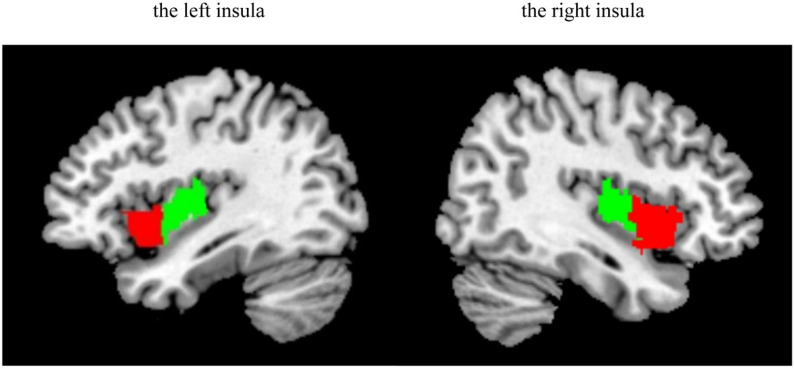
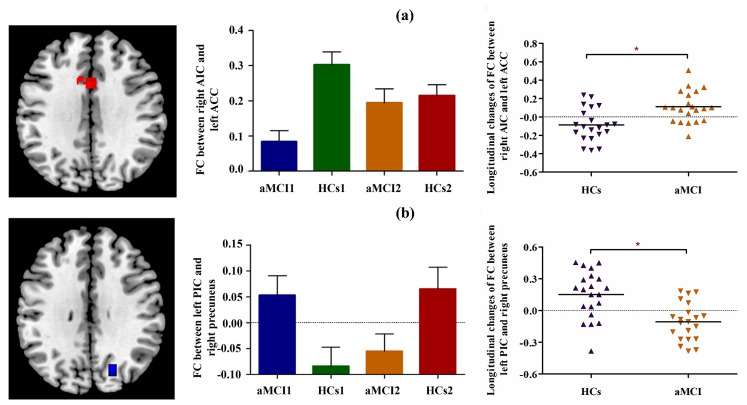
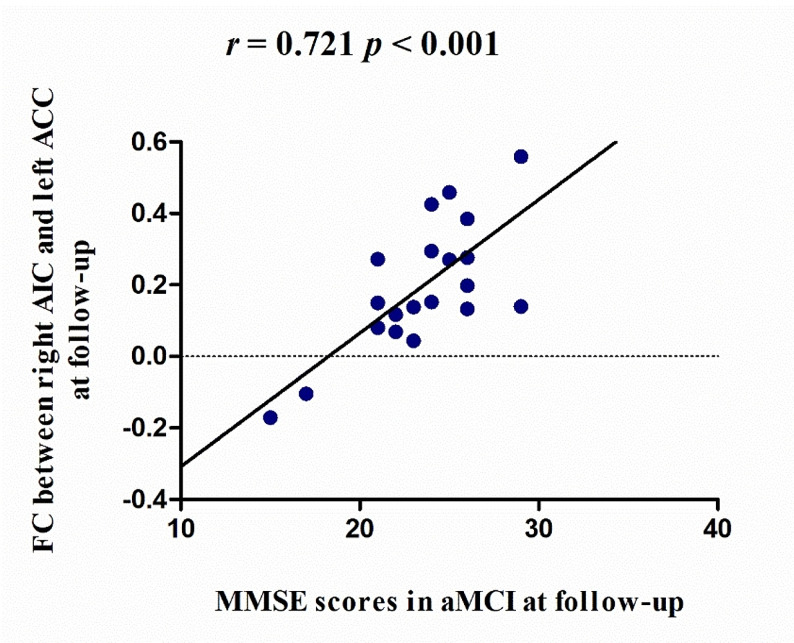
The insula, a crucial hub of the human brain network, can be divided into anterior and posterior regions. Previous studies have reported that different insula subregions play various roles in amnestic mild cognitive impairment (aMCI). However, the longitudinal changes in the functional connectivity (FC) of each insula subregion in aMCI patients over time remain unclear. Twenty aMCI patients and 20 healthy controls (HCs) were recruited and underwent resting-state functional magnetic resonance imaging (fMRI) scans and neuropsychological assessments at baseline and at the 15-month follow-up. FMRI data were preprocessed using SPM 12 and the CONN toolbox. Two-way analysis of covariance was used to compare longitudinal changes in the FC of each insula subregion with covariates including sex, age, education, follow-up interval, volume of gray matter, and global correlation (GCOR). Pearson's correlation was used to evaluate the relationship between insula subregional FC and neuropsychological performance in aMCI patients. In aMCI patients, the right anterior insula exhibited significantly increased FC with the left anterior cingulate cortex, whereas the left posterior insula exhibited decreased FC with the right precuneus compared with HCs. Furthermore, FC between the right anterior insula and left anterior cingulate cortex was significantly correlated with global cognition at follow-up. The current findings revealed different functional alterations in the insula subregions and provided new insights into the neurodegenerative process in aMCI patients.
Keywords: Amnestic mild cognitive impairment; Insula subregions; Longitudinal study; Resting-state functional connectivity.
© 2024. The Author(s).
Conflict of interest statement
Declarations. Ethical approval: All procedures in the studies involving human participants were performed in accordance with the ethical standards of the institutional and/or national research committee and with the 1964 Helsinki Declaration and its later amendments or comparable ethical standards. Competing interests: The authors declare no competing interests.
Figures
References
-
- Albert, M. S., Dekosky, S. T., Dickson, D., Dubois, B., Feldman, H. H., Fox, N. C., Gamst, A., Holtzman, D. M., Jagust, W. J., Petersen, R. C., Snyder, P. J., Carrillo, M. C., Thies, B., & Phelps, C. H. (2011). The diagnosis of mild cognitive impairment due to Alzheimer’s disease: Recommendations from the National Institute on Aging-Alzheimer’s Association workgroups on diagnostic guidelines for Alzheimer’s disease. Alzheimers Dement, 7(3), 270–279. 10.1016/j.jalz.2011.03.008. - PMC - PubMed
-
- Binnewijzend, M. A., Schoonheim, M. M., Sanz-Arigita, E., Wink, A. M., van der Flier, W. M., Tolboom, N., Adriaanse, S. M., Damoiseaux, J. S., Scheltens, P., van Berckel, B. N., & Barkhof, F. (2012). Resting-state fMRI changes in Alzheimer’s disease and mild cognitive impairment. Neurobiology of Aging, 33(9), 2018–2028. 10.1016/j.neurobiolaging.2011.07.003. - PubMed
-
- Biswal, B., Yetkin, F. Z., Haughton, V. M., & Hyde, J. S. (1995). Functional connectivity in the motor cortex of resting human brain using echo-planar MRI. Magnetic Resonance in Medicine, 34(4), 537–541. 10.1002/mrm.1910340409. - PubMed
MeSH terms
Grants and funding
LinkOut - more resources
Full Text Sources
Medical
