


Vitamin D level in COVID-19 patients has positive correlations with autophagy and negative correlations with disease severity
- PMID: 38783947
- PMCID: PMC11112027
- DOI: 10.3389/fphar.2024.1388348
Vitamin D level in COVID-19 patients has positive correlations with autophagy and negative correlations with disease severity
Abstract
Background and objectives: There is still incomplete understanding of the pathogenesis of COVID-19. Calcitriol, the main form of vitamin D in serum, regulates immune responses and increases resistance to pathogens, but the mechanism by which it protects against COVID-19 is uncertain. Autophagy has antiviral effects and helps to maintain homeostasis, but its specific role in COVID-19 is also uncertain. Both vitamin D and autophagy have important functions in the lung microenvironment. This study examined the relationship of serum vitamin D and autophagy-related proteins in patients with COVID-19 and evaluated their potential use as biomarkers.
Methods: Blood samples from COVID-19 patients at the Second Hospital of Jilin University were collected. The levels of vitamin D, autophagy-related proteins (Becline 1 [BECN1] and autophagy-related 7 [ATG7]), and inflammatory markers (TNF-α and IL-1β) were measured using enzyme-linked immunosorbent assays.
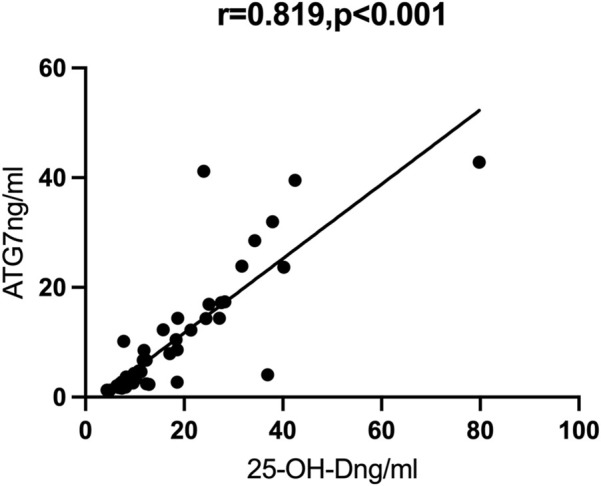
Results: We examined 25 patients with mild/moderate COVID-19 and 27 patients with severe/critical COVID-19. The group with severe/critical COVID-19 had more abnormalities in many laboratory indicators, including lower levels of autophagy markers (BECN1 and ATG7) and vitamin D, and higher levels of inflammatory markers (TNF-α and IL-1β). Partial correlation analysis showed that vitamin D had strong positive correlations with ATG7 (r = 0.819, p < 0.001) and BECN1 (r = 0.900, p < 0.001).
Conclusion: Our results demonstrated that the vitamin D level had significant negative correlations with COVID-19 severity and strong positive correlations with autophagy. These findings enhance our understanding of the pathogenesis of COVID-19, and provide a theoretical basis for clinical interventions that target autophagy and vitamin D.
Keywords: COVID-19; autophagy; mechanism; treatment; vitamin D.
Copyright © 2024 Dong, Hao and Gao.
Conflict of interest statement
The authors declare that the research was conducted in the absence of any commercial or financial relationships that could be construed as a potential conflict of interest.
Figures

Similar articles
-
Correlation of Plasma 25(OH)D3 and Vitamin D Binding Protein Levels with COVID-19 Severity and Outcome in Hospitalized Patients.Nutrients. 2023 Apr 10;15(8):1818. doi: 10.3390/nu15081818. Nutrients. 2023. PMID: 37111039 Free PMC article.
-
Vitamin D reduces autophagy by regulating NF-κB resistance to Aspergillus fumigatus infection.Gene. 2020 Aug 30;753:144819. doi: 10.1016/j.gene.2020.144819. Epub 2020 May 30. Gene. 2020. PMID: 32485309
-
Beclin-1, an autophagy-related protein, is associated with the disease severity of COVID-19.Life Sci. 2021 Aug 1;278:119596. doi: 10.1016/j.lfs.2021.119596. Epub 2021 May 10. Life Sci. 2021. PMID: 33984360 Free PMC article.
-
Vitamin D attenuates COVID-19 complications via modulation of proinflammatory cytokines, antiviral proteins, and autophagy.Expert Rev Anti Infect Ther. 2022 Feb;20(2):231-241. doi: 10.1080/14787210.2021.1941871. Epub 2021 Jul 15. Expert Rev Anti Infect Ther. 2022. PMID: 34112047 Free PMC article. Review.
-
Vitamin D supplementation for the treatment of COVID-19: a living systematic review.Cochrane Database Syst Rev. 2021 May 24;5(5):CD015043. doi: 10.1002/14651858.CD015043. Cochrane Database Syst Rev. 2021. PMID: 34029377 Free PMC article.
References
-
- Baranovskii D. S., Klabukov I. D., Krasilnikova O. A., Nikogosov D. A., Polekhina N. V., Baranovskaia D. R., et al. (2021). Prolonged prothrombin time as an early prognostic indicator of severe acute respiratory distress syndrome in patients with COVID-19 related pneumonia. Curr. Med. Res. Opin. 37 (1), 21–28. 10.1080/03007995.2020.1853510 - DOI - PMC - PubMed
LinkOut - more resources
Full Text Sources
