


Trends and projections of age-appropriate vaccination coverage in 41 low- and middle- income countries in Asia and Sub-Saharan Africa, 2000-2030
- PMID: 38784590
- PMCID: PMC11111938
- DOI: 10.3389/fpubh.2024.1371258
Trends and projections of age-appropriate vaccination coverage in 41 low- and middle- income countries in Asia and Sub-Saharan Africa, 2000-2030
Abstract
Introduction: Routine immunization programs have focused on increasing vaccination coverage, which is equally important for decreasing vaccine-preventable diseases (VPDs), particularly in low- and lower-middle-income countries (LMICs). We estimated the trends and projections of age-appropriate vaccination coverage at the regional and national levels, as well as place of residence and wealth index in LMICs.
Methods: In total, 174 nationally representative household surveys from 2000 to 2020 from 41 LMICs were included in this study. Bayesian hierarchical regression models were used to estimate trends and projections of age-appropriate vaccination.
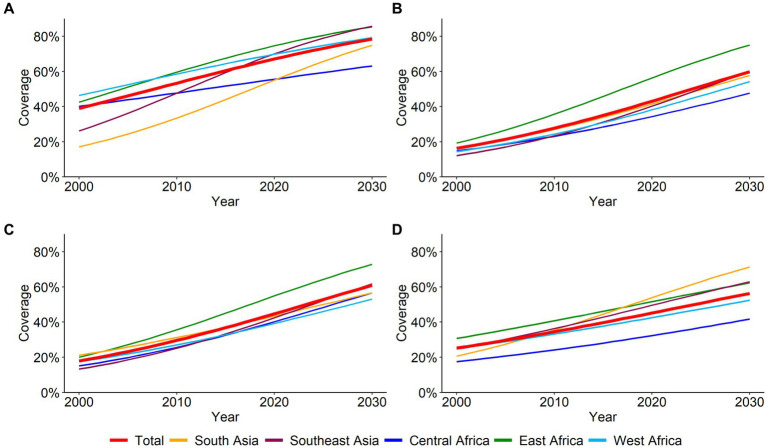
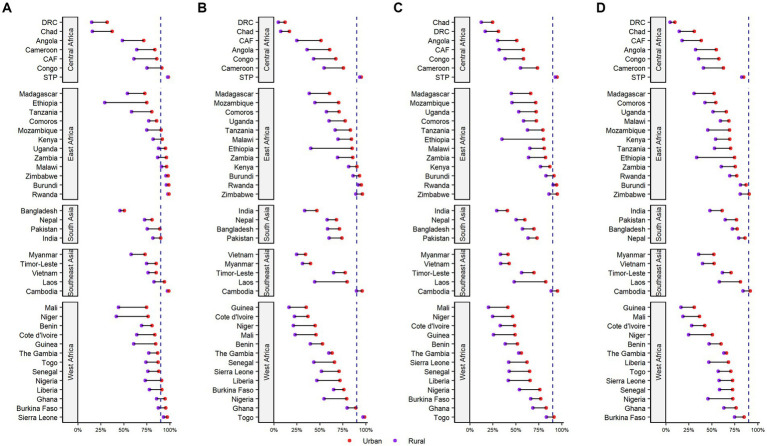
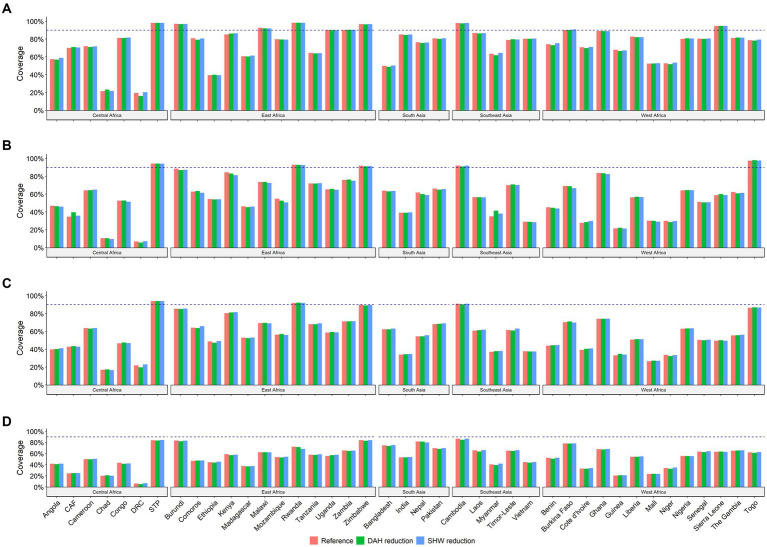
Results: The trend in coverage of age-appropriate Bacillus Calmette-Guérin (BCG), third dose of diphtheria, tetanus, and pertussis (DTP3), third dose of polio (polio3), and measles-containing vaccine (MCV) increased rapidly from 2000 to 2020 in LMICs. Findings indicate substantial increases at the regional and national levels, and by area of residence and socioeconomic status between 2000 and 2030. The largest rise was observed in East Africa, followed by South and Southeast Asia. However, out of the 41 countries, only 10 countries are estimated to achieve 90% coverage of the BCG vaccine by 2030, five of DTP3, three of polio3, and none of MCV. Additionally, by 2030, wider pro-urban and -rich inequalities are expected in several African countries.
Conclusion: Significant progress in age-appropriate vaccination coverage has been made in LMICs from 2000 to 2020. Despite this, projections show many countries will not meet the 2030 coverage goals, with persistent urban-rural and socioeconomic disparities. Therefore, LMICs must prioritize underperforming areas and reduce inequalities through stronger health systems and increased community engagement to ensure high coverage and equitable vaccine access.
Keywords: Bayesian model; VPDs; age-appropriate childhood vaccination; coverage; projection; trends.
Copyright © 2024 Islam, Rahman, Rahman, Abe, Akmatov and Hashizume.
Conflict of interest statement
The authors declare that the research was conducted in the absence of any commercial or financial relationships that could be construed as a potential conflict of interest. The author(s) declared that they were an editorial board member of Frontiers, at the time of submission. This had no impact on the peer review process and the final decision.
Figures
References
-
- Wang H, Bhutta ZA, Coates MM, Coggeshall M, Dandona L, Diallo K, et al. Global, regional, national, and selected subnational levels of stillbirths, neonatal, infant, and under-5 mortality, 1980–2015: a systematic analysis for the global burden of disease study 2015. Lancet. (2016) 388:1725–74. doi: 10.1016/S0140-6736(16)31575-6, PMID: - DOI - PMC - PubMed
-
- Lim SS, Stein DB, Charrow A, Murray CJ. Tracking progress towards universal childhood immunisation and the impact of global initiatives: a systematic analysis of three-dose diphtheria, tetanus, and pertussis immunisation coverage. Lancet. (2008) 372:2031–46. doi: 10.1016/S0140-6736(08)61869-3, PMID: - DOI - PubMed
-
- World Health Organization (2015). Together we can close the immunization gap. Available at: https://www.who.int/mediacentre/commentaries/vaccine-preventable-disease...
-
- World Health Organization . Immunization agenda 2030: A global strategy to leave no one behind. Geneva: WHO; (2020).
MeSH terms
LinkOut - more resources
Full Text Sources
