


Evaluation of the Safety and Efficacy of Repeated Mesenchymal Stem Cell Transplantations in ALS Patients by Investigating Patients' Specific Immunological and Biochemical Biomarkers
- PMID: 38785754
- PMCID: PMC11120501
- DOI: 10.3390/diseases12050099
Evaluation of the Safety and Efficacy of Repeated Mesenchymal Stem Cell Transplantations in ALS Patients by Investigating Patients' Specific Immunological and Biochemical Biomarkers
Abstract
Background: Amyotrophic lateral sclerosis (ALS) is an incurable disease. There are vigorous attempts to develop treatments to reduce the effects of this disease, and among these treatments is the transplantation of stem cells. This study aimed to retrospectively evaluate a mesenchymal stem cell (MSC) therapy cohort as a promising novel treatment modality by estimating some additional new parameters, such as immunological and biochemical factors.
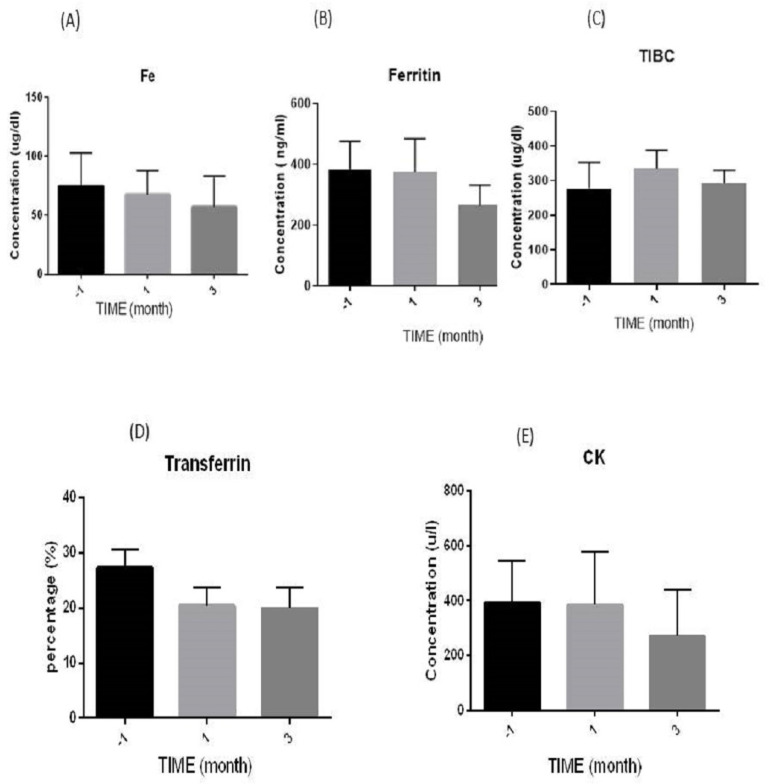
Methods: This study was designed as an open-label, one-arm cohort retrospective study to evaluate potential diagnostic biomarkers of repeated infusions of autologous-bone marrow-derived mesenchymal stem cells (BM-MSCs) in 15 confirmed patients with ALS, administered at a dose of 1 × 10⁶ cells/kg BW with a one-month interval, in equal amounts in both an intravenous (IV) and intrathecal (IT) capacity simultaneously, via various biochemical (iron (Fe), ferritin, total-iron-binding capacity (TIBC), transferrin, and creatine kinase (CK)) and immunological parameters (tumor necrosis factor-alpha (TNF-α), neurofilament light chain (NFL), and glial-cell-derived neurotrophic factor (GDNF) levels, evaluated during the three-month follow-up period in serum and cerebrospinal fluid (CSF).
Results: Our study indicated that, in the case of immunological biomarkers, TNF-α levels in the CSF showed a significant decrease at month three after transplantation compared with levels at month zero, and the p-value was p < 0.01. No statistically significant changes were observed for other immunological as well as biochemical parameters and a p-value of p > 0.05.
Conclusions: These results can indicate the potential benefit of stem cell transfusion in patients with ALS and suggest some diagnostic biomarkers. Several studies are required to approve these results.
Keywords: ALS; BM-MSC; GDNF; creatine kinase; ferritin; tumor necrosis factor-alpha.
Conflict of interest statement
The authors declare no conflicts of interest.
Figures

References
-
- ALS Managed Care ConsiderationsSantaniello, Briana. Am. J. Manag. Care. 2018;24:S336–S341. - PubMed
-
- Kwiatkowski Jr T.J., Bosco D.A., Leclerc A.L., Tamrazian E., Vanderburg C.R., Russ C., Davis A., Gilchrist J., Kasarskis E.J., Munsat T. Mutations in the FUS/TLS Gene on Chromosome 16 Cause Familial Amyotrophic Lateral Sclerosis. Science. 2009;323:1205–1208. doi: 10.1126/science.1166066. - DOI - PubMed
-
- DeJesus-Hernandez M., Mackenzie I.R., Boeve B.F., Boxer A.L., Baker M., Rutherford N.J., Nicholson A.M., Finch N.A., Flynn H., Adamson J. Expanded GGGGCC Hexanucleotide Repeat in Noncoding Region of C9ORF72 Causes Chromosome 9p-Linked FTD and ALS. Neuron. 2011;72:245–256. doi: 10.1016/j.neuron.2011.09.011. - DOI - PMC - PubMed
LinkOut - more resources
Full Text Sources
Research Materials
Miscellaneous
